
What the Laurel Means
The laurel — Laurus nobilis, the bay tree — is the deck's wreath of victory. Its meaning is older than tarot by some twenty-five centuries and arrives at Pamela Colman Smith's painting carrying a settled set of readings the picture only has to nod toward. First and most centrally, victory: the laurel crown was the prize of the Pythian Games at Delphi (every four years, instituted in the sixth century BCE) and, with adjustments, the prize of the broader Greek athletic and poetic competitions; the Roman triumph dressed the victorious general in laurel from the leaves at his brow to the branches in the hands of his soldiers. To wear laurel is to have completed something publicly enough that the polity has agreed on it. Second, sanctity: the tree is sacred to Apollo, the god of light, music, prophecy, and measured form. After the myth Ovid records in Metamorphoses I — Daphne, fleeing Apollo's pursuit, transformed at her own prayer into the laurel tree — the god takes the tree as his sign and binds its leaves to his hair. Victory and untouchability fuse in a single foliage.
Third, evergreen continuity: the laurel does not lose its leaves in winter. Pliny the Elder devotes a long passage in Naturalis Historia XV to its sacred botany — the only tree, he reports, never struck by lightning, planted at the door of Augustus's house, refused as fuel for any sacrificial fire because it crackles. The wreath is therefore not just "reward" but "the kind of completion that keeps living" — a closed shape that does not stop putting out leaves. Fourth, the philosophical schools refracted the same plant in opposite directions: Stoic thought reads the laurel as moral victory, the soul's triumph over the passions, while the Epicurean Garden reads it as intellectual attainment, the wreath given for arriving at the contemplative life. To paint laurel into a tarot scene is therefore to choose, with some precision, which of these registers is in play — public completion, divine sanction, evergreen permanence, moral victory, or intellectual repose. Smith uses all five across four cards.
How the Laurel Appears in the Deck
The laurel enters the Rider-Waite-Smith deck on four cards, and Smith uses it on each card to do a different job. On 0 The Fool, a laurel wreath sits on the wanderer's brow at the moment of departure. The reading is precise and a little startling: the victory is set on the head before the journey has begun. The laurel here is not earned at an end-point but worn at a starting-point — the figure is dressed for completion in advance, the way the unblemished are dressed for sacrifice or the chosen for coronation. The wreath is the deck's first sign that what looks like the beginning may already secretly be the end of an earlier arc.
On III of Cups, three women raise their cups in a circle dance among the harvest, and a small laurel wreath is woven into the picture at the top — friendship's victory, the joy that belongs to the group rather than to any individual. The wreath here is shared; nobody wears it alone. On Six of Wands, a horseback rider returns to a crowd, the rider's brow crowned with laurel and a second laurel bound to the lead staff. This is the deck's clearest image of public victory — the homecoming triumph, the polity's acknowledgement, the laurel that has just been received. It is also a quiet warning: the wreath is on the brow today, but the leaves dry and the moment passes; the rider rides on.
On XXI The World, the laurel reaches its most mythic deployment. The dancer at the center is enclosed by a great oval wreath of laurel — a closed shape that yet keeps putting out new leaves, two red ribbons binding it at top and bottom into the figure of the lemniscate, the two ends of the infinity sign. This is no longer a personal crown but a cosmic enclosure: the wreath as the seal on the entire arc of the major arcana, completion that is not an exit but the inside of a circle that goes on living. Read the four cards in order — Fool, Three of Cups, Six of Wands, World — and the laurel describes a single arc: the wreath set on the brow before the journey, shared among friends in the middle of the work, received in public after a victory, and finally enlarged into the very boundary that holds the World together. Victory begins as a private blessing, becomes a shared joy, becomes a public homecoming, becomes the shape the cosmos wears.
Cards That Carry the Laurel
Four cards in the deck place the laurel within the painted scene — at the threshold, in the circle dance, on the homecoming brow, around the dancing world. Its meaning shifts from anticipated to shared, to public, to cosmic.
Hover a pin to see where the symbol sits on the card.
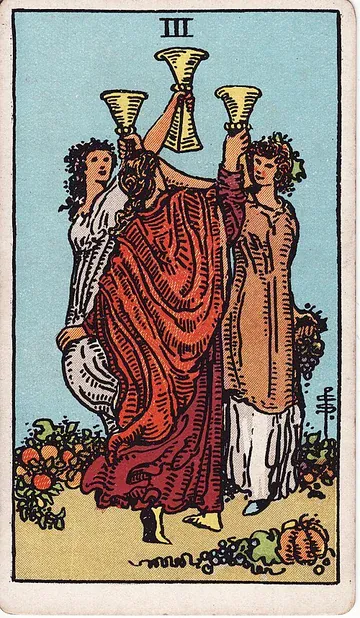
Three of Cups
On the Three of Cups a small laurel is woven into the harvest scene above the three women's raised cups — friendship's victory, the joy that belongs to the group rather than to any individual. Nobody wears it alone; the wreath is shared, the way the cups are touched together. This is the deck's quietest laurel — completion as the kind of evening when no single person is being celebrated.
· Read this card →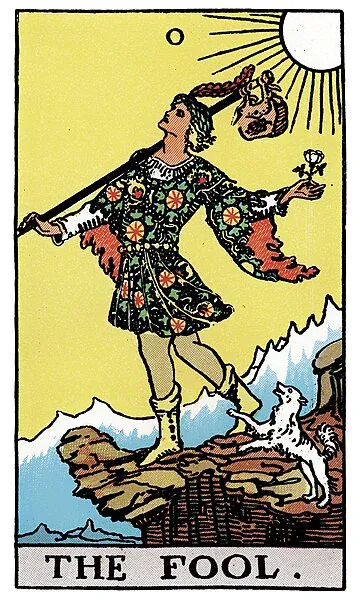
The Fool
On The Fool the laurel is already on the brow at the moment of departure — the victory worn before the journey, the way the unblemished are dressed before the rite. The deck's first sign that what looks like a beginning may already, secretly, be the end of an earlier arc. The wreath here is not a prophecy of victory; it is the visible mark that the figure was, before stepping out, already complete in some other register.
· Read this card →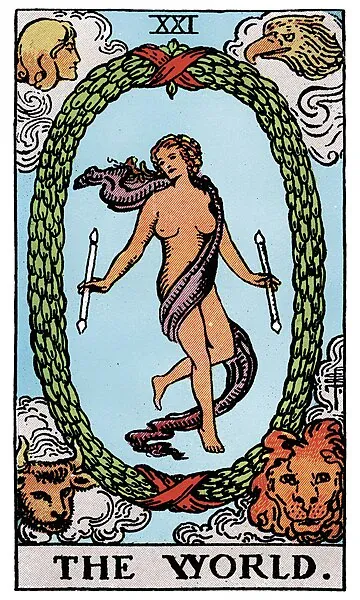
The World
On The World the laurel is the great oval wreath enclosing the dancer — a closed shape that yet keeps putting out new leaves, two red ribbons binding it top and bottom into the lemniscate. No longer a personal crown but a cosmic enclosure: the wreath as the seal on the entire arc of the major arcana, completion that is not an exit but the inside of a circle that goes on living.
· Read this card →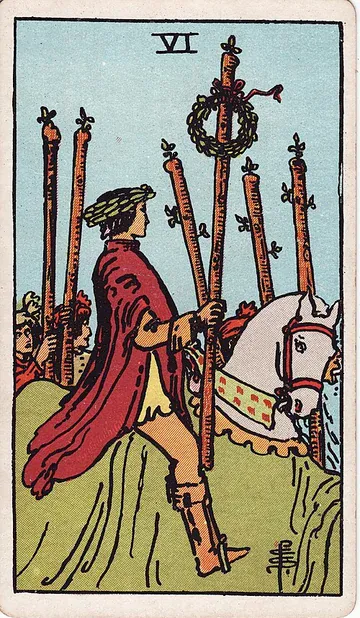
Six of Wands
On the Six of Wands the laurel is doubled — one wreath on the rider's brow, a second wreath bound to the lead staff. This is the deck's clearest image of public victory: the homecoming triumph, the polity's acknowledgement, the laurel that has just been received. The wreath is on the brow today, but the leaves dry and the moment passes; the rider rides on.
· Read this card →Other Symbols Nearby
The Laurel belongs to the Plant category — the painted growing things that frame and clothe the figures. Other plants in the deck thread parallel inheritances: the rose carries the Marian / Solomonic / courtly line, the pomegranate carries the Hellenistic / Hebrew fertility line. The laurel's lineage is distinct: classical, Apollonian, public — the wreath of completed contests rather than of bloomed interiors. Read the laurel against rose and pomegranate and the deck's botanical vocabulary resolves into three converging traditions.
Older Sources
The laurel's symbolic life begins in archaic Greece with the cult of Apollo at Delphi. Ovid sets down the foundational myth in Metamorphoses I.452-567, written down around 8 CE but drawing on much older Greek material: Apollo, struck by Cupid's arrow, pursues the nymph Daphne; she, struck by the lead arrow that repels love, flees in terror through the woods. As her strength fails she calls out to her father the river-god Peneus to destroy the form that has caused this trouble; her flesh becomes bark, her arms branches, her hair leaves, and she stands rooted as the first laurel tree. Apollo, arriving at the trunk, embraces the new tree and declares it forever sacred to him: his hair, his quiver, his lyre will all wear laurel; the leaves will crown the victors at his Pythian Games and the Roman triumphators in their day. The Greek word for the laurel — δάφνη, daphnē — is the nymph's name. To wear laurel in the classical world is to wear the form a desire took when it could not be received as itself; victory is, in this etymology, inseparable from a loss that became permanent.
Pliny the Elder, writing his Naturalis Historia in the 70s CE, devotes book XV chapters 39-40 to the laurel as sacred botany. He records that the laurel is the only tree never struck by lightning; that Augustus had laurels planted at the doors of the imperial palace; that laurel branches were carried at the head of the Roman triumph; that the leaves are refused as fuel for any sacrificial fire because they crackle and so are taken to break the silence the rite requires. The Pythian Games at Delphi awarded the victor a wreath of laurel rather than the olive of Olympia or the parsley of Nemea — the prize was the god's own foliage. By the Augustan age the laurel-bound general riding into Rome was the standard image of completed victory, and the laurel had become the empire's botanical signature for the moment of arrival.
The Hellenistic philosophical schools, several centuries later, refracted the same plant in opposite directions. The Stoa — Zeno, Chrysippus, and their successors — read the laurel as moral victory, the soul's triumph over the passions; to wear laurel in the Stoic mode is to have stilled the storms of grief, anger, and fear into the leaf that does not fall. The Garden of Epicurus read the same wreath as intellectual attainment, the sign of arrival at the contemplative life and freedom from anxious mythology — Lucretius in De Rerum Natura calls his master Epicurus's mind crowned with laurels for having walked beyond the flaming walls of the world. Two streams, one wreath, both still legible inside the same painted leaves. When Pamela Colman Smith placed laurel on four cards in 1909 — the Fool's anticipatory crown, the Three of Cups' shared joy, the Six of Wands' public triumph, the World's cosmic enclosure — she had this entire stack underneath her brush: Apollo's chosen tree, Daphne's transformed body, the Pythian victor's wreath, the Roman triumph, the Stoic moral victory, the Epicurean intellectual repose, Pliny's evergreen incorruptibility. The laurel does not need to choose among them; it carries them all.