
What the Pomegranate Means
The pomegranate is the deck's figure of fertility read through plurality. A single skin, a single fruit by name; cracked open, hundreds of seeds packed in honeycombed chambers. So its meaning is not the rose's — singular, opening, fragrant — but its inverse: a unity that contains a crowd, an outside that hides an inside that is already many. To read the pomegranate is to admit that what looks whole at the surface may be irreducibly plural at the core.
Across its two long traditions, the same paradox repeats. Greek myth makes the seed a binding agent — eat one, and you belong partly to the underworld for the rest of time. Hebrew temple architecture sets two hundred bronze pomegranates around the capitals of the entrance pillars, fertility braided into the threshold of holiness. The fruit's interior — many, hidden, slightly bloody when split — is what makes it unlike any other plant in the symbolic deck. It is fecundity that does not pretend to be simple.
How the Pomegranate Appears in the Deck
The pomegranate enters the Rider-Waite-Smith deck on a single card: III The Empress. It is not painted as fruit on a tree; it is patterned across her robe, repeated again and again, a textile of small red pomegranates against a paler ground. A.E. Waite's brief gloss in The Pictorial Key passes the symbol over quickly, but Pamela Colman Smith's choice to make the dress itself a field of seeds is the reading. The Empress is enthroned in a wheat field below a waterfall under Venus's shield; the pomegranates clothe her — they are how her body is read. Fertility here is not a single bloom but a worn pattern, a multiplicity carried close to the skin.
Read against The High Priestess on the previous card (II), where pomegranates also climb the curtain hung between her two pillars in some print runs of the deck, the fruit becomes a hinge between the two figures: the Priestess holds the seeds behind a veil, the Empress wears them openly. What was kept potential in II is brought to the body in III. The deck never lets the symbol drift far from this transition — knowledge of seed turning into the wearing of seed.
Cards That Carry the Pomegranate
One card in the deck places the pomegranate within the painted scene — III The Empress, where the fruit patterns the entire robe. Hover the pin to see exactly where on the image the seeded plurality sits.
Hover a pin to see where the symbol sits on the card.
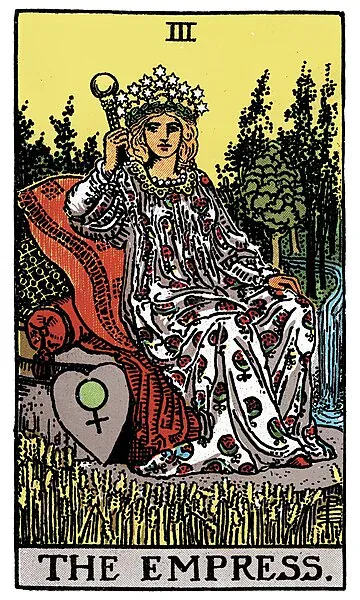
The Empress
On the Empress the pomegranates are not held but worn — repeated across the robe as a textile pattern. Smith's choice ties the figure's fertility to plurality and concealment in one gesture: the seeded fruit is closest to the body, but its interior remains painted-over, only its outside ever shown.
· Read this card →Other Symbols Nearby
The Pomegranate belongs to the Plant category — the painted growing things that frame and clothe the figures. Read these alongside it; rose and lily thread through the same Marian / Solomonic line.
Older Sources
The pomegranate's symbolic depth is older than the deck by some twenty-five centuries. The Homeric Hymn to Demeter, set down in Greek around the seventh century BCE, tells of Persephone abducted by Hades to the underworld; her mother Demeter, goddess of grain, withdraws her gift from the earth and the world goes barren. The compromise is brokered, but Persephone — under one reading reluctantly, under another by Hades's design — has eaten six pomegranate seeds, and so must return to the underworld for six months of every year. (Some later versions count seven.) The pomegranate becomes the binding seed: what you eat in the lower world claims you forever.
Three centuries earlier and a sea away, the Hebrew Bible records a different inheritance. 1 Kings 7:18-20 describes Hiram of Tyre wrought two hundred bronze pomegranates in two rows around the capitals of Jachin and Boaz, the twin pillars at the entrance of Solomon's Temple. Pomegranates are sewn onto the high priest's robe as well (Exodus 28:33-34). Here the fruit is a sign of consecration through fecundity — the threshold of the holy place is flanked, twice over, by the figure of multiplied seed.
By late antiquity these two streams converge. Christian iconography reads pomegranates in the Virgin's hand as the eucharistic sign of fruitful continence — Botticelli's Madonna of the Pomegranate (c. 1487) is the textbook instance — and in late-medieval Hermetic writing the fruit settles into a stable shorthand: one body, many seeds, the visible interior of the principle of generation. Pamela Colman Smith painting it across the Empress's robe in 1909 is the convergence point, where Hellenistic and Hebrew sources meet on a single textile and become wearable. The fruit on her dress is older than any individual mythos it carries.