
What the Rose Means
The rose is the deck's flower of double address. On the earthly register it speaks by color: red is passion and the spilled blood of devotion, white is purity and the unspoiled body, yellow is friendship, and the pair red-and-white set side by side is the deck's preferred device for naming desire and chastity in a single glance. The rose is the bloom that the troubadours sang to and the medieval glass painters set in cathedral windows; it is the figure of love that has been refined enough to be named in public. Where the pomegranate hides its plurality inside one skin, the rose opens its singular layered heart to be seen.
On the mystical register the rose changes weight. Christian iconography from late antiquity onward names the Virgin Mary the rosa mystica, the rose without thorn; the Rosicrucian writings of the early seventeenth century — Fama Fraternitatis (1614), Confessio Fraternitatis (1615) — set the rose joined to the cross as the central sigil of an inward European mystery stream; Dante closes the Paradiso with a vision of a celestial rose whose petals are the seats of the saints. Sufi poetry uses gulshan-i raz, the "rose garden of secrets," as the name for the contemplative interior. Read together these traditions make the rose the deck's one symbol that can be both wholly of this world and wholly of another, depending on which way the petals are turned.
How the Rose Appears in the Deck
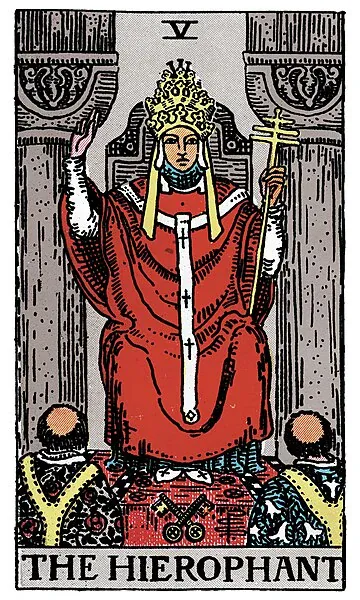
The rose enters the Rider-Waite-Smith deck on four cards, and Pamela Colman Smith uses it on each card to do a different job. On V The Hierophant, two acolytes kneel at the foot of the throne; one wears a robe embroidered with red roses, the other a robe embroidered with white lilies. The pairing is deliberate: red rose set opposite white lily, desire opposite purity, the two ranked acolytes who together inherit the lineage. The rose here is half a diagram — it works only against its lily counterpart — and the figure as a whole rhymes with the Boaz / Jachin pillars one trump up.
On the Ace of Pentacles a rose-covered arch leads out of the walled garden into a path beyond. Smith paints the roses dense across the trellis; the arch frames the gift the hand from the cloud is offering. The reading is precise: the gift is real, and the way to receive it is to stoop and pass under flowers — the rose is the threshold, and accepting the threshold is part of accepting the gift.
On the Page of Pentacles the rose returns as background — flowering on a trellis behind the young figure who studies the pentacle in his hands. The roses are not the focus; they frame the apprenticeship, the patient garden in which a coin can be carefully held without being immediately spent.
On the Nine of Swords the rose moves indoors, painted onto the quilt of the figure who sits up in bed unable to sleep. Among the zodiacal signs on the quilt are roses — the same flower that crowns the Magus and the High Priestess in Lévi's writings now reduced to a household textile under a body that cannot rest. The rose has not changed; what has changed is the room it is in.
Cards That Carry the Rose
Four cards in the deck place the rose within the painted scene — at the threshold, on the body, in the garden, on the quilt.
Hover a pin to see where the symbol sits on the card.
The Hierophant
On the Hierophant the rose is half a diagram — embroidered onto one acolyte's robe in red, set opposite the white-lily robe of the other. Desire and purity, ranked side by side; the figure works only as a pair. Read together the two robes make the same Boaz / Jachin balance the trump itself stands between.
· Read this card →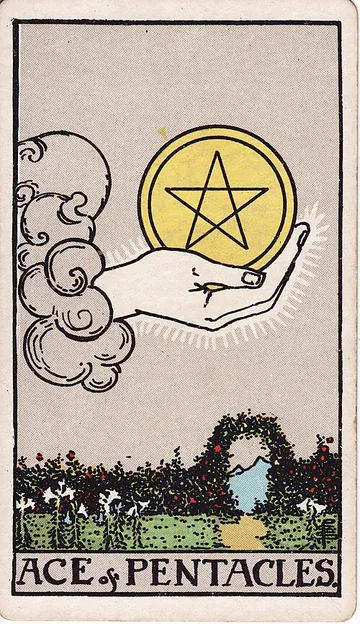
Ace of Pentacles
On the Ace of Pentacles the rose covers the arch through which the path leads out of the garden — a threshold that must be stooped through to be passed. The flowers are dense, not ornamental: accepting the gift is, in part, accepting the shape of the doorway.
· Read this card →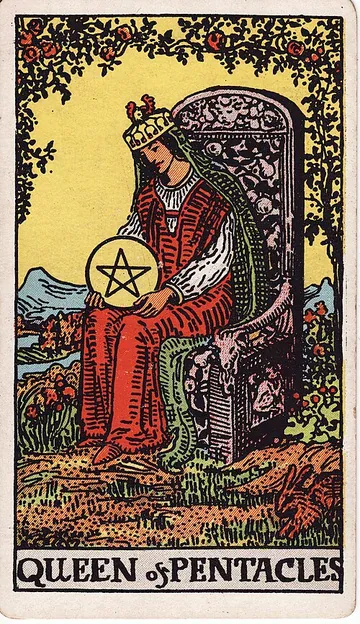
Queen of Pentacles
On the Queen of Pentacles the rose flowers behind the figure as garden bower — not the focus but the patient ground against which a coin can be carefully held without being immediately spent.
· Read this card →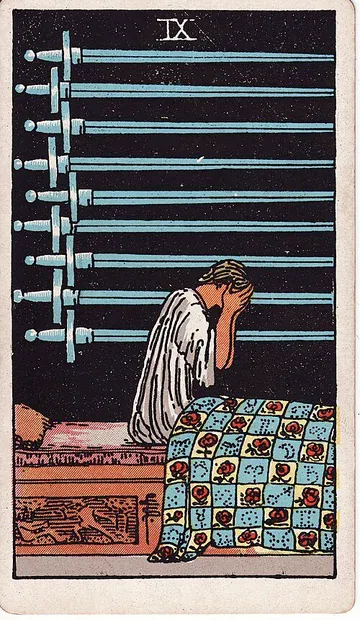
Nine of Swords
On the Nine of Swords the rose has moved indoors — painted onto the quilt that covers the figure sitting up in the dark. The same flower that crowns adepts in Lévi's writings is here a household textile under a body that cannot rest; the rose has not changed, the room has.
· Read this card →Other Symbols Nearby
The Rose belongs to the Plant category — the painted growing things that frame and clothe the figures. Other Plant symbols in the deck are listed below; pomegranate and lily thread through the same Marian / Solomonic line as the rose.
Older Sources
The rose's symbolic life is older than the deck by at least two millennia, and it arrives at Smith's painting carrying both a worldly and an otherworldly weight. The classical world made the rose the flower of Aphrodite — sprung, in one Greek myth, from the blood of her wounded lover Adonis — and so red was already, in the Hellenistic period, the color of desire that has spilled. By the late Middle Ages the Christian re-reading was complete: Marian piety named the Virgin rosa mystica, the rose without thorn, and her cult put roses into the windows of cathedrals from Chartres to Notre-Dame de Paris. Red roses were given to martyrs (the spilled blood baptized into devotion); white roses were given to virgins. The pairing the Hierophant card sets in front of the throne is exactly the medieval color-grammar.
The thirteenth-century French allegory Roman de la Rose, begun by Guillaume de Lorris around 1230 and continued by Jean de Meun around 1275, took the figure further: the entire poem is the dream of a lover seeking a single rose enclosed in a walled garden. The poem is courtly and erotic on its surface and a complete inward-mystical allegory underneath; it shaped the European imagination of the rose-as-beloved for the next four centuries. Dante, writing his Paradiso around 1320, closes the entire Divine Comedy with the vision in Canto XXXI of the celestial rose whose petals are arranged tier upon tier with the saints: the rose has become heaven itself, and the journey of the whole poem ends inside it.
Three centuries later the European mystery stream re-coined the figure once more. The anonymous Fama Fraternitatis, printed at Kassel in 1614, and the Confessio Fraternitatis of 1615, declared an invisible "Order of the Rosy Cross" and set the rose joined to the cross as the central sigil of an interior reformation. The Christian Rosenkreuz tradition that follows from these pamphlets — and through them, the eighteenth- and nineteenth-century occult revival, including Eliphas Lévi and the Golden Dawn — read the rose as the unfolding center of the cross of the elements: the four arms of matter and the single bloom of consciousness opening at the joint. When Pamela Colman Smith painted roses onto four cards in 1909, she had this entire stack underneath her brush — the courtly red and the Marian white, Roman de la Rose's enclosed garden, Dante's celestial rosa, the Rosicrucian rose-cross — and she did not need to choose between them. The flower carries them all.