· I ·
Ace of Swords
“The sword is drawn; false thoughts fall.”
Upright
Reversed
Identity
- Root of Element
- Air
- Essence
- The root of Air — the first clean edge before thought separates into kinds; the instant truth takes form.
Upright
Summary
Clarity breaks the fog.
A clean edge appears — what was blurred can now be named for the first time.
Reversed
Summary
The blade loses its aim.
The blade loses its direction — clarity hardens into cruelty, truth used to win rather than to clear; or the edge stays unsheathed in the mind, spinning into scorched thought.
Symbols
Story
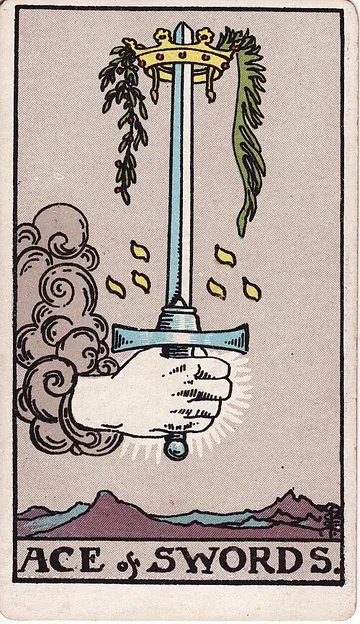
A hand extends from the clouds, gripping a double-edged sword held point-upward. The blade pierces a golden crown from which an olive branch and a palm frond hang — peace and victory suspended at the same fixture. Six motes of light descend along the two faces of the blade. Below, the mountains are serrated, as though freshly cut by some clarifying force. The air is thin, the silence near total — only the cold bright line along the edge remains.
Correspondences
- Element
- Air
- Color
- Silver-grey · frost-blue
- Direction
- East
- Season
- Spring
- Temperament
- Sanguine · quick and keen
- №
- 1
- Meaning
- One — origin; wholeness before division.
- Journey
- The spring of Air — the first clean edge before thought sorts itself into kinds.
- Color
- Silver-white · crystal clear
- Scent
- Mint · cedar dew
- Plant
- Mistletoe · ash tree
- Gem
- Clear quartz · topaz
- Metal
- Steel · quicksilver
- Animal
- Eagle · wild goose
- Time
- The first line of dawn · the first cold wind of morning
- Archetype
- The edge itself — distinguishing without destroying, naming without reducing.
- Figures
- Excalibur · the sword of Michael · the flaming sword at the gate of Eden
- Cultural Echo
- The sword Arthur drew from the stone was not won but recognized — its sovereignty appeared the instant its name was spoken.
Elemental Dignity
Air with Fire (Wands) is most quickening — thought feeds flame with oxygen, flame gives thought direction; with Earth (Pentacles) both wear each other down — analysis lightens weight, weight grinds analysis into idle circling; with Water (Cups) it raises waves, and is also dissolved by feeling into mist.
Shadow
The blade is drawn and cuts indiscriminately — clarity hardens into cruelty, truth used for winning instead of clearing. Or the reverse: the edge stays unsheathed, rusting in the mind into a scorched inner monologue.
Related Cards
Combinations with this card
· Elemental currents ·
Air & Air — when thinking begins to think itself
Two airs in one spread doubles the medium of cognition. Mind meets mind, plan meets plan, voice meets voice. The pairing tends to surface in spreads where the inquiry has been intensely mental — strategy, naming, debate, decision-tree work — and where the body has slipped quietly out of the conversation. The dialectic is not air versus a feeling card; it is air noticing how thoroughly it has filled the room. The journaling invitation is to find one anchor outside thought.
Air & Earth — thought meets ground
Air carries the plan; earth carries the weight. Together they form one of the deck's most workable dialectics — the question of how a clear idea finds a body it can actually live in. The pairing tends to surface where a clean mental design is meeting an embodied constraint: budget, schedule, terrain, biology, the tolerance of other people. Neither half is the obstacle. The work is translation, slow, between two grammars that can absolutely speak to each other when neither is asked to become the other.
Air & Fire — spark meets articulation
Fire wants; air names. Together they form one of the deck's most generative pairings and one of its most flammable. Articulation can give a desire its shape; the right sentence makes the next move possible. Articulation can also harden a desire too soon, locking a still-forming impulse into a premise it will quietly outgrow. The pair tends to surface around launches, declarations, public speech, and the months in which a new direction is moving from felt to spoken. The dialectic is timing, and how much oxygen the spark actually wants.
Air & Water — clarity meets feeling
Air clarifies, separates, names. Water gathers, mingles, holds. They are the two great solvents of the deck, working on different layers of the same situation. When they meet in a spread, one of them is usually being used to manage the other — thought to manage feeling, or feeling to manage the unbearableness of having to think. The pair tends to surface in seasons of grief, breakup, diagnosis, and any decision in which the data are clear but the heart is heavier than the data. The work is to let both have weight without collapsing one into the other.
· A QUIET LETTER ·