
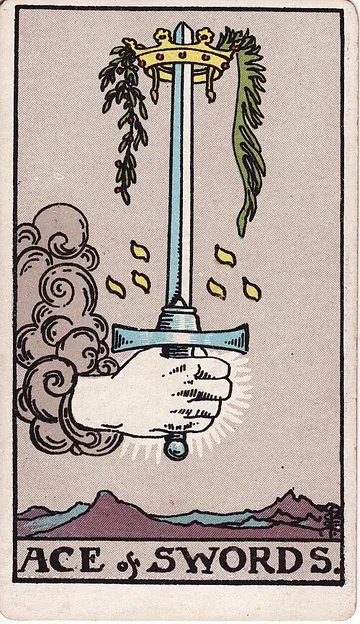
Ace of Swords Reversed · Core Meaning
The Ace of Swords reversed is the same image, inverted. The hand still extends from the cloud, the blade still rises, the crown still hangs at the point — but the point is now turned downward, and the orientation that made the upright card a card of clarity now makes the reversed card a card of clarity gone wrong in one of two specific ways. The blade has lost its aim. The seeker is holding the right tool and using it for the wrong work.
The first failure mode is honesty wielded as a weapon. The seeker has reached a real understanding — the analysis is correct, the diagnosis is true, the position is defensible — and is now using that real understanding to win an argument, score a point, embarrass another person, or settle an old account. Truth has shifted from a clarifying force to a prosecuting one. The blade is still sharp. The blade is no longer being used to name; it is being used to cut in the small, satisfying, ego-warming way that always feels justified in the moment and almost always damages something the seeker does not yet realize they care about.
The second failure mode is the opposite: the blade stays in its sheath, the sentence never gets said, the seeker spends weeks or months rehearsing a reply in their head that never makes it into the room. The clarity has been achieved internally. The articulation has been refused externally. The unspoken sentence does not vanish; it ferments. It becomes an internal monologue that grows louder and stranger over the weeks of its suppression. Eventually, when it finally comes out, it comes out distorted by everything that has been added to it during the suppression. This is the Ace of Swords reversed as overthinking — clarity rusting in the mind.
There is a third, subtler reading: the blade is being applied to the wrong object. The seeker has clarified something — what is wrong with their job, what is wrong with their family of origin, what is wrong with the political moment — and is now spending a great deal of energy on this clarity in a place where the clarity cannot do useful work, while the place where the clarity is actually needed (their own marriage, their own body, their own choice this week) goes unaddressed. The Ace of Swords reversed core meaning includes this kind of misdirection: real edge, wrong target.
The blade's element turns with the blade. Air, ungrounded, becomes the dry whirling of dust — discourse for its own sake, debate without referent, the conversation that has stopped being about anything except its own continuation. Kether of Yetzirah, when the blade flips, is the formative world spinning itself without a place to land. The seeker is asked to bring the spinning back into contact with the ground.
Reversed, the Ace of Swords asks: what is this blade actually for? And: who am I trying to win against? And: where is the unspoken sentence I have been refusing to say to the actual person it is meant for?
Ace of Swords Reversed · Love & Relationships
Turned over, the ace's edge finds two wrong targets in love: the person across the table, or the inside of your own skull. Either the truth has been used as a weapon — the clarifying sentence has become the prosecuting sentence — or the truth has stayed in the head, an unsaid script that has been quietly poisoning the climate between two people for months. The Ace of Swords reversed love meaning is not the absence of clarity; it is clarity misused.
For an existing partnership, the reversed card often describes the long pattern in which one partner has been keeping a running internal indictment of the other — every grievance noted, every small failure remembered, every disappointment catalogued — without ever bringing the indictment into a real conversation where it could be answered, repaired, or revised. The list grows in private. The partner being indicted is not given the chance to engage with the actual content of the indictment. The relationship slowly hardens around the silent prosecution. The Ace of Swords reversed warns of this pattern and asks for the conversation that turns the secret list into shared material.
The second pattern, the weaponized version, shows up in the partnership where one partner has begun to use sharp truthful observation as a regular instrument of injury. The observations are accurate. The accuracy is the problem. The reversed card asks the seeker to notice when the impulse to "just be honest" has shifted from a genuine attempt at clarification to a habitual small cruelty whose function is to remind the partner that they are being watched and judged. This is one of the more corrosive patterns the deck names. It is also one of the more curable, because the seeker who notices it can stop.
For a new connection in early months, the Ace of Swords reversed often describes the disclosure done badly — the honest sentence said too soon, in the wrong tone, without the relational ground to receive it. New connections are tender. The truth that the upright Ace would deliver as a clarifying gift becomes, in the reversed orientation, the truth that arrives like a small surgery on a body that had not yet decided to be a patient. The card asks for slower pacing. The same sentence, said in three months, may land. Said now, it overshoots.
For a single seeker asking about love after a wound, the Ace of Swords reversed often points at the inner script that has been running about the previous partner — all the things the seeker should have said, the comebacks rehearsed at three in the morning, the imagined courtroom scene in which the truth finally gets told. The card asks the seeker to notice that this internal trial is being staged because no real ending has been performed. The work is to stop the rehearsal and either say the actual thing once (in a letter that may or may not get sent) or release the script as a script. New love cannot move into a room that is being used as a courtroom.
For a love after wound that involves children or shared resources, the Ace of Swords reversed describes the negotiation that has been postponed too long. The legal conversation. The custody conversation. The financial division conversation. Each delay has accumulated cost. The card asks for the calm articulated meeting — not the dramatic confrontation, the calm one — at which the structural sentences finally get said.
When the question is whether someone loves you, a reversed ace asks you to read the silence rather than the warmth. They feel something. They are also withholding the saying of it — possibly because they are uncertain, possibly because they fear what saying it would commit them to, possibly because they have privately concluded a hard answer they do not want to deliver. The reversed card does not specify which. It does specify that the unspoken sentence is the actual content of the situation. You can wait for them to say it, or you can ask the question that makes the silence break. Both are valid. Continued ambiguity is not.
For polyamorous configurations, the Ace of Swords reversed often describes the agreements that have drifted out of articulation. Both partners have been operating on different private interpretations of what was decided last spring. The card asks for the renewal conversation — the one in which the actual current understanding is named, in plain words, by both people, and either confirmed or revised together.
For a long-distance relationship, the Ace of Swords reversed often points at the unspoken disagreement about the future that has been postponed across many calls. Both people have been keeping the conversation light because the heavier conversation feels too costly to have over a screen. The card warns that the postponement has its own cost. Pick the next visit and reserve the second evening for the conversation that has been waiting. Do not have it on the phone. Have it in the same room, with the question named in advance so neither person is ambushed.
A small particular caution for the Ace of Swords reversed in love: the seeker who is very good at language can use language to stay one step ahead of feeling. The reversed card sometimes points at the seeker who has produced a clear analytical account of the relationship — what is wrong, what is right, what should change — and who is using the analytical clarity as a substitute for the harder work of actually being present in the room with the partner. The card asks for the analysis to be set down for one evening. Sit with the partner. Do not produce the report. Notice what arises when the report is suspended. Often it is the actual feeling that the report had been organizing the seeker to avoid.
Ace of Swords Reversed · As Feelings
What a reversed ace shows, when the question is someone else's interior, is a sentence held behind the teeth — unspoken thought with an edge on it. They have arrived at a sentence about you — and they are not saying it. The card describes the interior in which the thought is being rehearsed, edited, postponed, or actively suppressed. Whatever they are not telling you is the content. The work, if there is work, is to find a way for the sentence to become safe to say.
If they are reserved, the Ace of Swords reversed in feelings often means a held criticism. They have noticed something specific — about your behavior, about your situation, about the relationship — and they have decided not to name it. Perhaps because they think it would not be received well. Perhaps because they are not sure they have the right to say it. Perhaps because they have decided that naming it is not worth the conflict. The result is the same: a quiet observation that lives in their head and does not enter the room. Read this as friction without explanation. Often the way out is to ask the direct question that makes the held observation safe to share.
If they are demonstrative, the Ace of Swords reversed in feelings can mean a complaint that has become public. They have been talking — to friends, to family, to the internet — about the situation that they have not directly addressed with you. The grievance has acquired an audience before it has acquired a conversation. The blade lands on this one, which is the blade's entire function. The card asks you to consider whether the right next move is to bring the conversation back from the audience to the room — to ask, gently, for the version of the observation said directly to you.
If they are intellectually intense by temperament, the Ace of Swords reversed in feelings often means they are spending a great deal of energy in their head about you — analyzing, theorizing, building a model — and almost no energy in their body or in the relationship. They feel something through thought rather than through sensation. The texture is real but distant. The card asks whether you want to be the subject of a study or the partner in a relationship. The conversation that turns one into the other is the work the reversed Ace is asking for.
For a partner of long standing, the Ace of Swords reversed in feelings can describe an indictment that has been growing in private. Years of unsaid observations. A list of small failures noted but never raised. The card warns that the silent list has reached a weight that can no longer be ignored. Either the list comes out — slowly, gently, in a real conversation that allows for response and repair — or the relationship begins to shift around the unaddressed weight. The card prefers the conversation. The conversation is hard. The alternative is harder.
For a new connection, the Ace of Swords reversed in feelings can mean a private hesitation. They like you. They are also noticing something — perhaps a small mismatch, perhaps a question about timing, perhaps a concern about a specific behavior — and they are weighing whether the noticing rises to the level of needing to be named. New connections often die in this exact moment because the noticing was not given air. Sometimes you can ask the question that gives it air. Sometimes the question itself is the thing that makes the answer no. The card respects either outcome more than the slow drift into silence.
For an ex you are reading on, the Ace of Swords reversed in feelings often describes the script they have been running about the relationship since it ended — the version of events they have refined, the lines they have practiced, the case they have built. The card warns that, if you talk again, the conversation will be partly with the script and partly with the actual person. Listen for which is which. The script is recoverable; the script can soften with real contact. But the first conversation will likely include some weeks of stored material that needs to be discharged before the actual exchange can begin.
A particular caution for the Ace of Swords reversed in feelings: do not try to extract the unspoken sentence with leading questions, repeated probing, or the small interrogations that ostensibly seek to clear the air but actually exert pressure. The reversed Ace closes further under pressure. It opens under invitation. The invitation looks like a calm statement of your own position, said once, without follow-up — "I notice we have been a little distant; I am here when you want to talk about it" — and then real silence. Real silence, not waiting silence. Genuine letting-be. The unspoken sentence is more likely to find air in real silence than in the silence that is obviously waiting for it.
Ace of Swords Reversed · Career
At work, a sharpened mind turned over becomes either a prosecutor or a hermit. Either the seeker has produced a sharp clear understanding of a workplace situation and is using the understanding as a weapon — to humiliate colleagues, to win meetings, to settle old accounts — or the seeker has produced the understanding internally and is refusing to bring it into the rooms where it could matter. Both failure modes show up under this card and both can be addressed.
For someone in a current role asking what is wrong, the Ace of Swords reversed often points at the diagnosis that has been complete for some time and that the seeker has been refusing to act on. You know what is wrong. You have known for months. The role is misaligned with the work you actually want to do. The boss is not someone who will ever see what you contribute. The team is going in a direction you do not want to follow. The internal sentence has been written. The reversed card warns that the cost of refusing to act on the sentence is not zero — every additional month adds friction that becomes harder to recover from. Either act, or honestly retract the diagnosis and decide to make peace with what is.
For someone considering whether to take a new role, the Ace of Swords reversed describes the seductive but partial analysis. The new offer looks good on the surface. The numbers are good. The title is good. The timing is good. The card warns that the analysis has not yet included the questions that would make it complete: do you want this work, or do you want the relief from your current work? Are you running toward something or away from something? What would you say about this role to a friend who knew you well? The reversed Ace asks for the harder questions to be added to the spreadsheet before the decision is finalized.
For an entrepreneur or freelancer, the Ace of Swords reversed often describes the business that has lost its sentence. The product was once clearly positioned. The work has slowly drifted into a hybrid that serves no one cleanly. The marketing tries to be everything to everyone. The card asks for the painful re-articulation: who is this for, what does it actually do, and what is the version with the most things cut. The drift can be reversed but only by deliberate cutting back to the sentence that started the work.
For a creative practice, the Ace of Swords reversed can describe the over-criticism that has stopped the work. The internal editor has become so loud that nothing reaches the page. The sentence that the upright Ace would have used to clarify the work is now being used to prosecute the work, sentence by sentence, before it can finish forming. The card asks for a season of writing without the editor — a notebook the editor is not invited to read, a sketchbook that is allowed to be bad, a daily practice whose only rule is that the editor stays out until the end of the year.
For a layoff or termination, the Ace of Swords reversed often describes the moment the seeker is rehearsing, in their head, the perfect speech they wish they had given on the way out. The card asks the seeker to notice that this rehearsal is taking real energy that could be spent on the next sentence — the one about what comes next. Write the unspoken speech in a private letter. Read it once. Burn it or file it. Then turn the page.
For a difficult colleague, manager, or report, the Ace of Swords reversed describes the conversation rehearsed too long. The seeker has been mentally practicing the confrontation for months. The reversed card warns that the fantasy version of the conversation has begun to substitute for the real one. The longer it is rehearsed, the more elaborate it becomes; the more elaborate it becomes, the harder it is to actually have. The card asks for a sharply simplified version. One sentence. One meeting. Said once, calmly, with the rehearsal abandoned at the door. The actual conversation will not match the rehearsal. That is fine. The actual conversation is the one that does the work.
For team leadership, the Ace of Swords reversed warns of the leader who confuses incisive criticism with leadership. The team has been receiving a steady diet of sharp observation about what is wrong. The leader has not noticed that the diet has started to suppress the work itself — people have begun to hide problems rather than surface them, to underclaim contributions to avoid being cut, to over-prepare every meeting because the meeting is going to feature a public dissection. The card asks the leader to put the blade down for a quarter. Praise specifically. Ask honestly. Let the team breathe. Sharp observation is a tool, not a default voice.
For a job search that has stretched into months, the Ace of Swords reversed warns of the over-articulate rejection of available roles. The seeker has produced a precise critique of every posting — wrong industry, wrong size, wrong stack, wrong location, wrong title. Each critique is defensible. The accumulated effect is that nothing meets the bar, and the bar has begun to function as a wall. The card asks the seeker to honestly examine whether the critiques are pointing at real disqualifications or whether they have become the structure that protects the seeker from re-entering work. Apply to one role this week whose critique you have already prepared. The application itself is the first crack in the wall.
For questions about authority, recognition, or promotion in the workplace, the Ace of Swords reversed describes the politics of the rooms above you. The decisions about you have been made in conversations you were not in. The understanding people have of your contribution has hardened in a particular shape that may or may not be accurate. The card asks for one direct conversation with the person who matters most — not to defend, not to promote yourself, but to ask the actual question: "what do you think I am here to do, and how are you measuring it?" The answer will tell you whether the misunderstanding can be corrected or whether you are working in a room that has decided who you are without your input.
Ace of Swords Reversed · Money
The unopened spreadsheet and the over-explained one are the same card inverted. Either the seeker has refused to look at the actual numbers — the spreadsheet has not been opened, the bank account has been quietly avoided, the bills have accumulated in a drawer — or the seeker has produced an over-articulate financial story that is functioning as a substitute for the harder work of actual decisions.
For someone managing debt, the Ace of Swords reversed warns of the avoidance that has hardened into a habit. The honest sitting with the spreadsheet has been deferred for so long that the avoidance has begun to feel structural. The card is not punishing the seeker; the avoidance is human. It is also no longer working. The card asks for one hour, this week, with the actual numbers, written down by hand, with no judgment and no plan — just the seeing. Plans can come later. The seeing is the only thing that makes plans possible.
For someone weighing a major purchase, the Ace of Swords reversed warns of the over-rationalized buy. The seeker has constructed a sophisticated argument for why the purchase is necessary, useful, an investment, deductible, time-saving, life-changing. The card asks whether the elaborate argument is doing the work of justification rather than analysis. A purchase that needs three paragraphs of rationale is usually a purchase that the body has already declined. The body's no can be overridden, but it should be overridden consciously, not by the accumulation of clever reasons.
For investments and speculation, the Ace of Swords reversed warns of the smart person's failure mode: the analysis that has become its own pleasure. The seeker has done extensive work on a thesis, has refined it through many drafts, has presented it to friends and received good feedback, and has begun to confuse the elegance of the analysis with the likelihood of being correct. The card asks for the simplest possible version of the thesis and the explicit articulation of what would prove it wrong. If the seeker cannot say what would prove the thesis wrong, the seeker does not have an investment thesis; the seeker has a story.
For a salary negotiation, the Ace of Swords reversed often describes the seeker who has prepared too thoroughly. The talking points have been drilled. The counter-arguments rehearsed. The script is so complete that the actual conversation can no longer happen — the other side responds in unexpected ways, the script does not cover the response, and the seeker either rigidly forces the script or abandons it for an unprepared improvisation. The card asks for less script and more real attention. Bring one number and one sentence. Listen carefully to the response. The negotiation is the conversation, not the recital.
For genuine financial scarcity, the Ace of Swords reversed asks for the unkind truth about which expenses are still actually voluntary. The story the seeker tells about the budget often includes several lines that are framed as fixed but are actually choices — the subscription that could be paused, the convenience that could be replaced with effort, the comfort that could be released. The card asks for one round of unflinching audit. Not all of the choices need to change. The audit just needs to be honest about which of them are still choices.
For windfall — inheritance, bonus, sale of an asset — the Ace of Swords reversed warns of the windfall deployed under pressure from old internal scripts. The seeker has been carrying, for years, a list of things they would do "if they ever had the money." The list was assembled by the version of the seeker who did not have the money and may not represent the wishes of the seeker who now does. The card asks for ninety days of holding the windfall before deploying any of it. Read the old list. Notice which items still feel true. Notice which items have aged into nostalgia for a self the seeker no longer is.
For business finances, the Ace of Swords reversed warns of the over-engineered budget. The seeker has built elaborate spreadsheets, multi-scenario models, sophisticated dashboards. The card asks whether the modeling has begun to replace the running of the business. Some of the most successful small businesses operate on a single sheet of paper. Some of the most over-modeled businesses fail because the modeling occupied the energy that was supposed to go into making the actual product good. The card favors the simpler version, deliberately maintained.
Ace of Swords Reversed · Health
Between the body's report and the mind's commentary on it, the reversed ace inserts either too much distance or far too little. Either the seeker has refused to name a real symptom — the appointment has been postponed, the worry has been carried in private, the body's report has been overridden — or the seeker has over-named, has spent so many hours researching, theorizing, and self-diagnosing that the actual signal from the body has been buried under a thick layer of explanation.
The Ace of Swords governs the throat and lungs and nervous system. Reversed, those are exactly the systems that may be reporting trouble. The breath has gone shallow and the seeker has not noticed. The throat has been tight for a season. The nervous system has been running at a rate above its true need and has begun to show the signs — sleep fragmenting, attention narrowing, small irritations becoming larger ones. The card asks the seeker to notice the body before constructing the story about the body. Sit. Breathe. Locate the place where the breath stops. Stay with the place. The story can come later.
For someone awaiting a diagnosis or test result, the Ace of Swords reversed warns of the catastrophizing rehearsal. The seeker has been mentally previewing every possible outcome, building the worst-case scenario in detail, planning the response to a result that has not yet arrived. The card asks for a moratorium on the rehearsal until the result is in hand. Real planning can begin when there is real information. Pre-planning around catastrophic fantasy consumes energy that the seeker will need for whatever the actual result requires.
For chronic conditions, the Ace of Swords reversed often describes the over-articulate management that has lost contact with the underlying body. The seeker has become an expert in their own condition — knows the literature, the protocols, the latest research, the practitioners. The expertise is real and useful. The card asks whether the expertise has begun to substitute for the simpler practices that originally made the difference. Sometimes the elaborate protocol is the right answer. Sometimes the elaborate protocol is the procrastination of the simpler thing — the daily walk, the eight hours of sleep, the consistent meals. The reversed card asks for an honest re-evaluation of what is actually doing the work.
For mental health questions, the Ace of Swords reversed often points at over-thinking that has begun to function as a coping mechanism. The seeker analyzes every feeling, narrates every interaction, theorizes every relationship, and the analysis itself has become a form of avoidance — the comfort of language used to keep the more difficult experience of feeling at arm's length. The card asks for periods of not thinking. Not new thinking. Not better thinking. Not thinking. Walks without a podcast. Meals without a screen. Hours in which the mind is not being asked to produce anything. These are not luxuries; they are the conditions under which the nervous system can finish what it has been trying to finish.
For someone managing a comfort behavior — alcohol, food, screens, scrolling — the Ace of Swords reversed warns of the elaborate rationalization that has been protecting the behavior from being seen. The seeker has constructed a sophisticated story about why the drinking is fine, why the snacking is fine, why the doom-scrolling is research. The card asks for the simplest possible question, written on a piece of paper: how much, how often, for what real purpose. The story collapses fairly quickly under the question. The collapse is uncomfortable. The collapse is also the door.
For acute issues — a recent injury, a new symptom, a worrying change — the Ace of Swords reversed warns against the temptation to manage the situation alone with internet research. The card explicitly favors the appointment with the actual practitioner. Search engines are an imperfect substitute for trained eyes. The card asks for the call to be made, the appointment to be scheduled, the second opinion to be sought. Then the research can resume — but as supplement to professional care, not as replacement.
A page that sends you toward a second opinion is not itself medical advice. The Ace of Swords reversed describes a relationship between language and body, not a treatment protocol. Keep your practitioners. Take your medicine. The card simply notices the place where words have begun to do the wrong work in relation to the body, and asks for a return to honest naming and honest listening.
Ace of Swords Reversed · Spirituality
A faculty built to sort the real from the not-real can be aimed, inverted, at everything except the person holding it. Either the seeker is using their developed clarity as a weapon against other people's traditions, teachings, and practices, or the seeker has produced a sophisticated internal critique of every available path that conveniently exempts them from committing to any of them.
The first failure mode is the spiritual seeker as cultural critic. The reading is sharp, the analysis of where various traditions go wrong is often correct, and the energy that could have been spent in actual practice is being spent instead in identifying the failures of teachers, lineages, communities, and books. The Ace of Swords reversed warns of this pattern with unusual gentleness. The criticism is real and sometimes important. The criticism is also not a substitute for practice. The reversed card asks the seeker to notice the moment when critique stops serving discernment and begins serving the avoidance of commitment.
The second failure mode is the seeker who has produced an articulate inner explanation for why no available path is worthy. Every teacher has a flaw. Every tradition has a problematic history. Every practice has a built-in compromise. The criticism is often substantive. The criticism is also functioning, in this seeker's life, as the structure that protects them from the harder work of actually entering a practice and being changed by it. The reversed card asks: are you finding flaws because the flaws are real and disqualifying, or because finding flaws is your way of staying outside the rooms where the change might happen?
For someone in active practice — meditation, prayer, ritual, devotional reading — the Ace of Swords reversed can describe the over-intellectualization of the practice. The seeker has read extensively about meditation and meditates inconsistently. The seeker has theorized prayer and rarely prays. The seeker has built a private taxonomy of the mystical traditions and entered none of them. The card asks for one practice, done daily, for thirty days, without commentary. Not the right practice. Any practice. The reversed Ace recovers its upright position through the body of doing, not through more analysis.
For seekers exploring belief, the Ace of Swords reversed warns of the seductive sophistication of agnosticism as a permanent position. There are rigorous reasons to remain agnostic about ultimate questions. There are also defensive reasons — the wish not to be wrong, the wish not to look credulous, the wish not to commit to anything that might require change. The card asks the seeker to honestly examine which is operating. Rigorous agnosticism remains an honorable position. Defensive agnosticism is a different thing wearing the rigorous one's clothes.
For questions about teachers, lineages, or communities, the Ace of Swords reversed often points at the moment when the seeker's discernment about a teacher has become the topic that organizes their spiritual life. The seeker is no longer learning from the teacher; the seeker is conducting an ongoing internal evaluation of the teacher. The relationship has shifted from study to surveillance. The card asks: is this evaluation pointing at a real disqualification that should lead to leaving, or is it the small chronic activity that has replaced the actual work of receiving the teaching? Both are possible. The honest answer to the question changes what the seeker should do next.
The mythic resonance of the Ace of Swords reversed is the named blade misused. Excalibur in the wrong hands becomes another piece of metal. Michael's sword, swung at the wrong target, becomes a weapon. The flaming sword at Eden, if it left its post, would no longer guard anything. The card asks the seeker to remember what the blade is for — distinction without destruction, naming without reducing — and to return the blade to its proper work.
A small practice when this card appears in spirituality: choose one critique you have been making — of a teacher, a tradition, a community, a friend's practice — and set it down for a season. Do not retract the critique. Just stop running it. Notice what energy is freed. Notice what other questions become available now that the critique is not taking the room. The reversed Ace returns to upright through this kind of deliberate quiet.
Ace of Swords Reversed · Yes or No
A no that is really a request — name the question first.
The reversed Ace of Swords rarely hands over a clean no. It is more often the answer that arrives after the seeker has refused to either name the question clearly or accept the answer that has been visible for some time. The card describes the situation in which the seeker has been arguing with their own clarity, and the reversed Ace asks for the argument to end.
For yes-or-no questions about whether to act — should I take the offer, should I send the message, should I make the move — the reversed Ace usually answers no, but with a particular condition. The no is not against the action; the no is against the action taken in this state of mind. The reversed Ace warns of the action taken from confusion, from rehearsed grievance, from the wish to settle a score, from the over-engineered analysis that has lost contact with the underlying impulse. The card asks for the action to wait until the seeker has either clarified the underlying state or made peace with not having clarified it.
For yes-or-no questions about whether something is true — is this person being honest, is this offer real, is this opportunity what it appears — the reversed card warns that the surface and the substance may not match. Something is being withheld. Something has not been said. The card does not accuse anyone of dishonesty in the criminal sense; it observes that the situation contains an unspoken sentence that, if surfaced, would change the picture. Ask the question that surfaces it. The answer to the original question depends on the surfaced material.
For questions about timing — will it happen soon — the reversed card answers no, not in the timeline you imagine, unless the underlying delay is addressed. The thing you are waiting for has been waiting on a sentence that has not yet been said by either party. Until the sentence is said, the timeline does not begin. Once said, it can move quickly.
For questions about whether to wait — should I pause, should I hold, should I let it ripen — the reversed card sometimes says yes, more often says no in disguise. The waiting that the seeker is considering is often a waiting that has begun to function as avoidance. The card asks the seeker to honestly distinguish the wait that gathers from the wait that postpones. The wait that gathers is real. The wait that postpones is the absence of a decision that the seeker is unwilling to make.
For questions about whether you deserve what you are asking for, the reversed Ace warns that the question itself is poorly formed. Deserving is not the right question for the reversed card. The right question is: what do I actually want, and what would saying it cost me? The cost question is the one being avoided. The card asks for the cost question to be sat with, plainly, until the answer is available. Then the original question can be re-asked, and the new framing usually has its own answer.
The Ace of Swords reversed in yes-or-no questions has one consistent instruction: do not act on the answer until you have sat with what you have been refusing to say. The action that follows that sitting will be a different action from the one you were considering. The card does not promise that the new action will be easier. It promises that it will be honest.
Ace of Swords Reversed · Advice
Put the blade down. Not forever, and not as an apology — for the length of one season. The seeker who draws this card is usually someone who has been wielding their clarity in a way that is no longer producing clarity in the room — either by using the truth as a weapon, or by hoarding the truth in their head where it has begun to ferment, or by applying the truth to the wrong target. The first instruction is to recognize the misuse and to stop it. The second instruction is to ask, calmly, what the blade was actually meant to cut.
If there is one specific instruction the reversed card offers, it is to write the unspoken sentence on a single piece of paper, fold it, and put it somewhere you can see it for a week. Do not say it during the week. Do not act on it. Just see it. Notice what happens to the sentence as you sit with it daily. Often the sentence revises itself — it becomes shorter, or kinder, or more accurate, or it reveals that it was actually a different sentence underneath. At the end of the week, decide what to do with the revised sentence. The seven-day delay between articulation and action is the medicine the reversed Ace is prescribing.
A second instruction: examine where you have been applying your sharpest analysis lately, and notice whether the target deserves the analysis. The reversed card often catches the seeker who has been spending considerable analytical energy on a problem that is not their problem to solve, while the problem that is theirs to solve goes untouched. The political moment. The colleague's marriage. The friend's career mistake. The card asks the seeker to redirect the analysis to their own life — their own marriage, their own career, their own choice this week — and to give the other targets a season of being left alone.
A third instruction: distinguish the conversation you are having in your head from the conversation that is actually possible in the room. The reversed Ace warns of the elaborate internal version of an exchange that has never occurred in real time with the actual person. The internal version is yours; you control it; the other person always responds the way you scripted. The real version will not match. The card asks the seeker to either have the real conversation, with all its messiness, or to retire the internal one. Running the internal one indefinitely is the cost.
A fourth instruction: when you find yourself winning an argument with someone you love, stop. The reversed Ace describes the pattern of using rhetorical victory as a substitute for emotional truth. Winning the argument is often losing the relationship. The card asks for the explicit choice — would you rather be right or would you rather be in the room with this person — and asks the seeker to act on the answer.
A fifth instruction, the gentlest of them: forgive yourself for the seasons of misused clarity. Most thinking people pass through a stretch in their twenties or thirties or forties in which their developed sharpness becomes, briefly, a weapon they use against the people closest to them. The reversed Ace is not a card of permanent failure. It is a card of recognition and re-aim. Recognize. Re-aim. Continue.
Practical advice for the day the card appears: pick one ongoing internal argument — with a colleague, a relative, an ex, a public figure who does not know you exist — and set it down for the day. Do not engage it. Do not finish the rebuttal. When it surfaces, notice it and turn the attention elsewhere. The reversed Ace returns to upright through small acts of disengagement. The mind that is constantly winning small fights has no edge left for the real work.
Ace of Swords Reversed · Combinations
Ace of Swords Reversed + The Magician
Two cards of focused intention, both inverted somehow. The Magician asks what tools have been raised; the reversed Ace asks where the raised tools have been pointed wrongly. Together this combination warns of the seeker who has cultivated real capacity and is using that capacity for a goal that has not been honestly examined. The intention has been intense; the intention may not have been right. The instruction is to pause the manifestation work and re-examine the wish underneath it. What were you asking for, and is it still what you want?
Ace of Swords Reversed + Justice
The drawn blade misused next to the steady scales. The combination often shows up around legal, contractual, or formal conflicts in which the truth is on the seeker's side and the seeker's handling of the truth has been making the situation worse. The position is defensible. The way the position has been advanced is not. The card asks for a colder, more ceremonial handling — the position made through the proper channels, in the proper voice, without the small additional cuts that have been added for emotional satisfaction. Justice will arrive. Speed it by removing the personal injury from the public proceeding.
Ace of Swords Reversed + Two of Swords
The misused edge meets the blindfolded indecision. Together this is the seeker who has both refused to choose and used sharp critique to dismiss every option as inadequate. The two cards reinforce each other in the worst direction: the indecision keeps producing critique, and the critique justifies the indecision. The combination asks for a circuit-breaker. Pick one of the two paths, even imperfectly. Let the choice itself produce information that the indecision can never produce. The reversed Ace can become upright only after a real decision is made.
Ace of Swords Reversed + Nine of Swords
The misdirected blade next to the night-thought figure with head in hands. Together this is one of the deck's clearer pictures of overthinking turned chronic. The night thoughts are sharp, accurate, and unproductive. The card asks for the daytime sentence — the one written on the page in good light, in plain words, that names what the night thoughts have been circling. Often the sentence is shorter and less catastrophic than the night thoughts had implied. Once written in daylight, the night thoughts lose much of their voltage. The combination favors the journal kept beside the bed.
Ace of Swords Reversed + Ace of Cups
The misused blade next to the offered cup. Together the combination shows the seeker who has been treating thought and feeling as opponents, and has been using sharp thought to criticize every feeling that arises before it can land. The card warns that this pattern is corrosive. The cup is being offered. The blade keeps cutting at the cup before it can be received. The instruction is gentle but firm: set the blade down. Receive the cup. The integration the seeker has been seeking through more analysis can only come through the willingness to feel the next feeling without immediately processing it. The reversed Ace recovers when it stops cutting at the heart's offerings.
Card Combinations
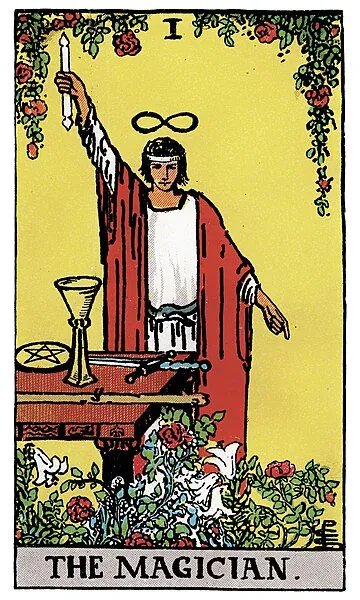
The Magician
Two cards of focused intention raised upward — the Magician's wand and the Ace's blade. Together they describe the moment a long-prepared inner sentence becomes an outer act. The intention has been cultivated; the tools are on the table; the word has been chosen. Now it is spoken into the world and the world begins to rearrange around it. The pairing favors the deliberate articulation that lands as event rather than the fevered effort that produces noise. Will and clarity in the same room.
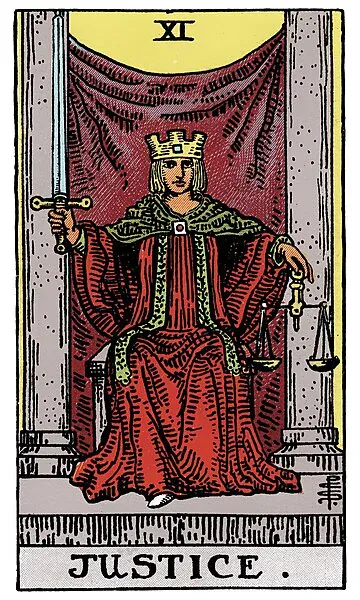
Justice
The freshly drawn edge meets the sword balanced steady on the throne. Justice already weighs the named thing; the Ace is the moment of naming. Together they describe situations that require truth to be both spoken and judged in proportion — legal matters, contracts, formal commitments, the closing of long accounts. The combination favors the position taken on principle and disfavors the position taken on impulse. Write the sentence; weigh it; speak it; then accept the result Libra's air-sign discrimination provides.
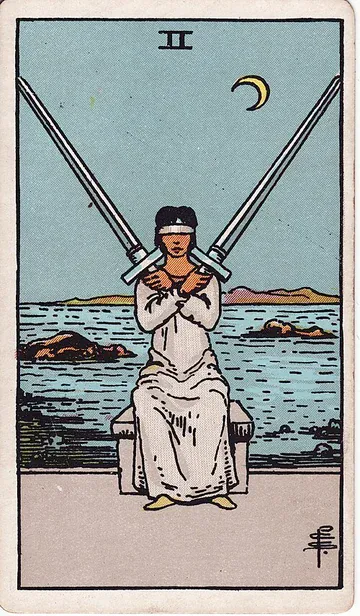
Two of Swords
The named edge meets the blindfolded indecision. The Two has been protecting the seeker from a choice that the Ace now requires them to face. The blindfold comes off; the crossed swords part; one of the two blades is set down deliberately. The Ace becomes the chosen edge — the position the seeker is willing to defend in the open. Together they describe the moment the long suspended verdict finally takes a side, and the cost of indecision becomes greater than the cost of choosing.
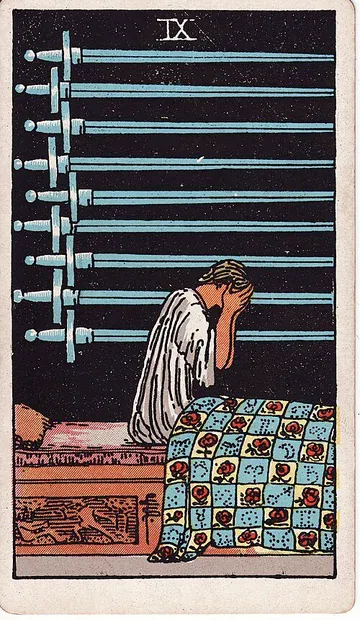
Nine of Swords
The blade upright next to the blade turned inward. The Nine of Swords is the figure sitting upright in bed, head in hands, the night thoughts cutting in nine known places. Together the combination is one of the deck's clearer treatments for chronic overthinking: name the actual fear in one sentence, write it on a page beside the bed, treat the named sentence as the work for the morning rather than the loop for the night. The Ace cuts the rope of the spiral by naming what the spiral has been protecting the seeker from saying.
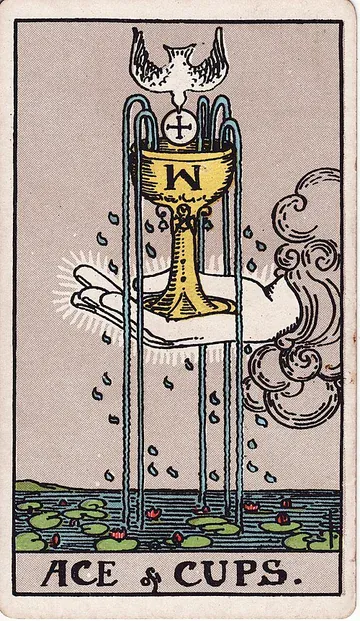
Ace of Cups
The two aces of the upper register — air and water, thought and feeling, the named and the felt. One holds the upright blade; the other holds the overflowing chalice. Together the combination is the rare moment the inner life becomes integrated: the truth that is also tender, the position that is also kind, the sentence that names the situation without losing the love. It disfavors the seeker who has been treating thought and feeling as opponents and favors the seeker willing to let the cup the sword forgets sit beside the blade — both upright, both honored.
Frequently Asked Questions
Does the Ace of Swords reversed refuse a question, or only postpone it?
Postpone, in almost every case. It is more often a soft no than a clean no, and what it usually says is: not yet, or not in this state of mind. The card warns against acting from rehearsed grievance, from over-engineered analysis, or from the unspoken sentence that has been fermenting in the head. The honest yes returns once the underlying clarity has been recovered and the action can be taken from a settled place rather than a charged one.
Is the cutting-but-accurate thing my partner keeps saying honesty or a weapon?
The reversed Ace puts both on the same blade: honesty wielded as a weapon (the sharp accurate observation that wounds) and truth withheld (the unsaid sentence growing in private) are its two love failures, and being right is no defense against either. For partnerships it often warns of the silent indictment that has accumulated for months without ever entering a real conversation. For new connections it warns of disclosure done too soon or too sharply. The work is to find the right tone and the right moment for the named sentence.
Why would someone who has already decided how they feel still say nothing?
Because the reversed Ace describes the sentence, not the silence around it. The other person has arrived at a sentence about you and is not saying it — possibly because they fear the response, possibly because they are not certain they have the right, possibly because they have privately concluded a hard answer. The card describes their interior weighing. The way through is often the calm direct invitation, said once, that makes the silence safe to break. Reading the withholding as indifference is the most common misreading of this card.
Which two ways can a clear mind go wrong when this ace inverts?
There are two specific failures of clarity, and the card names both. First, honesty wielded as a weapon — the sharp accurate sentence used to humiliate, prosecute, or score points rather than to actually clarify. Second, the blade left in the sheath — the truthful sentence held in the head until it ferments into chronic overthinking. The card also warns of the misdirected blade: real edge applied to the wrong target, while the place that needs the edge is left untouched.
How does a blade get put back down once it has been swung?
Slowly, and with a season set aside for it. Put the blade down. Write the unspoken sentence on a piece of paper and sit with it for a week before deciding what to do. Notice when you are winning arguments with people you love and stop. Redirect your sharpest analysis from problems that are not yours to solve back to your own life. The reversed Ace returns to upright through deliberate quieting, honest re-aiming, and the willingness to feel the next feeling before processing it.