
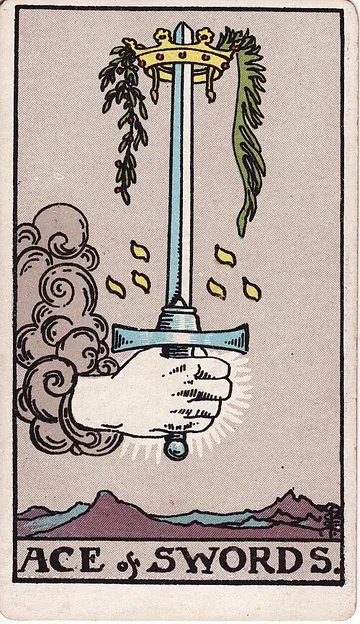
Ace of Swords · Core Meaning
The Ace of Swords shows a single hand reaching out from a bank of clouds, gripping a double-edged sword held point-upward. The blade pierces a golden crown, and from the crown hang an olive branch and a palm frond — peace and victory suspended at the same fixture. Six small motes of light fall along the two faces of the blade. Below the clouds, a low ridge of mountains rises, serrated, as though freshly cut by some clarifying force. The air around the image is thin. Almost no sound. Only the cold bright line along the edge.
This is the wish of every reader who has been circling something for months: to look at the situation and finally have a word for what they are looking at. The Ace of Swords meaning is not the act of cutting — it is the act of naming. The blade exists before the strike. The sword is drawn upward, not downward; the first task of the edge is to stand, to be seen, to declare what it is. Only afterward, if at all, does it fall.
The card holds two propositions inside one image. The first: clarity is a kind of authority, and authority is older than enforcement. The crown is already on the sword as it rises — not earned by combat, already worn. Truth holds sovereignty before it is acted upon. The second: the same edge that cuts conflict open also has the power to end it. Olive and palm, peace and victory, hang from the same fixture. The blade is not the enemy of the soft thing. The blade is what makes the soft thing legible.
Esoterically, the Ace of Swords is Kether of Yetzirah — the crown-point of the formative world, the root of Air. Aces in Lunarcana cosmology are the spring of their suit, the undivided source before differentiation. This card is the first clean edge before thought sorts itself into kinds, the instant before "true" and "false" become categories that have to be argued over. Numerologically it is one: origin, wholeness before division. Direction east. Season spring. Body the throat and lungs and the long thin nervous system that runs the spine.
The ace is also tied, in the deck's older mythic substrate, to the named blades — Excalibur, the sword of Michael, the flaming sword set at the eastern gate of Eden. Each of those swords is an act of recognition before it is an act of force. Arthur did not win the sword from the stone; the sword recognized him. Michael's sword does not strike chaos at random; it sorts. The flaming sword at Eden does not pursue; it stands. The Ace of Swords inherits this lineage. Its job is to stand up first.
A small note on the six falling motes of light along the blade. They are yods in the older esoteric reading — letters of light, sparks of name, the alphabet from which spoken truth is constructed. They fall along the edge, not on the ground. Revelation chooses the disciplined mind. The seeker who has done the work of attention is the seeker on whom the yods can land. The card describes both the gift and the discipline that allows the gift to be received: insight does not arrive at the unprepared room. It descends along the edge of the prepared one.
The blade is double-edged, and the deck means that literally. A sword sharpened on both faces cannot be swung without risk to the hand holding it; there is no safe side to grip. Whatever sentence this card offers cuts on the way out and again on the way back. Name your partner's evasion and you have also named your own tolerance for it. Diagnose the failing project and you have also dated your silence about it. This is not an argument against speaking. It is the reason the picture shows the sword standing still, point up, before anything happens — the pause in which the one holding it checks that they are willing to be measured by the same edge they are raising.
Notice, too, what the picture puts underneath. The ridge below the clouds is already jagged — thought lives above the tangle of matter, and the things still waiting to be distinguished have shape but have not yet met this blade. The air at that height is thin. Clarity is a high-altitude climate, and nobody breathes it comfortably for long. The card is a visit to that altitude, not an address.
Read this card in any spread as the moment a long fog gives way to one clean sentence. The reader who draws it is being asked, gently, what they have been refusing to say out loud. The fog is in the room because the sentence has not yet been said. The Ace of Swords as a tarot card meaning is the offer of the sentence — and the request that the reader say it once, deliberately, without softening, and then put the sword back down.
Ace of Swords · Love & Relationships
In love readings, the Ace of Swords arrives as the conversation that has been waiting in the wings for months. The relationship has been operating around a question nobody has named. The Ace of Swords means that the question has reached the point where it must be spoken — not as accusation, not as ultimatum, but as the simple work of giving a shape to what both people already know. After the conversation, the air will be different. The card promises the difference; it does not promise comfort.
For an existing partnership of long standing, the Ace of Swords describes the moment one partner finally says the thing they have been editing in their head for the last six months. It might be small — "I have been quietly resentful about the way we split Sundays." It might be structural — "I want to talk about whether we are actually going to have a child." It might be tender — "I have not felt close to you since spring, and I want us back." The card is not the content of the sentence. The card is the act of moving the sentence from internal monologue into the room where the other person can hear it. Long bonds carry many such unsaid sentences. The Ace of Swords is the one whose hour has come.
For a new spark in its early months, the Ace of Swords often shows up around the conversation that turns infatuation into a relationship. The honest disclosure of what each person has come from. The truthful answer to "what are we doing here." The first real disagreement that does not get smoothed over. New connections that survive this conversation are real. New connections that cannot bear it were not yet real. The card is not the test, exactly — it is the moment the test happens.
For a single seeker asking whether love is possible, the Ace of Swords is one of the more interesting answers the deck offers. It says: love is possible, and the work that opens the door to it is the work of getting honest with yourself first. Name what you actually want. Not the version polished for friends. Not the version offered at parties. The version you would write down at three in the morning if you knew no one would ever read it. The card asks for that sentence. When that sentence exists in clear form inside you, the door is unlocked.
For love after a wound, the Ace of Swords describes the post-mortem that finally tells the truth. Not the version of the breakup you have been telling. The version that names your share. The version that acknowledges what you saw early and chose to ignore. This is hard work and the card respects it. The wound does not close until it is named accurately. Once named, the closing begins on its own.
The card has a particular love language: the well-placed sentence. It loves the partner who, after a long silence at the dinner table, says one true thing that changes the air. It loves the friend who tells you the truth about your relationship that everyone else has been too kind to mention. The Ace of Swords love is not effusive. It does not pour. It cuts a single clean line, and the rest of the conversation can finally take place.
If you are asking specifically whether someone is in love with you and the Ace of Swords arrives upright, read it as a yes that requires articulation. They feel it. They have not yet said it. The card is not predicting that they will say it within a fixed window — that would be fortune-telling — but it is naming the structure of what is in the room. Their feeling has reached the point where it requires language. Either you give them the opening to use the language, or you ask the question that makes the language unavoidable. The card supports both moves.
For a long-distance relationship, the Ace of Swords often points at the conversation about what the next year actually looks like. Both people have been keeping things going on the assumption that the future will sort itself out. The card says: the future does not sort itself; it gets named. Pick a date. Pick a city. Or honestly admit you cannot pick either yet, and decide together what that means.
For a polyamorous or non-monogamous configuration, the Ace of Swords shows up around the agreements that have gone unspoken. New metamour, schedule drift, the comfort that has slowly slid into assumption — the card is the negotiation conversation, done deliberately, without melodrama, with the aim of clear renewed agreement.
Sometimes the sentence belongs to you, and it is a confession rather than an observation. The debt you have not mentioned. The diagnosis you have been carrying alone. The month you spent seriously considering leaving. The Ace of Swords does not distinguish between the truth you are owed and the truth you owe — it only registers that one of them is standing unspoken in the room. If the paragraph you keep editing in your head is about your own conduct, that is the one the card is pointing at. Say it plainly, without the long defensive preamble that asks to be forgiven before the facts have even arrived. The preamble is what turns a confession into a maneuver, and the other person can hear the difference immediately.
Then there is the harder arrangement: you have said your sentence and the other person will not stand still for it. They deflect, they joke, they go to bed, they promise to talk about it some other week. The upright card has a quiet answer here. The sword's first duty is to stand, not to strike — so the thing gets said once, clearly, at an hour when they are sober and unhurried, and then it stops being said. Repetition converts a naming into a nagging and lets them argue with your delivery instead of your content. Their refusal is itself legible: a person who cannot sit through one sentence about the relationship has just described the size of the room you are living in.
A small note on the card's particular caution in love. The same edge that ends ambiguity can, if not handled carefully, end the relationship along with it. The Ace of Swords does not want to be wielded as accusation. The sentence the card asks for is a naming sentence, not a prosecuting sentence. "Here is what I see" rather than "here is what is wrong with you." The crown is on the sword as it rises; the authority is in the truth, not in the punishment. Speak from the crown, not from the cut.
Ace of Swords · As Feelings
The temperature question — do they run hot or cold toward me — is the one this ace declines to answer, because an edge holds no heat. What it holds instead is clarity. They have arrived at a thought about you. The thought has finished forming. They know what they think. They may not yet have spoken it. The card describes the moment in their interior life when the long ambiguity has resolved into a single sentence they could write down if asked.
This is unusual among the as-feelings answers. Most cards describe a texture of feeling — warmth, hesitation, savor, withdrawal. The Ace of Swords describes a texture of thinking. The other person is not so much feeling something at you as having understood something about you. The understanding may be tender, or hard, or simply factual. But it is no longer being negotiated.
If they are reserved by nature, the Ace of Swords as feelings can mean they have privately concluded what they want and are choosing the moment to say it. The reserved person does not arrive at the sentence quickly. When the Ace of Swords shows up, they have arrived. Watch for the small ceremony — the dinner they ask you to, the walk they propose, the call that comes at an unusual hour. The sentence is on its way.
If they are demonstrative, the Ace of Swords can describe the moment they are going to make a public declaration. They have decided what they think and will tell people. Either to your benefit — the introduction to the family, the announcement to the friends — or to your cost — the open break, the public position taken. The card is not yet revealing which. It is naming the structural fact: a sentence is about to be spoken in front of others.
For a partner you have been with a long time, the Ace of Swords as feelings can mean they have finally articulated to themselves what they actually want from this relationship. The vague satisfaction or vague unease has crystallized into a position. The position may be tender — "I want to commit more deeply." It may be hard — "I have realized I want a different shape of life." Either way, what was diffuse is now focused. The work of the relationship is now to meet the focused thing.
For a new connection, the Ace of Swords as feelings can mean they have just come to a clear conclusion about you specifically. Not the general "I like this person." A specific judgment. They have decided whether you are a passing pleasure, a serious possibility, a friend, or a non-starter. The decision is theirs to share, but the decision exists. New connections in which the Ace of Swords arrives early often move quickly afterward in one direction or the other. The thinking has finished; the action follows.
For an ex who you are reading on, the Ace of Swords as feelings is one of the more honest answers the deck offers. They have understood the relationship now. They can articulate what it was, what it could not be, and what happened. This understanding is not the same as wanting you back. It is also not the same as being done. It is simply the reality of a thought that has reached its full shape. If you talk again, the conversation will be less foggy than you remember. Whatever it produces, it will produce honestly.
Where the bond has never had a name at all — the friend who is more than a friend, the colleague whose messages arrive at midnight — the Ace of Swords describes a private reclassification. They have filed you. In their own head the connection now belongs to a category, and the category has a word attached to it, even if the word has not yet reached you. This is why such connections change temperature abruptly with no visible event behind the change: nothing happened outside, but something finished inside. What you can actually read is the shift in precision. Vague warmth turns into exact behavior — a specific invitation, a specific withdrawal, a specific question about your weekend. Precision is the evidence that the thought has landed.
A small caution for this card in the feelings position. Sometimes the clarity the other person has arrived at is a clarity about themselves that incidentally involves you, rather than a clarity about you directly. They may have understood that they need to leave a city, change a career, end a marriage, start over, and you are part of the picture only as a side effect of the larger naming. Read carefully. The Ace of Swords centers truth, not romance. Their truth may not be a verdict on your worth. It may be a verdict on their own life that you happen to share.
The card asks you, in turn, to receive whatever they say without defense. The Ace of Swords as feelings invites you to be a clean listener. Whatever sentence they bring, let it land before you decide what to do with it. You can answer afterward. You cannot un-hear what they say while you are still arguing it. Sit. Listen. Let the truth be in the room before you start moving.
Ace of Swords · Career & Work
In career readings, the Ace of Swords is the card of the breakthrough thought — the one that resolves a problem you have been chewing on for a quarter, the strategy that finally sorts the team, the proposal that reads like the sentence everyone was waiting for. The card describes the moment the analysis finishes and the decision is sitting there, waiting only to be spoken into a meeting. The Ace of Swords career meaning is the moment the work clarifies.
For someone in a current role asking whether to stay, the Ace of Swords offers an unusual answer. It says: you already know. The card does not arrive when the question is genuinely open. It arrives when the question has been internally resolved for some time and the only remaining work is the saying. Pay attention to what your stomach already says when you imagine writing the resignation letter, or the renewal of contract. Whichever response is unambiguous in your body — that is the answer the card is naming. Your task is to honor it, not to keep relitigating.
For someone considering a new role, the Ace of Swords reads as a green light if the role aligns with the sentence you have been quietly trying to say about your career. The new role is the right one when it gives you the platform to do the work you have been describing to friends in confidence. The new role is wrong when it offers a louder version of work you no longer want. Read the offer against the inner sentence. If they match, take it. If they don't, the card is asking why you are still considering it.
For an entrepreneur, freelancer, or solo practitioner, the Ace of Swords often arrives around positioning. The product needs a sentence. The practice needs a sentence. The website needs a sentence. The person looking at your work needs to know, in one line, what you do and for whom. The card is the work of writing that line. Most founders avoid this work for years; the Ace of Swords is the season the avoidance ends. Sit with the sentence. Cut everything that does not survive the sentence. Build the next quarter around what survives.
For a creative practice — writer, painter, musician, designer — the Ace of Swords is the card of the through-line. The body of work has been accumulating. The shape is no longer obscure. The card asks you to name the shape: the book under the books, the series under the canvases, the album under the songs. Name it badly first. Refine the naming over a week. Then build the next chapter consciously around the named through-line. The Ace of Swords does not punish bad first attempts at naming; it punishes refusal to name.
For a job search, the Ace of Swords describes the job description that finally fits. After a season of vague applications, you read a posting and recognize the sentence as your sentence. Apply. Write the cover letter as if the description were already partly true of you. The card does not promise the offer; it confirms the recognition is real and the application is worth its weight.
For a layoff or transition, the Ace of Swords is one of the kinder cards to draw. It says: the next thing has a clearer outline than you currently believe. The fog around your future will lift faster than the fog around your past. Spend the first weeks of the transition writing one sentence about what you want next. Rewrite the sentence weekly. The clarity that comes from this practice will outpace the comfort of your old salary in two or three months.
For a difficult colleague or boss, the Ace of Swords reads as the conversation you have been preparing for in your head. It is time to have it. Write the sentence first. Practice it on a friend. Walk into the room and say it once. Do not negotiate the sentence as you say it. Do not soften it mid-utterance. Say it. Stop. Listen. Whatever happens next is the actual conversation; the prelude is over.
For a promotion, the Ace of Swords often shows up around the moment of being seen. The person above you has finally articulated to themselves what they think you contribute. The promotion conversation is no longer hypothetical; it is being scheduled. Be ready with your own sentence about what you want next. The card disfavors the person who shows up to that conversation without their sentence ready and accepts what is offered out of surprise.
For team leadership, the Ace of Swords advises the simplest possible message. Whatever the strategy is, write it in one paragraph. Whatever the priority is, write it in one line. Send it. The team has been operating in fog because no one has issued the sentence. Issue the sentence. The execution that follows will surprise you with how much was waiting on it.
A small structural caution: the Ace of Swords disfavors meetings about meetings, decks about decks, and reviews of frameworks for review. The card is the end of preparation and the beginning of position. If you find yourself convening another planning session, the card asks: have you already decided, and are you using the meeting to delay the saying? Often the answer is yes. Skip the meeting. Send the sentence.
Ace of Swords · Money & Finances
Money under this ace is not a sum but a sentence — the financial decision that has finally worded itself. The Ace of Swords money meaning is rarely a windfall card — it does not promise sudden wealth — but it is a powerful card of structural lucidity. The seeker has been holding several open questions about their money: should I leave the job for a lower-paying meaningful one, should I sell the house, should I consolidate the debts, should I stop paying for the storage unit holding things from a former life. The Ace of Swords names which of these questions has reached its decision point and asks for the call to be made.
For someone managing debt, the Ace of Swords describes the moment of looking at the spreadsheet without flinching. The exact number. The actual interest rate. The honest timeline to zero. After months of vague anxiety, the card asks for one sitting with the truth, written down. The clarity itself begins the recovery. Most people overestimate the size of the problem and underestimate the time it would take to solve it; the Ace of Swords ends both errors at once.
For a major purchase the seeker has been considering — a house, a car, a wedding, a course, a piece of equipment — the Ace of Swords asks the unprotected question: do I actually want this, separate from what I think I should want, or what I think it would say about me to own it. If the answer is yes, the card supports the purchase with unusual confidence. If the answer is honestly no, the card asks why the question keeps recurring, and what it would mean to set it down for a year.
For investments, the Ace of Swords is the card of doing the homework before placing the bet. Most investing failures are failures of clarity, not failures of timing. The card asks you to write, in one sentence, what you are betting on and what would make you wrong. If you cannot write the sentence, you do not have a position; you have a hope. The card disfavors hope-as-strategy. It favors the small bet that was articulated and the modest bet that is monitored against its own articulated thesis.
For a salary negotiation, the Ace of Swords is one of the strongest cards to draw. Walk in with the number written down. Say the number once. Do not justify it three times. Stop talking. The card describes negotiations won by the person who can name what they want without flinching. If you are uncertain what to ask for, that uncertainty is the actual problem to solve before the meeting; the card asks you to do that work first, in private, with a friend who knows the market.
For someone in genuine financial scarcity, the Ace of Swords is gentler than it looks. It says: name the next thirty days honestly. Not the catastrophic version that keeps you awake. Not the optimistic version that lets you avoid the mail. The actual version. Write the bills. Write the income. Look at the gap. The clarity is uncomfortable but it is also the door out. Decisions made from the clear picture — which calls to make, which payment plans to ask for, which expenses to cut — will land better than decisions made from the catastrophic story.
For windfall — inheritance, bonus, sale of an asset — the Ace of Swords advises the deliberate pause. Do not deploy the money for ninety days. Sit with the sentence about what it is for. Most windfalls are dissipated within a season because the receiver did not have a prior sentence ready. The Ace of Swords gives you the season to write the sentence. The deployment that follows the sentence outperforms the deployment that follows the receipt.
For business finances, the Ace of Swords often points at the line item nobody wants to look at. The subscription that renewed because no one canceled. The contractor whose contribution has thinned. The category of spend that grew without anyone noticing. The card asks for the audit and the cuts. They are not punishments; they are clarifications. The freed cash goes to the work that is actually moving the business.
Ace of Swords · Health
Health, under a blade held point-upward, turns on a single word: diagnosis — not in the medical sense alone, but in the older sense of naming what is wrong. The seeker has been carrying a body symptom or a pattern of distress that has refused to settle into a recognizable shape. The card describes the appointment, the test result, the conversation with the practitioner, or the private morning of self-honesty in which the symptom finally takes a name. After the naming, treatment is possible. Before the naming, only worry.
The Ace of Swords governs the throat and the lungs and the long thin nervous system that runs the spine. Air, the suit's element, lives in the breath. When the card arrives in a health reading, attention to those systems is rarely wasted. Notice whether the breath has gotten shallow over the last season. Notice whether the throat has been quietly tight. Notice whether the nervous system has been running at a baseline above its actual need. The card asks for one practice that addresses one of these — a daily five minutes of slow breathing, a yoga class with attention to the cervical spine, a week of evenings with no screens after eight. Choose one. Begin it.
For someone awaiting test results or weighing a decision about treatment, the Ace of Swords is a card of honest counsel. Read the report. Ask the practitioner the question you have been afraid to ask. Bring a written list. The card disfavors the appointment where you nod through the explanation and leave with the same fog you came in with. It favors the appointment where you said, out loud, what you did not understand, and refused to leave until you did.
For chronic conditions, the Ace of Swords often arrives around a re-articulation of the relationship between the seeker and the condition. The condition has not changed. The story the seeker has been telling about the condition has stopped working. The card asks for a new story — not a falsely optimistic one, not a darker one, an honest one. What is the actual range of good days and hard days. What is the actual cost of the management. What is the actual gain from the management. New decisions can come from the new story. The old story had run its course.
For mental health questions, the Ace of Swords is unusually direct. It asks whether you have named, to yourself or to a practitioner, the thing that has been quietly wrong. Anxiety that has a precise object. Depression that has a precise occasion. Grief that has a precise person. The card disfavors the diffuse complaint and favors the specific report. Write the specific report. Bring it to the appointment. Or bring it to the journal where you can read it back to yourself in a week. Specificity is the door to relief.
For someone managing a comfort behavior — alcohol, food, screens, scrolling, work itself — the Ace of Swords asks for the honest count. How many drinks. How many hours. How many days in a row. The number on the page changes the relationship to the behavior. The number in the head, vague, has been protecting the behavior from being seen. The card is the seeing. What is done after the seeing is the seeker's call; the card does not legislate. It only asks that the count be true.
Counting honestly is the whole of what the card asks, and it is not medical advice. Keep your practitioners. Take your medicine. The Ace of Swords offers the kind of attention the body is asking for — the attention of language, of naming, of the honest sentence said either to a doctor or to yourself. It does not replace care. It locates the place where care will land.
Ace of Swords · Spirituality
Discrimination is the old name for the faculty this ace sharpens — the capacity that tells the real from the not-real, the substantive from the substitute, the practice from the performance of practice. As Kether of Yetzirah, it is the crown-point of the formative world: the place where pure source begins to sort itself into form. For the seeker, it describes the moment when the spiritual life acquires its first edge — the realization that some teachings are for me and others are not, that some practices belong in this season and others have completed their work.
The card invites a single practice that any reader can do in thirty minutes today. Sit with paper and a pen. Write at the top: what is the question I have actually been carrying. Then sit, in silence, and wait for the sentence. Not the spiritual-sounding sentence. The real one. It may be a small question (what should I do about my mother) or a large one (am I living the life I was made for) or a structural one (do I believe in any of this). When the sentence arrives, write it down in plain words. That is the practice. That is the Ace of Swords meditation. The sentence on the page is the blade rising upward. The next month of your spiritual life can be conducted around it.
For seekers in active practice — meditation, prayer, ritual, devotional reading — the Ace of Swords describes the moment of distinguishing the practice from the wrapping around the practice. The cushion is not the meditation. The bell is not the meditation. The aesthetic is not the meditation. The card is gentle but honest: most spiritual lives accumulate scaffolding that quietly replaces the work it was supposed to support. The Ace of Swords season is the season of cutting the scaffolding back to the work. Keep what serves. Release what merely decorates.
For seekers exploring belief, the Ace of Swords asks for honesty about what you actually hold. Not what you say at parties. Not what your family believes. Not the eclectic syncretism that has accumulated since college. What, when you sit alone in the dark, do you actually think is true about the universe, about death, about why anything is here at all. The card disfavors the vague answer. It favors the answer that names something — even if what it names is "I don't know, and I am willing to keep not knowing carefully."
The mythic resonance of the Ace of Swords is the family of named blades — Excalibur, Michael's sword, the flaming sword at Eden. Each is a sword that recognizes before it cuts. Arthur did not seize the sword from the stone; the sword acknowledged him by yielding. Michael does not slash chaos at random; the blade sorts. The flaming sword at Eden does not pursue Adam and Eve into the world; it stands. The card inherits this lineage. The reader who draws it is being asked to let the sword in their own life stand for a season — to let recognition do the work that force has been failing to do.
For questions about path, the Ace of Swords often arrives at the moment a teacher, lineage, tradition, or framework either recognizes you or fails to. The discernment cuts in both directions. The teacher who feels right may be the right teacher; the teacher who has been almost-right for two years may be a teacher you should leave. The card asks you to look without flinching at where you actually belong now. The next chapter of your spiritual life depends on the honesty of this look.
A small caution for this card in spirituality. The Ace of Swords can be misread as license to argue with everyone about everything in the name of truth. That is not the card. The blade is held upward — its first work is naming, not striking. The reader who walks out of the spiritual reading and starts correcting strangers has misread the card. The reader who walks out and finally writes the honest sentence in their own journal has read the card correctly.
Ace of Swords · Yes or No
Yes — but only after you have said the sentence.
The Ace of Swords is one of the deck's clearer yes cards, but it qualifies its yes in a particular way. The answer is yes if the seeker can articulate, clearly and in one sentence, what they are actually asking for. The card disfavors the question that has not yet finished forming. It favors the question that has reached the point of being said cleanly out loud. If you can say what you want in one line, the answer is yes. If you cannot, the work of the card is the saying, not the answering.
For yes-or-no questions about whether to act — should I take the offer, should I send the message, should I make the move, should I have the conversation — the Ace of Swords answers yes, with the qualifier that the action should be preceded by one sentence of clear articulation. Write the sentence. Read it back. If it still feels true, act. The action that follows the named sentence lands differently from the action taken in fog.
For yes-or-no questions about whether something is true — is this person being honest with me, is this offer real, is this opportunity what it appears to be — the Ace of Swords answers yes, what is presented is what is. The card has no shadow of deception in the upright orientation. People are showing you what they think, opportunities are showing you what they are. Whatever you can see at the surface is the surface. There is no hidden trap. There is also no hidden treasure. What you see is what is there.
For questions about timing — will it happen soon — the Ace of Swords answers yes, sooner than the seeker expects, if the seeker has done the work of naming what they want. The card disfavors timelines that wait for the universe to deliver and favors timelines that begin the moment the sentence is spoken. The arrival of the named thing follows the naming closely. The arrival of the unnamed thing keeps being delayed because nothing is yet pointed at.
For questions about whether to wait — should I pause, should I hold, should I let it ripen — the Ace of Swords usually says no. The card disfavors waiting that has become a habit. It favors decisive position-taking. There are cards in the deck whose work is patience; the Ace of Swords is not one of them. The reader who draws this card and asks whether to wait is usually being told that the waiting is over.
For questions about whether you deserve what you are asking for — am I worthy of this role, this love, this rest, this money, this attention — the Ace of Swords answers yes, and asks why you keep needing to be told. The card disfavors the question of deservingness as a substitute for the work of naming what you want. Skip the deserving question. Ask the wanting question. The wanting question, named clearly, has its own answer.
The only situation in which the Ace of Swords softens its yes is when the question itself is unclear. The card cannot answer a foggy question with a clear yes. If you sit with the card and feel that the answer is uncertain, the card is asking you to first make the question clean. Rewrite the question. Strip the qualifications. Strip the conditional clauses. What is the one-sentence version of what you actually want to know. Ask that. The Ace of Swords has an answer for it.
Ace of Swords · Advice
Say it once, in one sentence, and then stop talking. Whatever has been circling in your head for weeks or months — the feedback, the proposal, the confession, the request, the decision — the card asks you to give it a single sentence and put the sentence into the room where it belongs. Do not soften it as you say it. Do not add three protective qualifications. Do not test-balloon it with two friends first. Say it once, in its plainest form, to the person who needs to hear it. Then stop. Listen to what comes back. The conversation that follows is the actual conversation; the years of preparation are over.
If there is one specific instruction the card offers, it is to write before you speak. The Ace of Swords loves the page. The sentence that survives being written is the sentence that can be safely spoken. The sentence that cannot be written — that keeps mutating, hedging, fragmenting on the page — is not yet a sentence. Stay at the page until the sentence stabilizes. Then carry it into the room.
A second instruction: cut one thing this week. Pick one habit, one obligation, one subscription, one open browser tab of a project you have no intention of actually doing, one ongoing low-grade resentment you have refused to either resolve or release. Cut it. Not three things. One. The Ace of Swords disfavors theatrical purges. It favors the single deliberate cut that creates room for the work that is actually waiting.
A third instruction: distinguish honesty from cruelty. The blade is held upward — its first job is naming, not striking. The seeker who uses the Ace of Swords as license to "finally tell people the truth" usually means: finally hurt the people they have been suppressing themselves with. The card does not ask for that. The card asks for the named sentence — said with the crown still on it, the authority of the truth itself, not the small angry authority of the wounded ego. If you cannot tell the difference, sit longer. The difference clarifies if you wait.
A fourth instruction: ask one question whose answer you have been avoiding. Not the rhetorical question. The actual question. What do I weigh. How much do I drink. Do I love this person. Will I take this offer. What did I want to be when I was seven that I quietly never gave up on. The card opens at the question. The opening continues if you let the answer come without immediately defending against it.
Practical advice for the day the card appears: open a new note on your phone or a fresh page in a notebook. Write at the top, what am I not yet saying. Sit with it for ten minutes. Write whatever comes — even if it comes badly, even if it contradicts itself, even if it is small. At the end of the ten minutes, draw a circle around the most honest sentence on the page. That is your sword for the day. Carry it. Let it stand. Decide later whether and how to use it. The work of the day was the drawing of it.
A final note. The Ace of Swords does not require you to act on the named thing immediately. Naming and acting are two different acts. You can name without acting, and let the named thing live in the room for a while as you decide what to do with it. The card respects this. What the card does not respect is the refusal to name at all — the long preference for fog over edge. Step out of the fog. Whatever you do next, do from the edge.
Ace of Swords · Card Combinations
Ace of Swords + The Magician
Two cards of focused intention raised upward. The Magician's hand lifts the wand toward the sky; the Ace of Swords' hand lifts the blade. Together the combination describes the moment a long-prepared inner sentence becomes an outer act. The intention has been cultivated. The tools are on the table. The word has been chosen. Now it is spoken into the world and the world begins to rearrange around it. Read this pairing as the convergence of will and clarity — the conditions under which a sentence said deliberately produces real change.
Ace of Swords + Justice
The deck's two great sword-bearers in the same reading. The Ace is the freshly drawn edge; Justice is the sword balanced steady on the throne, weighing what is on the scales. Together they describe a situation that requires the truth to be both named and judged — not just spoken, but spoken in proportion. Watch for legal matters, contracts, formal commitments, or the closing of accounts. The combination favors the position taken on principle and disfavors the position taken on impulse. Write the sentence; weigh it; speak it; then accept the result.
Ace of Swords + Two of Swords
The named edge meets the blindfolded indecision. One card holds a single bright blade; the other holds two crossed swords across the chest, eyes covered, the sea behind. Together the combination is the moment the indecision must end. The Two has been protecting the seeker from a choice that the Ace now requires them to face. The blindfold comes off. The crossed swords part. One of the two blades is set down deliberately. The Ace becomes the chosen edge — the position the seeker is now willing to defend in the open.
Ace of Swords + Nine of Swords
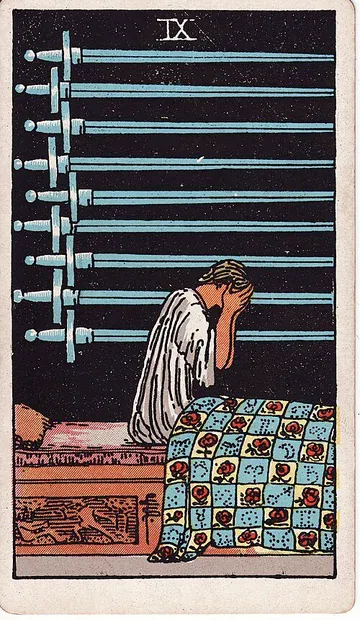
The blade upright next to the blade turned inward. The Nine of Swords is the figure sitting upright in bed, head in hands, the night thoughts cutting in nine known places. Together the combination is one of the deck's clearer treatments for chronic overthinking: name the actual fear in one sentence, write it on a page beside the bed, and treat the named sentence as the work for the morning rather than the loop for the night. The Ace cuts the rope of the spiral by naming what the spiral has been protecting the seeker from saying out loud.
Ace of Swords + Ace of Cups
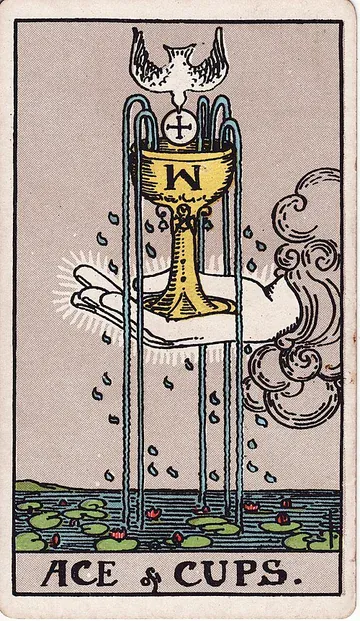
The two aces of the upper register — air and water, thought and feeling, the named and the felt. One holds the upright blade; the other holds the overflowing chalice. Together the combination is the rare moment the inner life becomes integrated: the truth that is also tender, the position that is also kind, the sentence that names the situation without losing the love. The pair disfavors the seeker who has been treating thought and feeling as opponents. It favors the seeker willing to let the cup the sword forgets sit beside the blade — both upright, both honored.
Ace of Swords + The Moon
Fog and edge in one spread. The Moon is the path between two towers with the dog and the wolf baying at the light and the crayfish hauling itself out of the pool — a landscape built entirely of things that cannot be named accurately at night. Set the Ace beside it and the reading becomes a contest between the two climates. The pairing is unkind to elaborate theories: it prefers one verifiable statement to the whole atmosphere the mind has built around it. Write down only what you have actually observed — the message that was sent, the hour they came home, the number on the invoice. Everything past that line is moonlight on water, and the blade has no work to do there.
Ace of Swords + Three of Swords
The blade that names, beside the three blades that pierce. One card holds a single sword upright in thin clear air; the other shows three of them driven through a red heart under rain. Together they separate two things people routinely collapse into one: the truth that hurts and the truth that harms. The Ace's cut is diagnostic and aimed at the situation; the Three's is in the tissue and aimed at a person. The pairing tends to arrive around a sentence that has to be said to someone it will wound — a resignation, a diagnosis, an ending. It does not release the seeker from saying it. It asks that the sentence go out without the extra half-clause added for effect, and that whoever says it stay in the room afterward.
Card Combinations
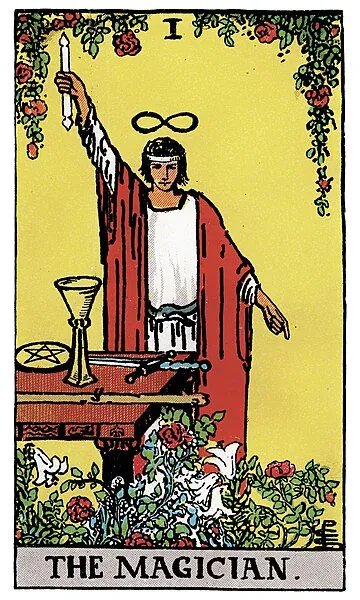
The Magician
Two cards of focused intention raised upward — the Magician's wand and the Ace's blade. Together they describe the moment a long-prepared inner sentence becomes an outer act. The intention has been cultivated; the tools are on the table; the word has been chosen. Now it is spoken into the world and the world begins to rearrange around it. The pairing favors the deliberate articulation that lands as event rather than the fevered effort that produces noise. Will and clarity in the same room.
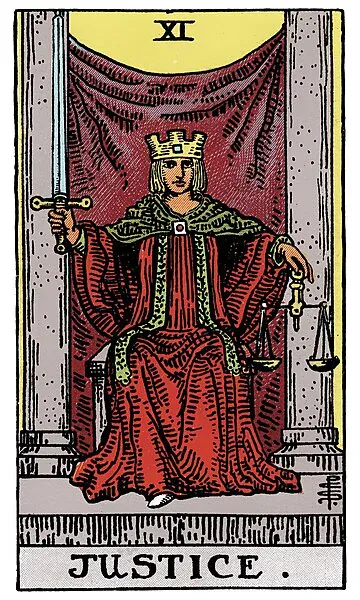
Justice
The freshly drawn edge meets the sword balanced steady on the throne. Justice already weighs the named thing; the Ace is the moment of naming. Together they describe situations that require truth to be both spoken and judged in proportion — legal matters, contracts, formal commitments, the closing of long accounts. The combination favors the position taken on principle and disfavors the position taken on impulse. Write the sentence; weigh it; speak it; then accept the result Libra's air-sign discrimination provides.
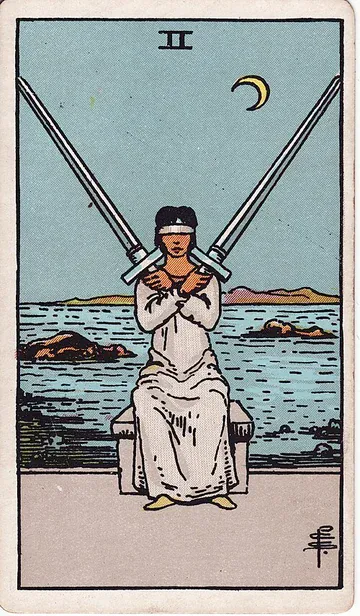
Two of Swords
The named edge meets the blindfolded indecision. The Two has been protecting the seeker from a choice that the Ace now requires them to face. The blindfold comes off; the crossed swords part; one of the two blades is set down deliberately. The Ace becomes the chosen edge — the position the seeker is willing to defend in the open. Together they describe the moment the long suspended verdict finally takes a side, and the cost of indecision becomes greater than the cost of choosing.
Nine of Swords
The blade upright next to the blade turned inward. The Nine of Swords is the figure sitting upright in bed, head in hands, the night thoughts cutting in nine known places. Together the combination is one of the deck's clearer treatments for chronic overthinking: name the actual fear in one sentence, write it on a page beside the bed, treat the named sentence as the work for the morning rather than the loop for the night. The Ace cuts the rope of the spiral by naming what the spiral has been protecting the seeker from saying.
Ace of Cups
The two aces of the upper register — air and water, thought and feeling, the named and the felt. One holds the upright blade; the other holds the overflowing chalice. Together the combination is the rare moment the inner life becomes integrated: the truth that is also tender, the position that is also kind, the sentence that names the situation without losing the love. It disfavors the seeker who has been treating thought and feeling as opponents and favors the seeker willing to let the cup the sword forgets sit beside the blade — both upright, both honored.
Frequently Asked Questions
What is the first thing the Ace of Swords does when it turns up?
It hands over a name. The Ace of Swords meaning is the moment a thing that had none acquires one. It is the breakthrough thought, the clean sentence that sorts a long fog, the diagnosis that makes treatment possible. The blade is held upward — its first job is naming, not striking. After the naming, you decide whether and how to act. The card describes the clarity itself, not its consequences.
Can the Ace of Swords answer a question I cannot yet put into one sentence?
Not cleanly — and that condition is the whole card. The Ace of Swords is a yes for the seeker who can write what they are asking in a single clean line. If you can write the sentence, the answer is yes — usually sooner than you expect. If you cannot, the card asks you to do the work of naming first. The Ace of Swords yes or no answer is structurally tied to the seeker's clarity, not to the universe's whim.
Which conversation is the Ace of Swords asking a couple to finally have?
The one that has been waiting in the wings for months, edited in private and never said aloud. The relationship has been operating around an unnamed question; the card is the moment the question must be spoken. For new sparks it is the first honest disclosure; for long bonds it is the unsaid sentence whose hour has come; for singles it is the work of naming what you actually want. The Ace of Swords love meaning is named honesty, not romantic prediction. What the card cannot tell you is how the other person answers; it only insists that the sentence leave the head it has been living in.
Does the Ace of Swords as feelings mean they have already made up their mind about me?
It means the thinking has finished. The other person has arrived at a clear thought about you — not a texture of warmth or cool, but a specific articulated position. They know what they think. They may not yet have said it. The card describes the moment of inner clarification just before the speaking. Whether the sentence is tender or hard, it has finished forming and is on its way into the room. A made-up mind is not the same as a delivered one, and this ace is the interval between the two — which is why it so often turns up in the week before someone finally speaks.
What does the Ace of Swords mean as a tarot card overall?
As a tarot card the Ace of Swords is the root of Air — Kether of Yetzirah, the crown-point of the formative world. It governs the throat and lungs, the nervous system, the eastern direction, the spring season, the first clean edge before thought sorts itself into kinds. Its mythic kin are the named blades: Excalibur, the sword of Michael, the flaming sword at Eden. Truth that recognizes before it strikes.