
· XIII ·
Death
“I let what must die pass; the deeper life comes forward.”
Upright
Reversed
Upright
Summary
What must end, ends.
A force of clearing — what has already ended is merely confirmed. The card does not make the ending; it names it.
Reversed
Summary
The dead, unburied.
Change is held at the door. It is not that no ending has come, but that the ending is unacknowledged — so the old thing rots on inside your life.
Symbols
Story
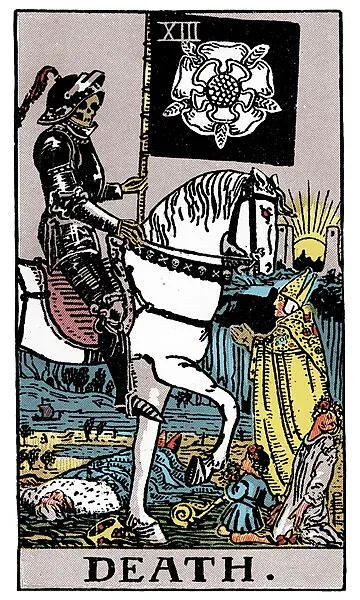
A skeleton in black armor rides a pale horse slowly across a field. A crowned king lies fallen underfoot; a bishop kneels in his vestments; a maiden turns her face half away; a child looks up with open eyes. The banner bears a five-petalled white rose. On the horizon, the sun rises between twin towers, and a quiet river runs behind him. All bend before his passing — crown, miter, and child alike — and his step does not quicken for wrath, nor slow for pleading.
Correspondences
- Element
- Water
- Color
- Obsidian · deep crimson
- Direction
- West
- Season
- Late autumn · after the first frost
- Temperament
- Melancholic · descending water
- Planet
- Pluto
- Zodiac
- Scorpio
- Modality
- Fixed
- №
- 13
- Meaning
- 13 — the closing of a cycle; beyond it, the four of rebuilt ground.
- Journey
- The hinge of the Fool's journey — the old self must die before the hero crosses into the second half.
- Letter
- נ · Nun (noon)
- Meaning
- Fish — swimming toward the life that comes next.
- Type
- Simple Letter
- Path
- 24 · Tiphareth ↔︎ Netzach
- Color
- Black · deep crimson
- Scent
- Myrrh · patchouli
- Plant
- Cypress · yew · poppy
- Gem
- Obsidian · bloodstone
- Metal
- Iron
- Note
- G
- Animal
- Scorpion · raven · serpent
- Time
- Dusk · around early November
- Archetype
- The Reaper — the psychopomp who leads souls across.
- Figures
- Anubis · Kali · Charon · Osiris.
- Cultural Echo
- Charon at the river in Dante's Commedia.
Shadow
Mistaking change for punishment; writing further on a chapter that should already be closed; dressing slow decay as "perseverance."
Related Cards
Combinations with this card
· Major arcana pairings ·
Death & Empress — what nurture asks us to release
Two of the deck's most embodied cards meet. The Empress nurtures, gathers, holds; Death composts, releases, lets fall. They are not enemies but the in-and-out breath of the same biological work. When they appear together, the pair tends to surface a question about what we have lovingly cultivated that has finished its growing season — and what the act of release will itself feed.
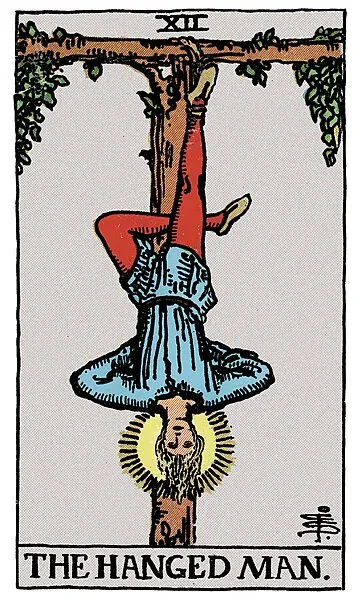
Death & Hanged Man — release into release
Two cards of letting-go in two different keys. The Hanged Man is voluntary suspension, the chosen pause. Death is the involuntary turn of the page. Side by side, they form one of the deck's quietest dialectics: surrender that one elects, and surrender that arrives unasked. The pair tends to invite a slower, more honest look at where one is still negotiating with a change that has already happened.
Death & Lovers — grief at love's threshold
Two cards of profound bond meet. The Lovers is the act of choosing — for partnership, for an alignment of values, for what one will join one's life to. Death is the moment a chosen bond changes shape, by ending or by metamorphosis. The pair tends to surface when love itself is asking to be re-chosen, or grieved, or both at once. It rarely points to literal endings; more often it points to the version of the bond that has quietly already ended.
Death & Sun — ending opens into clearing
A pair that surprises by how often it lands well. Death clears what has finished; the Sun warms what now stands in open light. Together they sketch the rhythm of any honest renewal — the felt relief of seeing what has actually been growing in the background, once the dead branches are cut back. The combination tends to invite a journaling reflection on what was hidden by the older shape, not just what the older shape was.
· A QUIET LETTER ·