Death · Core Meaning
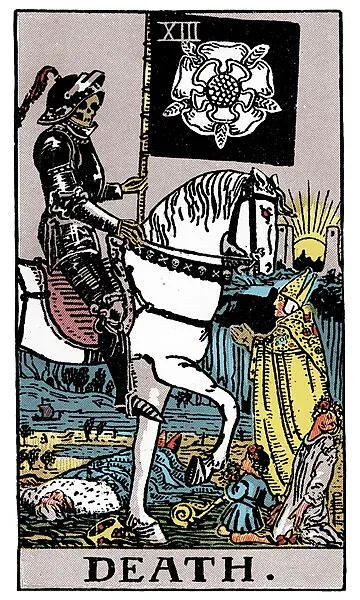
Death is the card that names the ending everyone in the scene already knows. A skeleton in black armor rides a pale horse across a field. A crowned king has fallen beneath the hooves. A bishop kneels in his vestments. A maiden turns half away, unable or unwilling to look directly. Only the child faces the rider with open eyes. Behind them runs a quiet river. Beyond the river, the sun stands between two towers, rising or setting with the same cold gold. The card is not theatrical. It is exact.
This is the center of Death tarot meaning: what must end, ends. The card does not manufacture loss. It does not arrive as punishment. It enters when a form has already completed itself and the psyche is still trying to negotiate with the corpse. A relationship shape, a self-image, a role, a fantasy of repair, a habit of survival, a public title: one of these has finished its term. Death confirms the fact. It carries the banner so the fact cannot be mistaken for a mood.
The black banner carries a white five-petalled rose. This is the card's mercy. The rose is not red with appetite or romance; it is white, stripped to essence. Five petals echo the human body, head and limbs, and also the living rose family. Something passes through the ending without being taken. It is not the old form. It is not the crown. It is not the costume. It is the seed of life that was hidden inside the old arrangement and could not breathe there anymore.
Death belongs to Scorpio, fixed water, and to Pluto's underworld pressure. It is late autumn after the first frost: the garden no longer argues with the season. The temperament is melancholic, descending water, the dark stream that carries leaves, names, and abandoned plans down to the place where they can rot into soil. The Hebrew letter is Nun, the fish, life moving under the surface toward another life. On the Tree, path 24 runs from Tiphareth to Netzach, from the solar heart toward desire, beauty, and instinct. The heart must cross a dark water before desire becomes honest again.
For a querent in shock, Death says the first task is not optimism. It is orientation. What exactly has ended? What is still merely frightened? What is already gone but still consuming strength because no one has admitted its absence? For a querent already exhausted, Death can feel like relief. The rider is severe, but he is also clean. He does not bargain. He does not keep half-dead things alive for politeness.
For a querent who has mistaken intensity for life, Death is especially clarifying. The card distinguishes crisis from vitality. A bond that constantly erupts may look alive because it makes noise. A career that keeps the body flooded with urgency may look meaningful because it never lets the mind rest. A family role that requires constant rescue may look sacred because it demands sacrifice. Death rides through all of these and asks a colder question: does this thing actually live, or has motion replaced breath?
For a querent who fears the card, the image offers its own correction. Death is armored, but he is not lunging. The horse steps forward. The river runs quietly. The sun still stands at the horizon. The scene contains terror because human beings resist endings, but it does not contain chaos. Even the fallen king is not mocked. The card's severity is ritual severity: the clean linen, the closed door, the name spoken once, the body returned to earth.
For a querent who has already made the practical ending but still feels haunted, Death says the visible act and the inner rite are not always the same. The lease can end before the body believes the home is gone. The last day at work can pass before the identity leaves the skin. The final message can be sent while the hand still expects a reply. The card asks for the ceremony that lets the nervous system catch up with the fact.
Read Death in any spread as the psychopomp: Anubis at the threshold, Charon at the river in Dante, Kali with the blade, Osiris dismembered and remade into a different sovereignty. The card leads what is finished across. It does not ask whether the king approves. It does not punish the bishop for kneeling. It lets the child look. The child is the part of the seeker that can still meet reality without performance.
Death · Love & Relationships
Death tarot love is rarely about a dramatic event arriving from outside the relationship. More often, it describes a relationship form that has already ended while the people inside it continue to perform the old ceremony. The same messages are sent. The same apologies are made. The same bed is shared or remembered. But the living pulse has moved elsewhere. The pale horse steps through the room and the furniture tells the truth before the mouth does.
For an existing partnership, Death upright can mark the end of one version of the bond. This does not automatically mean the whole relationship is dead. It does mean the prior contract cannot continue. The arrangement built around avoidance, parent-child dynamics, silent resentment, crisis bonding, or the myth of who each person used to be has reached its limit. If the relationship has life beneath it, that life can only appear after the old costume is removed. The bishop kneels because even sacred office has to bow here. Love is not exempt from change because it once felt holy.
For a partnership that has been quietly over for some time, Death is more direct. It says the ending is not a threat; it is already present. The emotional body may have known for months. The household may have known before either partner spoke. The fallen king on the card is the old authority of the relationship: the story that once ruled the room. No amount of crown-polishing returns breath to it. The dignified act is to acknowledge the death, divide what needs dividing, grieve what deserves grief, and stop calling endurance devotion.
For a new connection, Death can feel startling because the card is not soft. In early love, it often means the connection changes the seeker's old pattern so thoroughly that the previous romantic identity cannot survive. Someone who has lived through pursuit and withdrawal meets a bond that requires honesty. Someone who has confused longing with love meets steadiness and finds the old appetite weakening. Death in new love does not flatter the spark. It asks what the spark requires you to bury.
For a solo seeker asking whether love is possible, Death says yes only after an ending is honored. The old beloved may be gone but still occupying the chair. The old betrayal may be over but still deciding which doors remain locked. The old self, the one trained to choose the unavailable or to disappear before being chosen, may still be crowned internally. The card asks for a small funeral before a new invitation. Not a performance of closure. A real accounting of what no longer belongs in the house.
For love after a wound, Death is the card of the season after the first frost. Nothing blooms on command. The ground is not barren; it is cold and honest. The myrrh, cypress, yew, poppy, and dark iron of this card belong to mourning practices because mourning is a technology of return. It returns strength from the dead to the living. If the heart has been spending itself keeping an old scene animated, Death says that strength can come back into the body.
If the question is whether someone is in love, Death refuses the sweet shortcut. It may show a person whose feelings are changing form, or a person who knows the old way of relating is finished. The feeling may be serious precisely because it has crossed a threshold. They may be grieving the self they have to leave behind in order to love honestly. Or they may be releasing the bond. The surrounding cards matter, but Death's own language is clear: love cannot remain in its previous shape.
For the seeker who asks about a relationship that is technically intact but emotionally weathered, Death is a diagnostic lamp. It asks which parts still answer when touched. Is there curiosity? Is there desire? Is there repair that changes behavior, not merely speech? Is there a future that both people can describe without lying? The answer may reveal that the relationship itself lives but one mode of it is dead. Or it may reveal that the couple has been tending a mausoleum together.
For the seeker who has been left, Death does not require instant peace. It asks for the dignity of reality. The maiden on the card turns half away because looking fully is difficult. That half-turn is human. But the child looking directly shows the next movement: not forcing forgiveness, not inventing a silver lining, simply facing the fact without letting it become the whole sky. Grief becomes poisonous when it is asked to remain vague.
For the seeker who ended the relationship and feels guilty, Death offers another severe kindness. Ending what is over is not the same as cruelty. There are cruel endings, careless endings, avoidant endings. But the refusal to end can also be cruel, especially when it asks another person to keep investing in a structure whose life has gone. The card asks for clean speech, clean logistics, and grief without self-mythologizing.
The card's love language is uncompromising truth. It does not serenade. It clears the room. It takes down photographs that have become altars to a version of the bond no one inhabits. It asks both people to stand without costume: no crown, no spiritual excuse, no maiden's half-turned face. The child looks directly because the child does not yet know how to preserve a lie for the sake of manners. In love, Death asks for that kind of sight.
For reconciliation questions, Death upright is severe. It does not support returning to the old arrangement. It can support a future relationship only if the prior form is treated as truly dead. No quick re-entry. No continuation disguised as healing. The river behind the rider is crossed once. If two people meet again on the far bank, they meet as altered people, not as actors walking back into the same scene.
Death · As Feelings
Death as feelings describes an inner state at the threshold: not casual liking, not simple rejection, but the heavy knowledge that something cannot remain as it has been. The person may feel changed by you. They may feel the bond has reached a point of no return. They may feel a chapter closing inside them and not yet know whether the grief belongs to losing you, losing their old self, or losing the fantasy that kept the relationship bearable.
If the person is reserved, Death can look like silence. This is not the silence of indifference. It is the silence of someone standing by the river with the coin in their hand, understanding that words spoken now cannot be unsaid. They may be sorting what is living from what is finished. The black armor suggests self-protection, but the skeleton inside the armor suggests there is nothing ornamental left. Their feeling has been reduced to bone.
If the person is demonstrative, Death as feelings may appear as abrupt intensity followed by withdrawal. They say something final, or they make a gesture that changes the weather, then they step back. The feeling frightens them because it asks for a death of habit. The old flirtation script no longer works. The old avoidance loses its charm. The old power game looks childish under the white rose banner. Their emotional system may need quiet before it can speak cleanly.
For a long bond, Death as feelings often means the person is grieving the old version of the relationship. They may still love. They may also know that the familiar shape is gone. There is tenderness here, but it is not sentimental. It is the tenderness of folding clothes after someone has left, of touching a doorframe before moving house. They may feel respect, sorrow, relief, and fear in the same hour. The card asks not to flatten this into either love or no love. It is a more adult weather.
For a new connection, Death as feelings can mean the person senses that knowing you changes the arrangement of their life. They may not have language for that yet. A person accustomed to shallow bonds may feel stripped. A person used to being the crowned king in every romance may feel dethroned. A person protected by cynicism may meet your directness the way the maiden meets the rider: half-turned, unable to look away completely.
If the question is whether they are done, Death can answer yes when the surrounding spread confirms depletion, distance, or repeated failed repair. In that case, the feeling is not hatred. It is finality. The river has been crossed internally. Their body may already be living in the after. Trying to pull them backward usually increases the pain because the card's movement is one-directional.
If the question is whether they still care, Death can answer with a painful nuance: they may care deeply and still know the old bond must end. The white rose is important here. The pure thing may survive the death of the form. Respect may survive a breakup. Gratitude may survive the end of desire. Love may become blessing from a distance. Death separates essence from arrangement.
If the person has been hot and cold, Death as feelings may indicate that one inner chapter is closing while another has not yet opened. They may be trying to behave like the person they used to be in connection, but the old reflex no longer works. The flirtation feels thin. The distance feels dishonest. The return feels impossible to make cleanly. In this state, mixed signals are not a strategy so much as a symptom of threshold.
If the person is afraid of loss, their feeling may be organized around control. The black armor becomes emotional armor: tight schedules, careful wording, refusal to be seen needing anything. Underneath is bone, the simple fact of mortality, vulnerability, and change. Death in feelings can show someone whose heart has been touched precisely where they do not like to admit a heart exists.
Sometimes the weather being reported is not about you at all. If the person has recently lost someone — a parent, a friend, a marriage, a country, a body that used to do more — grief flattens the middle register of feeling first. Warmth turns formal. Desire goes quiet. Small talk becomes unbearable and long conversation becomes expensive. They may appear to have cooled toward you while they are in fact underwater with the fish of Nun, moving somewhere the surface cannot report. What they feel can be entirely intact and still unreachable this season. One misreading is to take the missing ordinary signal as the absence of love. The other is to wait forever on the strength of that correction. Ask what they can actually offer now, and listen to the size of the answer rather than its tone.
For the seeker receiving this card about another person's feelings, the practical instruction is to stop demanding a simple verdict before the threshold has been crossed. Watch the body language. Are they kneeling, bargaining, hiding their face, or looking directly? The card gives four human responses in one image. The king collapses. The bishop bows. The maiden turns away. The child looks. Their feeling is somewhere among these postures, and the posture matters more than the speech.
Death · Career & Work
Death tarot career readings describe the end of a professional form. A role, title, project, industry identity, client relationship, creative direction, or way of earning has finished its usefulness. The card does not always indicate leaving the job this minute. It does indicate that the old authority is down. The fallen king is the title that once made sense, the business model that once ruled, the boss whose power has lost moral weight, the resume line that no longer carries life.
For someone in a current role, Death asks whether the work is alive or merely maintained. A job can pay well and still be dead. A team can be polite and still have no future. A founder can love the original idea and still know the product has completed its cycle. The card cuts through the ethics of endurance. Staying because a thing is still living is different from staying because the funeral would be inconvenient.
For someone considering a new role, Death often marks a necessary break from the prior identity. The new role may not be a step up in the old hierarchy; it may be a doorway into a different field, scale, rhythm, or definition of authority. This is difficult for the part of the psyche that wants the crown to remain meaningful. But Death's horse does not pause for the crown. The question is not whether the old title can be preserved. The question is whether the living work is calling from the far bank.
For entrepreneurs and freelancers, Death is the card of killing the beloved but exhausted offering. A service package, audience promise, brand language, niche, or client type may have become a beautiful corpse. It once fed the business. Now it consumes creative oxygen. The black banner with the white rose is the instruction: salvage the essence, not the shell. What still lives in the work? What form has to be buried so that essence can move?
For creative practice, Death is one of the most important cards. A style dies. A manuscript is abandoned. A public persona no longer fits the hand that makes the work. The artist may be tempted to keep producing the recognized thing because recognition is a crown, and crowns are difficult to lay down. But the card knows the difference between audience applause and living necessity. It asks the maker to follow the descending water under the surface, even if the studio goes quiet for a season.
For layoffs, restructures, and endings imposed from outside, Death carries dignity rather than blame. The rider passes through systems as well as individuals. Sometimes the organization is the dead thing. Sometimes the role is already gone before the official email arrives. The card's practical wisdom is to stop bargaining with a structure that has completed itself. Gather documents. Preserve relationships that remain living. Mourn the identity cleanly. Then stand on the far bank.
For students, apprentices, or people at the beginning of a path, Death may mark the end of a borrowed ambition. A degree, certification, or training route may have been chosen by the family, the younger self, or the part of the psyche that wanted a safe crown. The card does not mock that choice. It simply asks whether the path still has blood in it. The child in the image matters here: the young part may see the truth before the official adult self permits it.
For managers and leaders, Death can ask for the end of a leadership style. The crowned king falls because authority that cannot change becomes brittle. A leader may need to stop ruling through crisis, charisma, rescue, secrecy, or being indispensable. A team may need a cleaner structure even if the leader's old identity depends on being the one who holds everything together. Death in leadership is succession, delegation, and the humility to let an old way of being important die.
For people whose work is care work, healing work, teaching, or spiritual labor, Death warns against consecrated exhaustion. The kneeling bishop is not a command to serve until the body breaks. He is a sign that even sacred duty bows to endings. A caseload, classroom, ministry, or family service role may need a boundary, sabbatical, or completed term. Devotion that cannot end becomes devouring.
For advancement questions, Death can be paradoxical. It may say the desired promotion belongs to the old life. The next professional step may require leaving the ladder rather than climbing it. Or it may say that a former version of you must end before greater responsibility can be carried. The bishop kneels here: expertise, credentials, and spiritualized duty all bow to the truth of transition.
Money and career often overlap in Death readings. The fear beneath the work question is usually survival: if this ends, what feeds me? Death does not make that fear foolish. It simply refuses to let survival be confused with vitality. There are seasons to remain for practical reasons. There are also seasons when staying becomes a slow internal decay. The card asks for the difference to be named without drama.
The strongest career advice in Death is closure. Finish the project properly or declare it done. Write the resignation letter before sending it. Archive the files. Thank the people who were real allies. Let the old name die without spitting on it. The psychopomp does not sneer at the dead; he leads them across.
Death · Money & Finances
In money readings, Death is the end of an old financial pattern. The pattern may be scarcity, compulsive rescue, debt cycling, income tied to a dead role, loyalty to a family script, or spending that preserves an identity no longer true. This is not a lucky windfall card. It is a pruning card. It says the financial organism cannot keep feeding every branch.
For a seeker managing debt, Death can be the moment the debt story stops being vague. The numbers are named. The account is closed or consolidated. The private shame loses its crown. There may be grief in this because debt often carries memory: the period of illness, the move, the person supported, the years spent surviving. Death asks for a clean ledger and a clean mourning. Both matter.
For a big purchase, Death asks whether the purchase belongs to the living life or the dead one. Is the object needed by the person you are becoming, or is it tribute to a former self? The fallen king is especially useful here. Some purchases are crowns: symbols of arrival, status, revenge, proof. Death strips the crown from the question. Without the performance, does the purchase still have life?
For investments or financial risk, Death is conservative in the old sense of the word: preserve what can live by cutting what cannot. It does not favor gambling from panic. It can favor exiting a position that has become a corpse in the portfolio, ending a subscription that drains attention, or selling an asset that belongs to a finished chapter. The movement is not hoarding. It is composting.
For people whose money is tangled with family, Death may describe the end of inherited financial obedience. The family myth about sacrifice, secrecy, shame, or rescue may no longer be workable. A parent may have been the crowned king of the money story. A partner may have been the bishop, blessing arrangements that harmed everyone. The card asks the seeker to stop treating old authority as permanent law.
For career-linked money, the card asks whether income is being used to justify a dead life. A salary can become a crown. Benefits can become vestments. A mortgage can become a river no one dares cross. These practical realities matter, but Death asks that they be named as practical realities rather than confused with destiny. The question becomes: what plan lets survival remain honored while decay stops being worshipped?
For shared finances, Death can mark the closing of a joint structure: a lease, account, family business, debt agreement, inheritance process, or long-standing informal exchange. The work is to make the ending legible. Put terms in writing. Separate cleanly. Avoid using money as the last thread of emotional control. The river is crossed more safely when the boat is built out of facts.
For abundance questions, Death sounds stern but can be generous. It says money returns when the dead claims on it are buried. The subscription that belongs to an abandoned ambition. The storage unit full of a former life. The unpaid emotional debt that keeps becoming cash. The impulse to keep a failing thing alive because admitting the loss would hurt more than another payment. Each burial returns strength.
Money that arrives out of an actual death deserves its own paragraph, because Death is the card readers hold when it happens: an inheritance, a settlement, a life-insurance payment, the price of a family house. Such money comes with instructions nobody wrote down. Spend it well. Do not waste it. Make the loss mean something. Under that pressure people tend to do one of two things — freeze the sum in an account for years and touch nothing, or discharge it quickly into something loud enough to drown the silence. The card's counsel is to keep the ledger and the grief on separate days. Park the money somewhere boring. Decide when you are not aching. The money is not the person, and treating it as a relic keeps both the sum and the dead unburied.
The practical move is inventory. List the accounts, commitments, possessions, debts, and silent obligations that no longer belong to the life actually being lived. Then choose one to end cleanly. Death does not require a dramatic purge. It respects decisive, concrete closure: the canceled payment, the final invoice, the sold object, the written agreement, the boundary that stops money from serving a ghost.
Death · Health
In health readings, Death should be handled with care and without sensationalism. It is not a diagnosis and not a sentence. It is a card of endings, transitions, and the body's demand that an old pattern stop. The season is late autumn after first frost. The temperament is melancholic, descending water. The body image is not speed; it is elimination, rest, compost, the dark repair that occurs when life stops pretending to be summer.
For acute concerns, Death can mark the point where an old approach has reached its limit and a new level of attention is needed. This may mean ending denial, ending delay, ending self-treatment, or ending the habit of minimizing what the body has been saying. The rider's black armor is practical: protect the body by taking reality seriously. Seek appropriate care. Ask direct questions. Let facts dethrone fear.
For chronic conditions, Death often describes the grief of lifestyle change. A food, rhythm, capacity, substance, workload, or identity may need to end. This is not small. The body may be asking for a funeral for the former normal. People often skip that grief and then wonder why compliance feels like punishment. Death says: mourn the old pattern, then stop feeding it.
Emotionally, this card maps to the places where unacknowledged endings turn somatic. The relationship that ended internally but not externally. The job that deadens the body every morning. The family role that requires the face to turn half away. Descending water carries what has not been cried, digested, or spoken. The health question may be asking where grief is being stored because it has not been given a river.
For recovery, Death can be oddly merciful. It describes the phase where the old self-image cannot be resumed, and therefore a more honest life becomes possible. After illness, burnout, grief, surgery, sobriety, or deep exhaustion, the question is not how to return unchanged. The card asks what life looks like if the event is allowed to alter the structure. The sun between the twin towers is not backward motion. It is a gate.
For people in caretaking bodies, Death may point to the need to end a role before resentment enters the blood. The person caring for a parent, child, partner, client, or community may have become the bishop kneeling endlessly at the threshold. Care can be holy and still require limits. A body asked to prove love by ignoring its own ending signals eventually speaks in symptoms. The card asks for care plans, respite, shared responsibility, and the burial of martyrdom.
For seasonal health, the late-autumn signature matters. The first frost tells the garden to stop producing and begin returning. A body in a Death season may ask for fewer inputs, darker evenings, simpler food, longer sleep, less performance. This is not collapse. It is descent. The poppy, cypress, yew, myrrh, and patchouli of the card are not summer medicines. They belong to the chamber where repair is quiet.
For mental health, Death speaks to closure, grief, and the relief of no longer maintaining a false life. It may accompany the end of a coping mechanism that once saved the seeker and now harms them. The skeleton is not cruel here; it is what remains when performance drops. Good support matters. Ritual matters too: writing the name of the old pattern, burying the page, walking by water, letting the body understand that a chapter has ended.
The practical health counsel is simple and serious: do not use the card as a substitute for medical care; do use it as an invitation to stop postponing the conversation the body has already begun. What is the body asking to end? What burden has become normal only because it has been carried for too long? What would rest look like if it were not treated as failure? Death listens for those questions.
Death · Spirituality
Spiritually, Death is the threshold keeper. It stands where identity loses its costume and essence has to cross without luggage. The card's myths are not decorative: Anubis weighs the heart, Charon ferries the dead, Osiris is broken and reconstituted, Kali cuts through the false continuity of ego. The psychopomp does not explain the river. He knows the crossing.
For an established practitioner, Death asks which practice has become embalmed. The altar may be beautiful and dead. The journal may be full of sentences that no longer risk truth. The devotional language may still be spoken while the actual devotion has moved. This card does not shame old forms. It simply asks whether the form still carries life. If not, thank it and bury it.
For a seeker between traditions, Death can describe the loss of inherited belief. This loss deserves more tenderness than simple rebellion. A childhood god, a family ritual, an old doctrine, a former certainty: these do not vanish without leaving bones. The white rose on the banner says something pure may pass through the death of the belief. The essence is not always identical to the institution that once held it.
The Tree path from Tiphareth to Netzach gives the card a subtle spiritual route. The solar heart descends toward desire, instinct, and embodied beauty. Death is not anti-life. It is the path by which the heart stops pretending desire can be purified without loss. The fish of Nun moves under the visible world. It carries life through water that the conscious mind cannot control.
For shadow work, Death asks the seeker to notice where endings are moralized. Many people were taught that quitting is failure, that loyalty means indefinite endurance, that forgiveness means restoration, that spiritual maturity means not needing to grieve. Death cuts those teachings away when they become hostile to life. A clean ending can be an ethical act. A boundary can be a rite. A burial can be a form of reverence.
For ancestral or lineage practice, this card can carry unusual force. The fallen king may be a family authority. The kneeling bishop may be the inherited religious form. The river may be the dead whose stories still irrigate the living. Death asks what the seeker has been carrying on behalf of those who came before. Some inheritance should be honored. Some should be buried with prayers and not passed to the child looking up.
A simple practice: perform a thirty-minute ritual of ending. Choose one object, document, habit token, or written phrase that belongs to a completed chapter. Sit with it in silence. Name what it gave. Name what it cost. Wrap it, bury it, burn it safely, delete it, donate it, or place it by running water. Do not replace it immediately. Let the cleared space remain honest.
Death's spiritual teaching is not rebirth as slogan. Rebirth is the far horizon, the sun between the towers. The actual work is the crossing: the coin under the tongue, the boat, the river, the refusal to drag the corpse back into the house. A seeker who accepts this card's discipline becomes less dramatic about endings and more faithful to life.
Death · Yes or No
No to staying the same. Yes to the necessary transformation.
Death yes or no is one of the deck's most misunderstood binary answers. If the question asks whether the present form can continue unchanged, the answer is no. If the question asks whether release, closure, or a deep change is the right movement, the answer is yes. The card refuses the convenience of a simple yes when the deeper question is about whether life can avoid its own threshold.
For relationship yes-or-no questions, Death often says no to returning to the old form. It may say yes to an honest ending, yes to a changed relationship, yes to a conversation that cannot be undone. If the question is "can we go back to how it was," the pale horse answers no. If the question is "can something truer exist after the old form dies," the sun between the towers answers yes, but not cheaply.
For career questions, Death says no to continuing a dead role indefinitely. It says yes to closure, resignation, redefinition, or the end of a project whose life has gone. For money questions, it says no to feeding an old pattern and yes to cutting waste, closing accounts, consolidating, or letting a financial identity die.
For personal growth questions, Death is a severe yes. Yes, the old skin is ready to come off. Yes, the habit has completed its usefulness. Yes, the name you used for yourself may no longer fit. The card's yes is not bright. It smells of cypress, yew, myrrh, and wet iron. But it is clean.
For questions about contact, messages, or returning, Death asks what the contact is meant to revive. If the message would serve truth, closure, or an accountable transformation, the answer may lean yes. If the message is a hand reaching into the grave to feel whether the old pulse can be forced back, the answer is no. The card is not against speech. It is against necromancy disguised as communication.
For questions about whether to wait, Death usually says no to indefinite waiting. Waiting can be sacred in Hanged Man territory, but Death's domain is passage. If the essential ending is already known, waiting becomes a candle kept burning in an empty house. The better question is what action honors the ending without rushing the next life.
If the question asks whether someone still feels the same, Death usually says no. That does not always mean absence of feeling. It means the feeling has changed form. Love may become grief. Attachment may become blessing. Desire may become respect. Anger may become finality. The white rose survives, but the red bloom of the old arrangement is gone.
For timing questions, Death does not behave like a clock. It describes threshold rather than date. The relevant timing is the point at which denial stops costing more than grief. The moment may already be here. The card asks less "when" than "what are you still pretending is alive?"
Leaving a place — a city, a house, a country, a congregation, a group chat that used to be a friendship — is the version of this question that arrives most often at two in the morning. Death leans yes when the leaving is a burial and no when it is only a transfer. Moving a body does not bury a form: the same arrangement reassembles in the new city, with new names in the same seats, if nothing was ever declared finished. So test it inward first. What would have to end even if you stayed? If the honest answer is nothing, the address is not the thing asking to die. If the honest answer is specific — a role you play there, a person you cannot be truthful with, a version of your day — then the departure has an actual corpse to carry, and the card says go: quietly, with the paperwork done and the keys returned.
Use Death as a yes-or-no card by naming the object of the question precisely. Yes to the funeral. No to the embalming. Yes to the river. No to the return crossing. Yes to the life hidden in the white rose. No to the crown that has already fallen.
Death · Advice
The advice of Death upright is to stop keeping the dead thing presentable. Do not put makeup on the old role, the old story, the old relationship pattern, the old fear, the old ambition. Do not keep calling slow decay by the name of loyalty. The card's first instruction is recognition: say, plainly, what has ended.
Make a list of what is already dead. Not what you resent. Not what is difficult. What is dead. A project that no longer has a pulse. A friendship maintained only by guilt. A fantasy of being chosen by someone who has never chosen clearly. A version of your body, career, family role, or public name. Write each one without ornament. The skeleton has no soft tissue; the list should have none either.
Choose one burial. Death does not ask for theatrical destruction. It asks for a clean act. Send the closing email. Cancel the appointment that belongs to a former life. Remove the object from the room. Archive the folder. Say the sentence that ends the ambiguity. Stop paying the fee. Change the status. Return the key. Let the nervous system learn that ending is an action, not an idea.
Date the ending. Not a date in the calendar ahead — a mark on the past. Write down the day the thing actually finished: the evening the conversation changed nothing, the quarter the numbers stopped meaning anything, the morning you noticed you no longer wanted the title. Memory smears endings into a long gray drift, and a drift cannot be mourned because it has no edge to stand on. A date gives grief a shore. It also settles the private argument about whether you are acting too soon, because you are not choosing to end this. You are recording when it ended.
Tell the people whose lives are built on the old shape. Not everyone — an ending is not a press release — but the few whose calendars, money, or expectations still assume the former arrangement: the colleague who routes work through you, the friend who invites you as half of a pair, the parent who asks after the company every Sunday. Say it once, plainly, without the essay of justification that invites debate. Each telling removes one prop from the stage set. An ending only you know about is still doing its work in a room with the door closed.
Give grief its proper vessel. The card is severe because it respects mourning. If something mattered, do not pretend the ending is pure liberation. Light the candle. Walk by water. Wear black for a day if the body wants a sign. Speak the name once and then let silence answer. The river behind the rider is quiet because grief does not need constant explanation to be real.
Do not rush rebirth. The white rose is not a motivational slogan. It is small, precise, and carried on a black banner. After a real ending, the new life may appear first as a subtle return of appetite: one cleaner breath, one honest desire, one room that feels easier to enter. Protect that. Do not force it into a plan before it has roots.
Ask where hierarchy is distorting the truth. The fallen king shows that status cannot stop an ending. The kneeling bishop shows that spiritual or moral language cannot sanctify what is dead. The maiden shows the cost of half-looking. The child shows the medicine of direct sight. In practical terms: stop letting rank, vows, appearances, or fear of seeming ungrateful decide what is true.
Treat closure as a craft. Good closure has tools: dates, documents, witnesses, boxes, passwords changed, keys returned, debts counted, rooms cleaned, words chosen. Vague closure keeps the ghost in circulation. Crafted closure gives the psyche something to touch. The black armor of the rider is not merely symbolic; it is equipment for crossing a hard field.
Watch for the temptation to turn Death into identity. Some seekers become the person who is always ending, always purging, always cutting away. That too can become a crown. Death is a passage, not a temperament to perform. After the burial, attention should return to the living. If ending becomes addictive, ask what new life is being avoided by constant clearing.
Finally, move one portion of strength from the dead to the living. The card's integration cue is exact: return the force you spend maintaining the appearance of life. Give that force to the body, the honest project, the present friendship, the clean room, the bank account, the practice that still answers when called. Death is not against devotion. It is against devotion wasted on a corpse.
Death · Card Combinations
Death combinations intensify the question of endings because Death is already a threshold card. The neighboring card tells what kind of threshold is being crossed: surrender, rupture, awakening, rest, or voluntary departure. Read the pair by looking at the bodies in the images. Who hangs, who falls, who rises, who lies still, who walks away? The body tells the timing.
Death + The Hanged Man
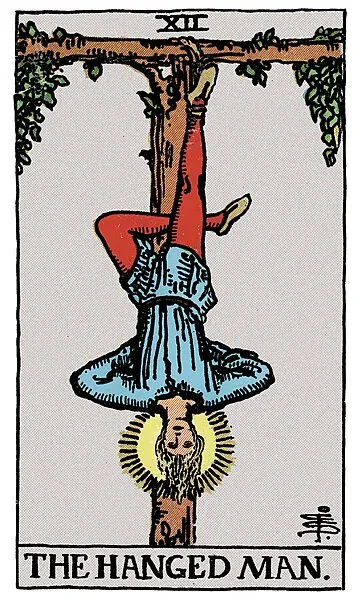
The ending requires surrender before action. The Hanged Man is suspended, seeing from the inverted angle; Death rides below, naming the form that cannot continue. Together they describe the moment when delay is not avoidance but ripening. Do not cut too early. Do not keep hanging after the truth is clear. The sacrifice must become passage, not a permanent identity.
Death + The Tower
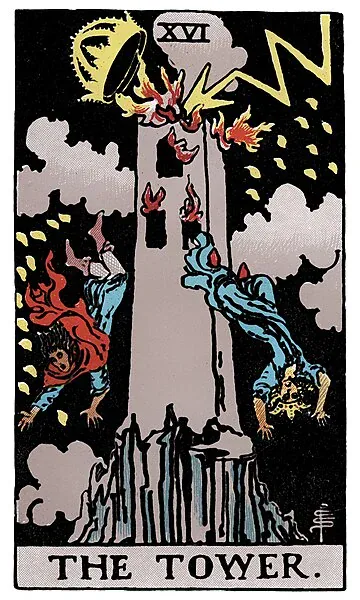
Here the ending is not quiet. The Tower breaks the structure Death has already marked as finished. Lightning strikes what the pale horse would otherwise have crossed with steady inevitability. This pair often appears when denial has made a clean ending impossible. The lesson is not catastrophe for its own sake; it is the mercy of false architecture finally losing power.
In practice this pairing tends to find a seeker who has spent months managing appearances: the household that performs a good evening for guests, the company that calls a closure a reorganization, the family that revises the story at every dinner so no one has to say the plain sentence. Management is skilled work, and it stops working here. The reading worth taking from the pair is not to brace for ruin but to ask which sentence, said this week in an ordinary room, would make the collapse unnecessary. A kneeling bishop holds no roof up. Somebody has to say aloud what the building is now for, and whether anyone is still living in it.
Death + Judgement
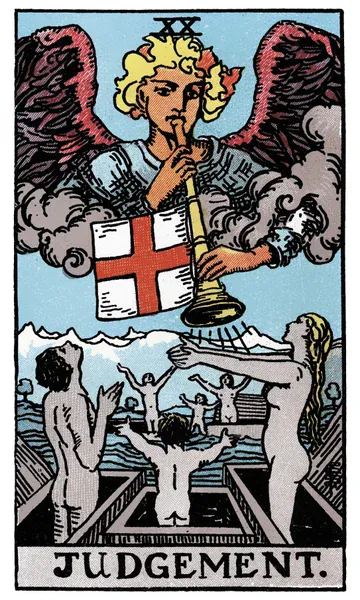
The grave opens after the burial is complete. Judgement brings the trumpet, the call, the summons into a new moral life. Death alone buries; Judgement raises what can answer. Together, they ask for accountability after an ending: not merely leaving the old chapter, but hearing what the end reveals about purpose, repair, and the voice that calls from beyond shame.
The trap in this pair is the seeker who hears the trumpet as amnesty. Judgement's figures rise naked; they rise summoned, not excused. Beside Death, the call asks for the particular repair the ending exposed — the debt counted rather than estimated, the letter written to the person who was in the room, the honest account of how you behaved while the old form was still standing and still useful to you. Death buries the shape. Judgement asks what the shape cost other people. A seeker who skips that question usually rebuilds on the same foundation and is surprised, later, by the same floor.
Death + Four of Swords
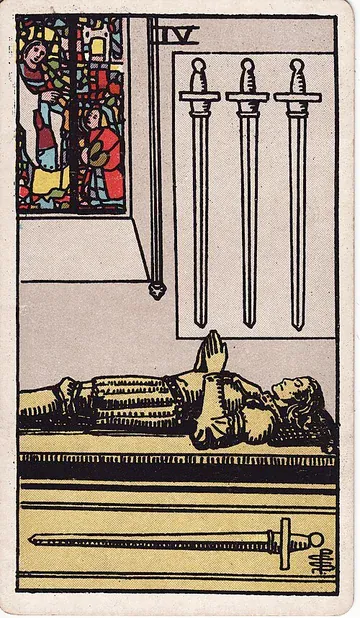
The ending requires rest, not immediate reinvention. Four of Swords places the body in stone quiet, prayer hands folded, the mind withdrawn from battle. With Death, it says the nervous system needs a chamber after the crossing. Grieve, sleep, recover, let the old pattern leave the tissues. The next action comes after stillness has done its work.
Death + Eight of Cups
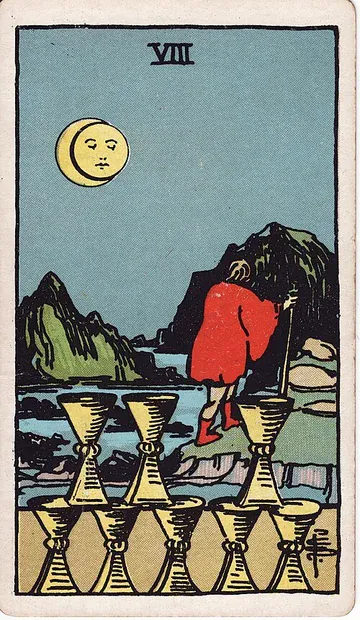
The departure is chosen. Eight of Cups shows the figure walking away under moonlight from cups that once mattered. Death gives the walking a deeper finality. This is not boredom. It is soul-level completion. Together, they describe leaving with grief, sobriety, and respect for what the cups gave before they stopped being enough.
In practical reading, Death with Eight of Cups is the pair for leaving without contempt. The cups are not kicked over. The rider does not spit on the king. Something had value, and because it had value, the ending deserves precision. This combination is useful when the seeker is tempted to invent hatred in order to leave. Hatred may create momentum, but it also binds the psyche to the very scene it wants to escape. The cleaner road is harder: bless what was real, name what is finished, and walk.
Across all five combinations, Death asks the same discipline in different chambers. With The Hanged Man, wait until the sacrifice has yielded sight. With The Tower, stop pretending the struck building is shelter. With Judgement, answer the call after burial. With Four of Swords, let rest be part of the crossing. With Eight of Cups, leave the completed cup behind. None of these pairs makes Death gentler. They make it more legible.
Card Combinations
The Hanged Man
Death with The Hanged Man is the threshold between surrender and passage. Something must end, but the timing asks for one last change of perspective before the cut. If the insight has already arrived, the suspension should not become a shrine to delay.
The Tower
Death with The Tower shows an ending that can no longer remain private. Death marks the completed form; The Tower breaks the structure built around denying it. The pair is severe, but it clears false architecture fast.
Judgement
Death with Judgement is burial followed by summons. The old chapter closes, then a clearer call rises from the grave. This pair asks for accountability after release: what does the ending require the living self to answer?
Four of Swords
Death with Four of Swords asks for a chamber of rest after the crossing. The ending is real, but immediate reinvention would violate the body. Sleep, silence, prayer, and nervous-system repair become part of the transformation.
Eight of Cups
Death with Eight of Cups is chosen departure with finality. The cups once mattered, and that is why leaving carries grief. Together they show a soul walking away not from failure, but from a completed emotional chapter.
Frequently Asked Questions
What does the Death tarot card mean?
Death means an ending already present is ready to be acknowledged. It is the card of transformation, release, and the clean closure of a form that has completed itself. The black-armored skeleton on the pale horse does not create the ending; he carries it across. The king, bishop, maiden, and child show different human responses to the same threshold. What survives is the white rose: the essence that can pass through change.
Does Death mean a breakup, or the end of a pattern inside the relationship?
In love, Death means a relationship form must end. Sometimes the whole bond is over; sometimes the old pattern inside the bond is the thing that has to die. The card asks for honesty rather than performance. The old contract, old silence, or old fantasy has reached its limit. Love may continue after a threshold, but not by returning to the exact shape that has already finished.
What is someone feeling under Death — grief, or recognition?
Death as feelings describes threshold emotion: serious, altered, and aware that the old form cannot continue. Someone may feel changed by you, may be grieving the former bond, or may know internally that the relationship has crossed a point of no return. The feeling may contain love, grief, relief, and fear in the same room. It is not a light feeling. It is bone-level recognition.
Is Death a flat no, or a no to staying the same?
Death is no to staying the same and yes to necessary transformation. If the question asks whether the old form can continue unchanged, the answer is no. If the question asks whether closure, release, or deep change is the right movement, the answer is yes. In practical terms: no to embalming, yes to the river. It is a threshold answer, not a simple convenience.
Does Death always mean an ending?
Death always involves an ending, but not always the ending people fear. It may be the end of a role, pattern, relationship shape, denial, or identity rather than the end of the whole relationship or situation. Look for the fallen king: the authority of the old story is down. Look for the white rose: something essential can pass through. The ending may be internal before it is visible outside. The card's deeper teaching is that real renewal begins only after the completed form is allowed to finish.