
What the Angel Means
In the iconographic vocabulary of the Western mystery stream, an angel is a messenger before it is anything else — a figure whose job is not to act on the world directly, but to make audible a sentence that has been true all along. Pseudo-Dionysius, writing in the late fifth century, organizes the celestial host into nine ranks across three triads: seraphim, cherubim, thrones at the top, then dominions, virtues, powers, then principalities, archangels, angels at the level closest to creation. The schema travels into Aquinas, into the medieval cathedrals, and from there into the Hermetic books that A.E. Waite was reading in 1909.
The Hermetic and Golden Dawn tradition pins the four most-named archangels to the four elements: Michael at the south for fire, Gabriel at the west for water, Raphael at the east for air, Uriel at the north for earth. Tarot inherits this fourfold without diagram. Where an angel appears on a card it is therefore never decorative — it is the picture's claim that what is happening below is being witnessed from a level the figures themselves cannot see, and that the witness itself is the precondition by which the scene becomes legible. The angel is the moment the story consents to be heard.
How the Angel Appears in the Deck
Angels surface on three Rider-Waite-Smith cards, and each appearance is doctrinally precise. On The Lovers (VI), a winged figure crowned in flame hovers above the naked pair in the garden — A.E. Waite, in the Pictorial Key, reads this as the higher principle under which a true union must be ratified; the Golden Dawn lecture papers Smith was working from name the figure as Raphael, the archangel of air, which is why The Lovers' Hebrew letter is Zayin and the suit-attribution is the airy current of intellect. The angel is not officiating a wedding so much as making the recognition possible: the man looks at the woman, the woman looks at the angel, the angel looks at the light.
On Judgement (XX), the angel is Gabriel — the trumpet-bearer of the Annunciation in Luke 1:26-38, here also fused with the Apocalyptic seventh trumpet of Revelation 11:15 that announces the end of the historical hour. Three figures rise from open coffins; the child with their back turned is closest to the sound. Smith and Waite stage the scene as the moment the long-true sentence becomes finally audible — judgement here is not punishment but recognition. Read across the deck the angel resolves into one statement: Raphael over The Lovers makes choice possible, Gabriel over Judgement makes return possible, and the cherubim carved on the Queen of Swords' throne (XIII of Swords in the RWS numbering convention used by this deck) remind the seat of judgement that its purpose is not to crush the soul but to let it still change.
Cards That Carry the Angel
Three cards in the deck place an angelic figure within the painted scene.
Hover a pin to see where the symbol sits on the card.
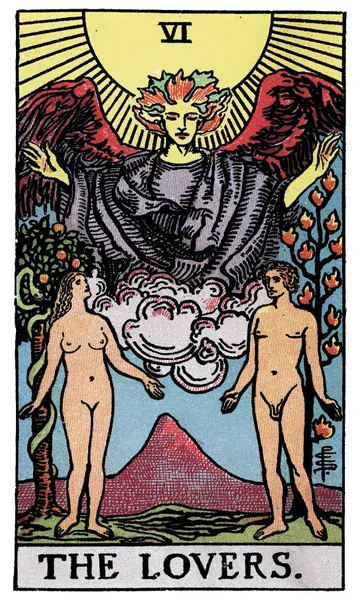
The Lovers
On The Lovers the angel is Raphael — crowned in flame, wings spread above the naked pair in the garden. Read by Waite as the higher principle under which true union is ratified; he is the light that sees them, and the condition by which they can recognize each other.
· Read this card →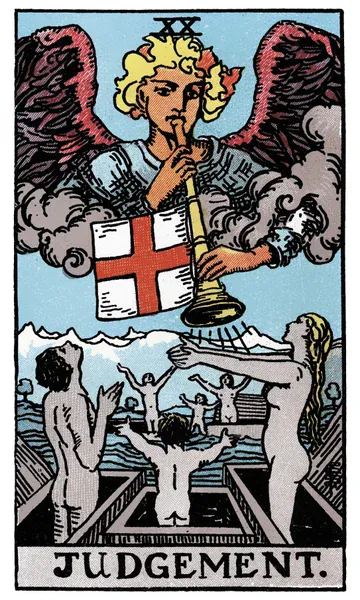
Judgement
On Judgement the angel is Gabriel — leaning out from a long cloud with a brass horn, banner trailing red on white. He does not command; he only makes the long-true sentence finally audible, fusing the Annunciation horn of Luke 1 with the seventh trumpet of Revelation 11.
· Read this card →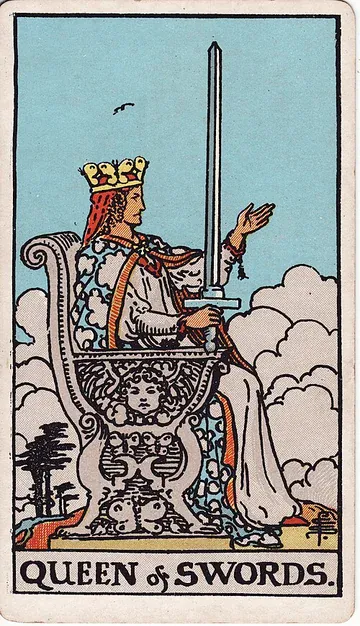
Queen of Swords
On the Queen of Swords the angels appear in low relief — cherubim carved into the throne-back, paired with butterflies. The seat is one of sacred judgement; the butterflies say judgement exists so the soul may still change, may still fly.
· Read this card →Other Symbols Nearby
The Angel belongs to the Animal category in the Tarot Atlas — the bestiary of winged and four-footed witnesses that watch the cards from above or beside the action. Read it alongside the serpent and the other creatures listed below.
Older Sources
The angelic vocabulary tarot inherits is layered. Pseudo-Dionysius the Areopagite, writing in Greek in the late fifth or early sixth century, sets out nine ranks of celestial intelligence in three triads — seraphim, cherubim, thrones; dominions, virtues, powers; principalities, archangels, angels — a scheme that Aquinas codifies in the Summa and that the medieval painters use to staff their heavens. The four most-named archangels enter Western magical practice through this stream: Michael of fire, Gabriel of water, Raphael of air, Uriel of earth, the elemental fourfold rehearsed every night in the Golden Dawn's Lesser Banishing Ritual of the Pentagram.
Two scriptural moments do most of the work on the cards. The Annunciation of Luke 1:26-38 — Gabriel addressing Mary, the long-prepared sentence becoming finally audible — gives Judgement its grammar of recognition rather than punishment. The Revelation of John 11:15 — the seventh trumpet announcing that the kingdom of the world has become the kingdom of heaven — gives Judgement its eschatological pitch. By the time A.E. Waite commissioned Pamela Colman Smith in 1909, the angel was already a precise instrument: Raphael over The Lovers (Hebrew letter Zayin, the airy current under which choice is ratified); Gabriel over Judgement (the trumpet that ends and begins history at the same beat); the carved cherubim on the throne of the Queen of Swords (the witness that judgement is meant to liberate, not to crush). Smith's three paintings stand on a hierarchy roughly fifteen hundred years deep.