
What the Fish Means
Across the Western mystery stream, the fish is the creature of the unseen depth. It belongs to the element water, and water in the Hermetic ordering is feeling, intuition, the unconscious — that which moves below the surface and only sometimes shows its face. To paint a fish on a card is therefore to picture the moment when something the depths have been holding chooses to surface, to be seen by the dry, conscious figure who stands at the margin between the two worlds.
Three layered traditions sharpen this meaning. The early Christian church used the Greek word for fish, ΙΧΘΥΣ, as a secret acrostic for Iēsoûs Christòs Theoû Hyiòs Sōtḗr — Jesus Christ, son of God, saviour — so that the fish became the password of a hunted community, knowledge that lived underwater. The Pythagoreans named fish as the emblem of echemythia, the disciplined silence by which esoteric truth is kept alive. And from the Near East, the goddesses Atargatis and the older Astarte are figured with fish as their attendants, marking the fish as a creature sacred to the matrix from which life issues. The fish therefore carries, all at once, the gnosis that survives by going underwater, the silence that protects what cannot yet be said, and the fertile darkness that is the source of speech itself.
How the Fish Appears in the Deck
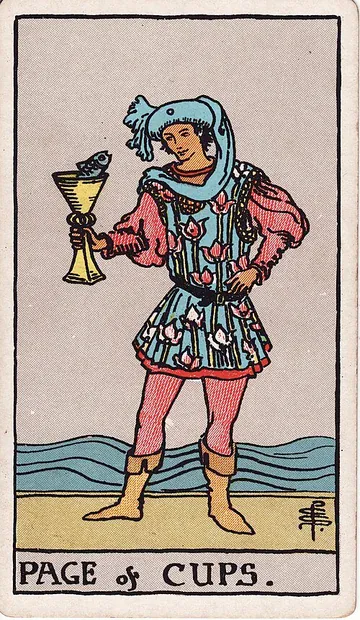
The fish enters the Rider-Waite-Smith deck only through the Cups suit — appropriate, since Cups are the painted body of the element water — and only through three of its court figures. On the Page of Cups (cups-11), a small fish leans up out of the chalice the youth holds, meeting his eye. A.E. Waite reads the Page as a young messenger of the affections, and the fish is the message itself: a sentence rising from below, unsought, asking to be acknowledged.
On the Knight of Cups (cups-12), the fish has migrated into the armour. Pamela Colman Smith scales the knight's tabard and helm-cloak in the pattern of fish-scales — the rider does not carry water, he is dressed in it. The card pictures a man whose defence is already made of his own element: he does not come to fight, but he has not come unprepared. On the King of Cups (cups-14), the fish leaps free of the throne entirely — a small silver shape arcing in the sea behind him, and a great fish-pendant resting on his chest. The king does not enter the water as the page does, nor wear it like the knight; he sits enthroned upon it, and the fish jumps in the distance to remind him whose realm he governs. Read across the three court cards, the fish maps a whole arc of the soul's relation to its own depths: in the page the message arrives, in the knight the body is shaped by the element, and in the king the depths jump by themselves, no longer needing to be summoned.
Cards That Carry the Fish
Three court cards in the suit of Cups place the Fish within the painted scene.
Hover a pin to see where the symbol sits on the card.
Page of Cups
On the Page of Cups the fish lifts its head out of the chalice to return the youth's gaze — the message of the depths arrives with its own face, and the page's task is only to recognize that the sender matters less than the sentence.
· Read this card →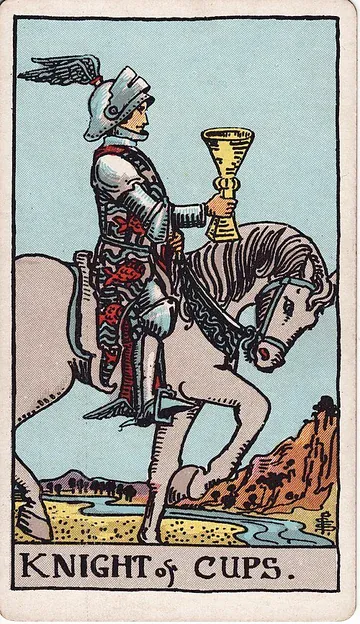
Knight of Cups
On the Knight of Cups the fish has moved into the armour itself — the tabard and helm-cloak are scaled like a fish, so the rider is dressed in the very element he carries in his cup; defence and content are made of the same water.
· Read this card →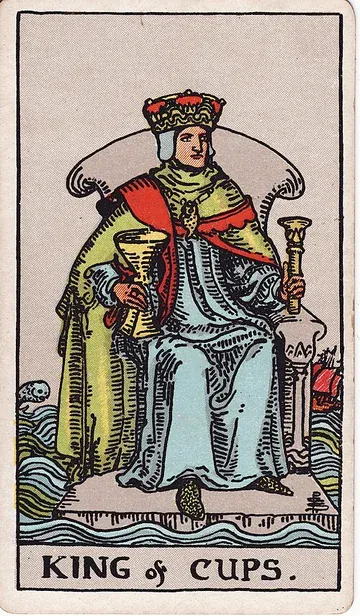
King of Cups
On the King of Cups the fish leaps free in the distance behind the throne, and a smaller fish hangs as a pendant at his chest — he does not enter the water, he governs from above it, and the depths salute by jumping where he can see them.
· Read this card →Other Symbols Nearby
The Fish belongs to the Animal category — the bestiary of creatures that act as elemental and moral witnesses to the human figures. Read it alongside the serpent, the lion, the wolf, the sphinx, the angel, and the other animals carried elsewhere in the Tarot Atlas.
Older Sources
The fish reaches the 1909 deck along three converging tracks. The first is Christian and underwater — in the centuries when belonging to the church was a capital offence, members marked their meeting-places with the simple outline of a fish, because the Greek word ΙΧΘΥΣ (ichthys) doubled as an acrostic for Iēsoûs Christòs Theoû Hyiòs Sōtḗr, Jesus Christ, son of God, saviour. Tertullian, writing De Baptismo at the turn of the third century, names the faithful pisciculi, little fishes, born in the water of baptism; the fish is the emblem of the secret community whose knowledge survives by going under the surface.
The second track is Pythagorean. Iamblichus, in the Life of Pythagoras, transmits a tradition by which the master named the fish as the figure of echemythia, disciplined silence — the fish lives in water and does not speak, and the initiate who has been admitted to inner teaching protects it the same way. The third is older still: from the Near East, the goddess Atargatis at Hierapolis and her predecessor Astarte are figured surrounded by fish, sometimes part-fish themselves; the fish is the attendant of the matrix from which life issues, the creature sacred to the great mother. Renaissance and Hermetic astrology then bound all three streams to the zodiacal sign Pisces, ♓, the two-fish sign of the late winter; the Golden Dawn tables that A.E. Waite inherited assigned Pisces to water in its most reflective and most silent mode. When Smith painted the page, the knight, and the king of Cups, every one of these layers was already loaded into the chalice — Christian acrostic, Pythagorean silence, Near-Eastern fertility, Hermetic water — and the small painted fish carries all of them at once.