What the Horse Means
Across the Western mystery stream, the horse is read as the vehicle of will. It is the noble animal — the one Greek and Roman poetry singles out as the proper companion of the warrior, the messenger, the king — and at the same time the war-steed, the body that carries violence further than a man's own legs. Its ambivalence is built into its iconography: the same animal that crowns a hero's victory carries his death across a battlefield. The horse has a temperament; it can be inspired, frightened, urged, or quieted. To be on horseback is to be moving by means of another's life, and the relation between rider and mount is therefore the central image the horse contributes to the Western pictorial vocabulary.
Plato sharpens this in the Phaedrus, where the soul is figured as a charioteer driving a noble horse and an unruly one — reason holding the reins of two contrary motions. The Hermetic and Golden Dawn traditions inherited by A.E. Waite read the four Knights of the deck as the Phaedrus charioteers split into four — one cavalier per element — so that each Knight is a particular elemental motion held under the discipline of a rider. Where the horse appears in tarot it therefore almost always asks the same question: who is on top, the will or the animal? — and answers it differently in each picture, depending on which element the rider's saddle stands in.
How the Horse Appears in the Deck
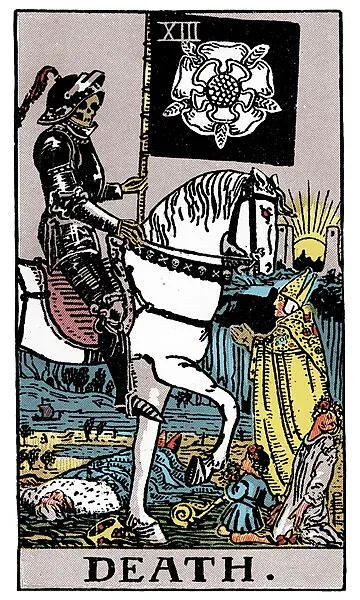
The horse surfaces three times in the Rider-Waite-Smith deck, once for each of three of the four elements. On Death (XIII), the rider sits on a pale horse — Smith's chlorós, the pallor of disease and twilight — that walks at a slow, level pace beneath a black banner. A.E. Waite reads the rider as not death so much as the gate at which one form ends and another rises through the same opening; the horse is therefore not a charger but a carriage, a level instrument that does not need to be hurried. This is the horse of the spirit element, neutral by design.
On the Knight of Pentacles (pentacles-12), the horse stands almost still in a ploughed field, its head dropped, its weight in its hooves — Smith paints it heavy and dark, the body of earth itself made into a working animal. This is the horse of patience: the strength of this Knight lives in the slowness with which the horse can pull a plough one furrow at a time. On the Knight of Wands (wands-12), the horse rears up on its hind legs in a desert, its forelegs lifted in mid-leap. This is the horse of fire: momentum, departure, the threshold at which the rider has to find direction inside the speed because the speed is no longer asking permission. Read across the three cards, the horse maps the four elemental tempos onto a single animal — the level walk of spirit, the slow pull of earth, the leap of fire. The Knight of Cups, the fourth elemental cavalier in the Golden Dawn schema, completes the set on his own white mount; though our atlas does not pin him here, his presence in the Phaedrus quartet is the silent fourth that finishes the saying. Look for him when you read the Knights together.
Cards That Carry the Horse
Three cards in the deck place the Horse within the painted scene.
Hover a pin to see where the symbol sits on the card.
Death
On Death the horse is pale and unhurried — a level instrument, not a charger. Death does not ride a favoured mount; it uses a neutral carriage. The slowness of the walk is the entire teaching: the gate is patient.
· Read this card →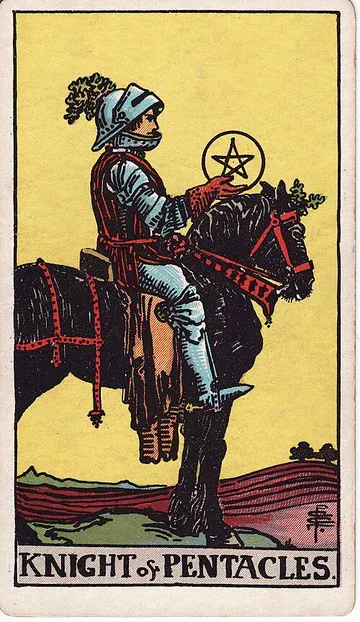
Knight of Pentacles
On the Knight of Pentacles the horse stands almost still in a furrowed field, head down, weight in its hooves. Strength here lives in the feet — this is not the charge but the plough, and the slow pull is the virtue.
· Read this card →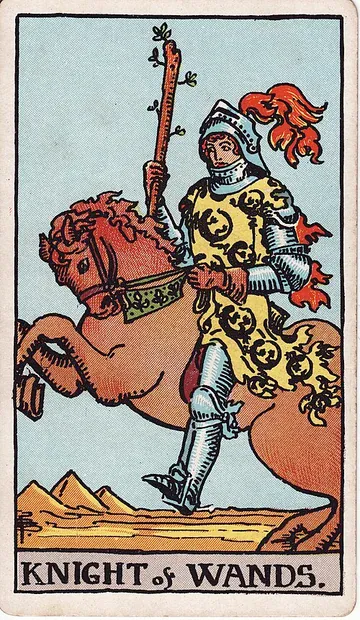
Knight of Wands
On the Knight of Wands the horse rears mid-leap in a desert, forelegs in the air. The instant before landing — both the posture of departure and the threshold of losing control. The rider must find direction inside the speed.
· Read this card →Other Symbols Nearby
The Horse belongs to the Animal category — the bestiary of creatures that act as elemental and moral witnesses to the human figures. Read it alongside the serpent, the lion, the wolf, the fish, the angel, and the other animals carried elsewhere in the Tarot Atlas.
Older Sources
The horse arrives at the 1909 deck through three converging streams. The first is Platonic. In the Phaedrus, Socrates figures the soul as a charioteer driving two horses — one noble, willing to be turned by reason; one unruly, dragging toward appetite — and reason's whole task is to keep the team in a single direction. By the Renaissance and the Hermetic revival, this picture had been read as a moral allegory of any rider on any mount: the horse is the body or the passion or the natural element, and the human task is to remain a charioteer rather than be carried.
The second stream is biblical. Revelation 6 describes four horsemen, riding white, red, black, and pale (Greek chlorós) horses; the fourth, named Death and followed by Hades, is the rider Smith paints on Death (XIII), softened from a battlefield apocalypse into a single, level walk. The third stream is the Golden Dawn synthesis A.E. Waite carried into the deck. Israel Regardie's later transcription preserves the order's teaching that the four Knights of the minor arcana are the four elemental cavaliers — Wands the fire-knight on a leaping horse, Cups the water-knight on a slow white mount, Swords the air-knight on a galloping grey, Pentacles the earth-knight on a heavy still horse — so that the Phaedrus charioteer is split into four pictures, each a particular element learning to be ridden. When Smith painted the rearing wands-knight, the still pentacles-knight, and the level horse beneath Death, every one of these layers was already there in the saddle: Plato's discipline of the soul, the Apocalypse's level walk, the Golden Dawn's elemental quartet. The fourth Knight — of Cups — completes the saying on his own white horse, though our pin atlas leaves him for the reader to find.