
What the Child Means
In the iconographic vocabulary of the Western mystery stream, the child is rarely sentimental and never decorative. Three distinct meanings braid into the single figure: innocence as unrehearsed perception, the heir as the next link in a remembered line, and the witness whose presence at a threshold guarantees that what is happening can still be seen. The child does not act on the scene; the child stands inside it as the proof that the scene is real. To paint a child into a card is to declare that some part of what is being shown has not yet been compromised by knowing.
The Christian inheritance carries two scenes that do most of this work. The Holy Innocents of Matthew 2:16-18 — the children of Bethlehem killed under Herod's order — make the child into the figure whose blood is shed for what they cannot yet name; medieval iconography pairs them with the Magi as the earliest witnesses of the Incarnation. The instruction in Matthew 18:3 — that one must become as little children to enter the kingdom — turns the figure into a spiritual return rather than a stage left behind. Jung, reading these scenes alongside myth and dream, names two faces of the same archetype: the divine child, who carries the future of the psyche in a body too small to be feared, and the puer aeternus, the eternal youth who refuses to age and so refuses to ripen. Pamela Colman Smith, painting in 1909, declines the Victorian habit of pathos: her children meet the eye level on, calm, neither pitied nor idealised.
How the Child Appears in the Deck
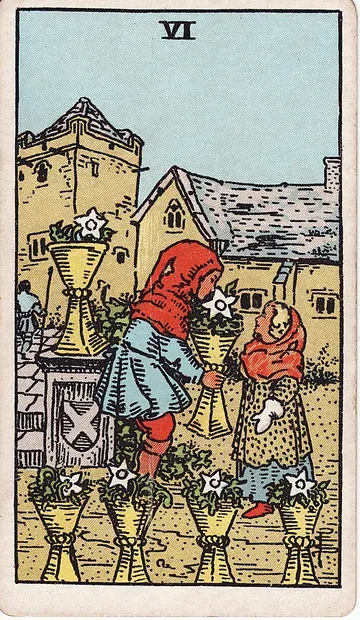
The child surfaces on three Rider-Waite-Smith cards, and each appearance does a different theological job. On the Six of Cups, two children stand in a sunlit courtyard — the older offering a cup filled with white flowers to the smaller, who receives with a gravity that is not yet self-conscious. Read by Waite as the card of remembered things, the painted detail that does the work is the parity of attention: the giver lowers, the receiver lifts, the gesture is exact. The child here is innocence as the capacity to give and receive without negotiation, the friendship before exchange has learned to keep score.
On Death (XIII), a small child kneels in the foreground before the armoured rider — eyes open, posy of flowers held up, neither fleeing nor hiding. Smith and Waite stage this child as the witness who is still permitted to look directly at what the bishop on the same card cannot meet without averted gaze. The child is not killed in the scene; the child is the figure for whom death is not yet an obscenity, only a horseman riding through. On the Ten of Pentacles, the child of the household reaches up toward two leaning hounds in the courtyard of the seated patriarch — the youngest hand making the first curious motion toward an inheritance the elders have already secured. Read across the three: the child on the Six of Cups carries innocence without strain, the child on Death carries witness without fear, and the child on the Ten of Pentacles carries the line forward without yet being asked to. The figure is one and the same — the part of the soul that has not yet been schooled into refusal.
Cards That Carry the Child
Three cards in the deck place a child within the painted scene.
Hover a pin to see where the symbol sits on the card.
Six of Cups
On the Six of Cups two children share a courtyard — the elder offering a cup of white flowers, the smaller receiving with both hands lifted. Smith paints them at the parity of friendship before exchange has learned to keep score; the card's tenderness is in the levelness of their attention, not in any sentimental appeal.
· Read this card →Six of Cups
On the Six of Cups two children share a courtyard — the elder offering a cup of white flowers, the smaller receiving with both hands lifted. Smith paints them at the parity of friendship before exchange has learned to keep score; the card's tenderness is in the levelness of their attention, not in any sentimental appeal.
· Read this card →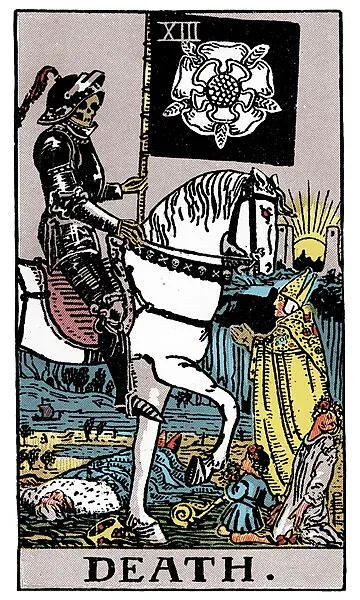
Death
On Death the child kneels in the foreground before the rider — flowers raised, eyes open. Where the bishop must turn his face aside, the child meets the horseman directly. The painted point is precise: only an eye that has not yet learned to fear can stay open at the threshold, and the card needs that eye to make its claim.
· Read this card →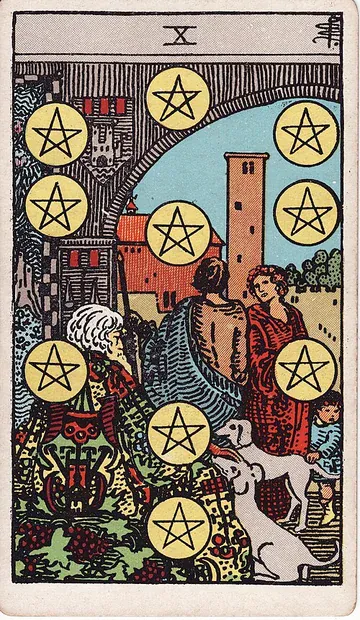
Ten of Pentacles
On the Ten of Pentacles the child of the household reaches up toward two leaning hounds in the courtyard's center — the smallest hand inside the painted family, making the first curious motion toward the inheritance the elders have already secured. The line continues not because anyone insists, but because the child reaches.
· Read this card →Other Symbols Nearby
The Child belongs to the Animal category in the Tarot Atlas — the bestiary of figures the painted scene relies on as witnesses, including the angel above and the four creatures of the throne. Read the child alongside the angel for the pair of innocent witnesses; alongside the lion, wolf, and serpent for the wider register of who is permitted to look.
Older Sources
The child as a precise iconographic figure enters Western art from at least three streams. Matthew 2:16-18 — the killing of the Holy Innocents under Herod — gives the figure its earliest theological weight: medieval altarpieces pair the slain children with the Magi, the only two groups present at the Incarnation. Matthew 18:3 — the saying that one must turn and become as little children to enter the kingdom — converts the figure from a stage of life into a spiritual orientation; Augustine and the medieval mystics reread this line for centuries as a description not of regression but of an unforced perception that adulthood has to learn to recover. The two scenes together fix the child as both martyred witness and contemplative posture.
C.G. Jung, working through dream material in the early twentieth century, names two faces of one archetype: the divine child, whose smallness is exactly what makes the future of the psyche carriable, and the puer aeternus, the eternal youth whose refusal to age becomes a refusal to ripen. The two faces explain why the child in tarot is never simply hopeful — innocence cut loose from time becomes evasion. Pamela Colman Smith, painting the deck in 1909, watched the late-Victorian habit of sentimentalising children at funerals, in advertising, in nursery prints, and refused it. Her child on Death does not weep. Her children on the Six of Cups do not pose for the viewer. Her child on the Ten of Pentacles is mid-gesture, not arranged. The figure she paints is patristic and Jungian rather than Victorian — a long inheritance that uses the child to say what only the unrehearsed gaze can say.