
What Black Means
Black is the most reticent color the deck owns. In the Western symbolic tradition it carries four overlapping readings the painted scene allows itself at any moment: mourning (the funeral garment, the long widowhood, the black armband), occult mystery (the color of what is not yet illuminated, the priest's cassock, the hidden chamber), negation (absence, refusal, the unilluminated portion of any whole), and — in the Hermetic stream — the prima materia of the alchemical work, the nigredo: the matter in dissolution before the next color can rise. Black says no in four different keys, but the no it speaks is rarely final. It is more often the color of the pause that precedes a turning, the silence the sentence leans against.
Hermetic alchemy gives black the most demanding technical sense of the four stages. Nigredo, the blackening, names the moment the matter is broken down — putrefied, dissolved, mortified — so the work can begin at all. Every later color (white, yellow, red) can only arrive because nigredo cleared the ground first. The instruction in the old treatises is severe: the soul must die before it dies. Read against the sequence — nigredo (black) → albedo (white) → citrinitas (yellow) → rubedo (red) — black is not the opposite of light but the chamber from which light is later struck. The deck's blacks sit on this seam: the cloak of grief, the unlit ground behind the throne, the cat at the heel, the small fire-creature on the floor — each a place where the work has not yet declared itself, only made room.
How Black Appears in the Deck
The deck stages black as four discreet points rather than a moving line — black is the ground, not the figure, and Pamela Colman Smith treats it accordingly. On the Five of Cups (V) it is the long cloak of the figure who stands over the three spilled vessels — the chosen garment of grief, both shelter and severance. The cloak is not punishment; it is the duration mourning has earned, the body's right to remain inside the loss for as long as the loss requires. On The Devil (XV) the ground is black behind the chained pair — not a moral judgment painted onto the scene but the unilluminated portion of the soul: the part that has not been brought into language yet, where compulsion and desire still operate without witness. The figure on the throne does not represent evil so much as the work that still needs doing in the dark.
On the Queen of Wands (XIII of the suit) black returns as the small cat at her foot — the creature folk superstition names inauspicious, kept deliberately at her heel. Her willingness to shelter what is called other is part of why her fire never goes out: the queen who can house the black cat is the queen whose sovereignty is not founded on exclusion. On the King of Wands (XIV of the suit) black is the small salamander on the ground beside the staff's foot, lifting its head to return the king's gaze — a creature of the same kin as the pattern stitched on the cloak, only still small. The fire's heir is already present, only the king has not yet pronounced it. Read the four together — Cups, Devil, Queen, King — and black draws the line from grief through occult ground to the kept creature: the color of what the work must include rather than overcome.
Cards That Carry Black
Four pinned instances of black across the deck — one minor (Five of Cups), the trump XV, and the two senior wands court cards. Its meaning shifts from cloak, to ground, to kept creature, to small fire's-heir.
Hover a pin to see where the symbol sits on the card.
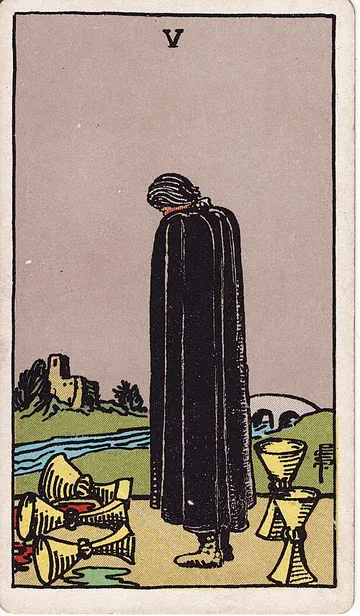
Five of Cups
On the Five of Cups the black is the long cloak of the figure who stands over the three spilled vessels — the chosen garment of grief, both shelter and severance. Mourning has its duration; black is the color the body wears while that duration runs.
· Read this card →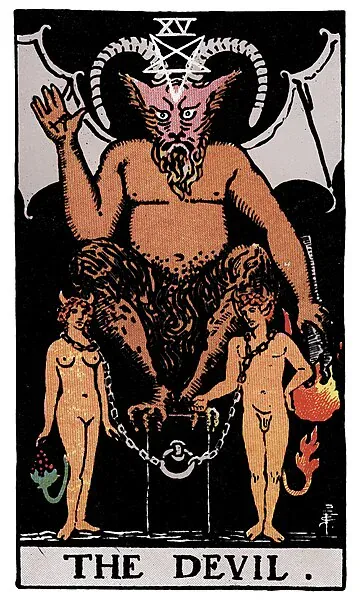
The Devil
On The Devil the black is the unlit ground behind the throne — not a moral judgment but the part of the soul that has not been brought into language. The chains hang loose; what holds the figures is the unconsciousness of the bond, not the iron. Black here is the work that has not yet been done.
· Read this card →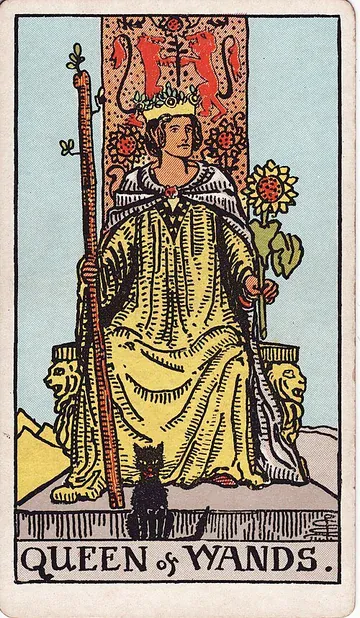
Queen of Wands
On the Queen of Wands the black is the small cat at her feet — the creature folk superstition names inauspicious, deliberately kept at her heel. Her willingness to shelter what is called other is part of why her fire never goes out.
· Read this card →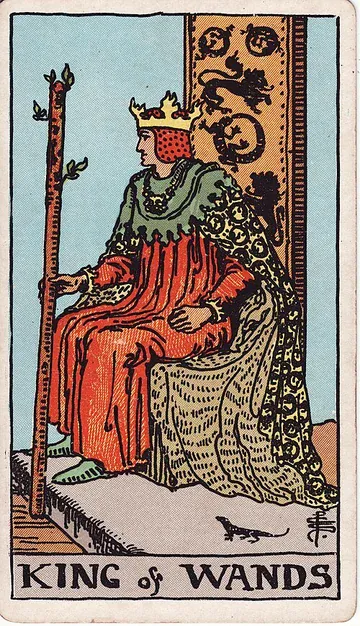
King of Wands
On the King of Wands the black is the small salamander on the ground beside the staff — same kin as the pattern stitched on his cloak, only still small. The fire's heir is already present in miniature; the king's gaze has just found it.
· Read this card →Other Symbols Nearby
Black belongs to the Color category — the painted hues that carry doctrinal weight inside the scene. In the alchemical sequence it is the opening term: nigredo → [white](/guide/symbols/white) (albedo, the washed soul) → citrinitas → [red](/guide/symbols/red) (rubedo, the completed work). The three together form the visible spine of the Great Work, and the entries on white and red carry the rest of the arc. Other colors in the atlas (grey, golden, blue, green) are catalogued in the index, with long-form essays following.
Older Sources
Black is the oldest color of the threshold. Egyptian funerary practice painted the resurrected Osiris green, but the gateway to the underworld he ruled was rendered black; Greek chthonic ritual offered black animals to the powers below the earth, distinguishing them from the white offerings owed to the Olympians above. The Hebrew Bible threads black through mourning (Job 30:30, the skin grown black with grief; Lamentations 4:8, the once-radiant Nazarites darkened beyond recognition). The Roman Catholic liturgy retained black vestments for Good Friday and the Office of the Dead through the Tridentine missal; only after the Second Vatican Council was violet admitted as an alternate. Across medieval and early-modern Europe, black settled in as the dominant funeral hue once the older bridal-and-funeral white receded — the long Spanish black of the Habsburg court and the Dutch bourgeois black of the seventeenth century are the visual record of that settlement.
The technical reading runs alongside. From the early Latin alchemical treatises through Paracelsus and the seventeenth-century rosicrucian compendia, the Hermetic stream names the four color stages of the Great Work — nigredo, albedo, citrinitas, rubedo — and assigns nigredo to the prima materia: the matter in dissolution, the corpse blackening in the sealed vessel, the soul that must die before it dies in order for any later whitening to be possible. C.G. Jung's Mysterium Coniunctionis (1955-56) reads the entire sequence as a psychic process and reserves nigredo for the encounter with the shadow — the moment the unconscious has been broken open enough to be confronted, before any reconciliation. The Hermetic Qabalists of the Golden Dawn add a parallel note: Daath, the hidden eleventh sephirah named the Abyss, is rendered black where it is rendered at all — the gap on the Tree across which knowledge cannot pass without losing itself. Saturn, the lead-stage of the planetary work, takes its severe black-and-grey palette from the same family of associations. Pamela Colman Smith's blacks — the mourner's cloak, the Devil's ground, the queen's cat, the king's small salamander — sit on top of this stack. They are the figure of the room before the candle is struck.