
What Gold Means
Gold in the Western symbolic tradition is not a brighter yellow. It is the metal — and the meaning the metal carries lifts it out of the color register and into a register of its own. Four readings overlap on every painted gold in the deck. First, divine radiance: from the gold leaf of Byzantine icons through the gilt of Flemish altarpieces, gold is the visible sign of light that does not belong to this world — the supersubstantial light Pseudo-Dionysius names in The Celestial Hierarchy, set down in pigment because it cannot be set down in paint. Second, royal sovereignty: the crown, the sceptre, the seal — gold reserved for the body politic's apex, the metal of legitimate command. Third, incorruptibility: alone among the metals known to antiquity, gold does not tarnish, does not rust, does not corrode in the body or the grave. It is the metal that survives. Fourth, the alchemical telos: the Hermetic Great Work names aurum philosophicum, the philosophical gold, as its end — base metal returned to the incorruptible state it was always meant to wear. Gold is therefore the only color in the deck that means simultaneously "holy," "royal," "deathless," and "finished."
Inside Lunarcana itself, gold carries a fifth, self-reflexive weight that the reader of this entry already encounters on every page. The site's design rule is that gold is a threshold signal only — brand sigil, ritual moment, drop cap, the edge of a card flipping, the revealed position label, the moon phase. Default ink is ivory; gold appears where one register turns into another. This is not arbitrary aesthetic preference but a translation of the historical reading: a working grimoire that deploys gold as common decoration would have flattened, by use, the very grammar this symbol carries. So the rule names itself in the writing as well: when this entry uses gold (the symbol), it does so under the same austerity the site applies to gold (the color). The two are kept in agreement so that one can keep teaching the other.
How Gold Appears in the Deck
Pamela Colman Smith uses gold sparingly enough that each appearance carries weight. On VIII Strength, the lemniscate hovering above the woman's head is painted gold — the same horizontal eight that hovers over I The Magician. Eliphas Lévi reads this glyph as the sign of the living: force in continuous motion, what does not run out. On Strength the sign is gold because what the figure is doing — closing the lion's jaw without violence — is exactly the alchemical gesture: the base appetite is not killed, it is integrated, and gold names the metal of that integration. The lemniscate is not a halo of personal sanctity but the visible mark of the Work proceeding correctly.
On the Ace of Pentacles, the coin the hand from the cloud offers is gold and radiant — the suit's element (earth) given in its noblest form. The card is not promising material wealth so much as showing earth itself raised to its incorruptible register: the gift is solid, but the solidity is sacramental, the metal already bearing the alchemical weight. The walled garden, the rose-covered arch, the path leading out — all framed by the offered gold as the gift that begins the suit's whole arc. To accept the Ace of Pentacles is to accept that what is given is not just a coin but a coin made of the metal that does not tarnish.
On the Ace of Swords, the gold is the crown already set on the sword's point as it rises out of the cloud. This is the same grammar as the Pentacle, displaced into air: the sword is not yet wielded, but the crown is already on it. Gold here is sovereignty that precedes action — the truth carries authority before it is enforced; the legitimacy is part of what is being raised, not earned afterward. Read the three together — Strength's lemniscate, the golden Ace of Pentacles, the crowned Ace of Swords — and gold marks the same thing each time: the moment a faculty is shown in its noblest, incorruptible form. Will integrated, matter sanctified, truth crowned.
Cards That Carry Gold
Three cards in the deck place gold in a load-bearing position — not as costume detail but as the metal of the Work. Its meaning shifts from integration, to gift, to crown.
Hover a pin to see where the symbol sits on the card.
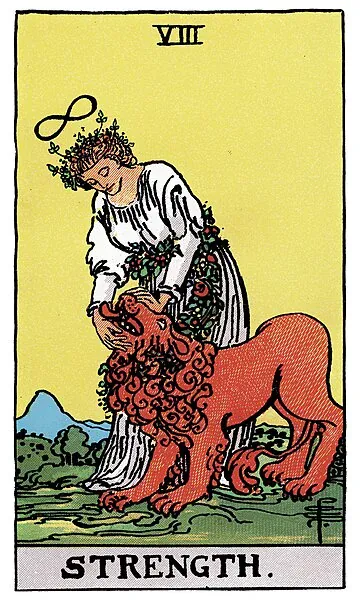
Strength
On Strength the gold is the lemniscate above her head — the same horizontal eight that hovers over The Magician. Lévi reads this as the sign of the living: force in continuous motion. Painted gold rather than gold-tinted because what she is doing — closing the lion's jaw without violence — is exactly the alchemical gesture, and gold is the metal of that integration. Not a halo of personal sanctity; the visible mark of the Work proceeding correctly.
· Read this card →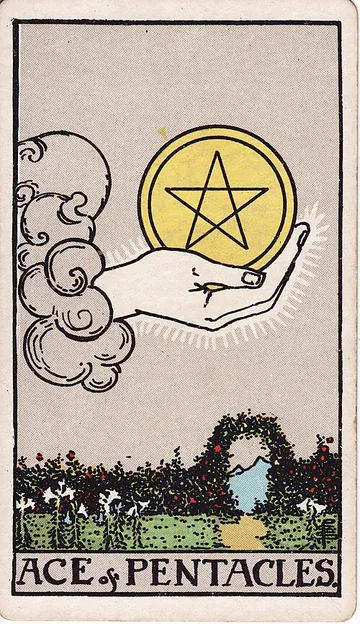
Ace of Pentacles
On the Ace of Pentacles the gold is the radiant coin itself, offered from the cloud above the walled garden. Earth's element given in its noblest form — the gift is solid, but the solidity is sacramental. The card does not promise wealth; it shows earth raised to its incorruptible register, the metal already bearing the alchemical weight before any human hand has held it.
· Read this card →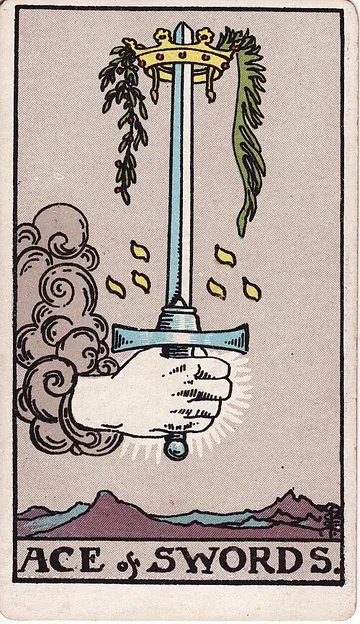
Ace of Swords
On the Ace of Swords the gold is the crown already set on the sword's point as it rises out of the cloud. The sword is not yet wielded, but the crown is already on it. Gold here is sovereignty that precedes action — truth carries authority before it is enforced. The legitimacy is part of what is being raised, not earned afterward.
· Read this card →Other Symbols Nearby
Gold belongs to the Color category — the painted hues that carry doctrinal weight inside the scene. Its formal sibling in the alchemical sequence is red (rubedo): red is the Work made visible by the color of fire-passed matter, gold is the Work made permanent in metallic form. The two are best read across each other — see the entry on red for the chromatic phase that immediately precedes the metallic apex. White (albedo) sits earlier in the same sequence, the washed soul that has not yet reddened. Other colors in the atlas (black, grey, blue, green) are catalogued in the index, with long-form essays still forthcoming.
Older Sources
Gold's symbolic life is older than any deck by some five thousand years. The Egyptian dynasties named gold the flesh of the gods — the skin of Ra, the metal that did not tarnish in the tombs and so could carry a body across into the next world unchanged. The Pharaoh's death-mask is the canonical witness; the Mesopotamian temple inventories, the Lydian gold coinage of Croesus in the sixth century BCE, the gold of the Hebrew sanctuary (Exodus 25 — the ark of the covenant overlaid within and without with pure gold) — all stand in the same lineage. Gold is the metal of the threshold between the mortal and what is above mortal, and the cultures of the ancient Near East and Eastern Mediterranean coincided early on this reading. Pseudo-Dionysius the Areopagite, writing in late antiquity (5th c. CE), gives the doctrinal form: in The Celestial Hierarchy gold figures the supersubstantial light by virtue of its refusal to tarnish — a metal that does not yield to time stands, in the iconographic vocabulary, for what does not yield to time.
Hermetic alchemy from the early Latin treatises through Paracelsus into the rosicrucian compendia of the seventeenth century gives gold its operative meaning. The Great Work — nigredo, albedo, citrinitas, rubedo — is named, in its outward sign, the transmutation of base metal into gold; in its inward sign, the integration of the soul into its incorruptible Self. The aurum philosophicum, the philosophical gold, is the Work's terminus. C.G. Jung's Mysterium Coniunctionis (1955-56) reads the entire alchemical corpus as a psychic process and reserves the gold for the integrated Self — what survives the purifications because it was always, beneath the corrosion, what the metal was. Gold is not a goal added to the soul; it is what the soul is restored to.
Lunarcana's design rule on gold is downstream of all this — and explicitly so. The site treats gold as a threshold signal: brand sigil, ritual moment, drop cap, card-flip edge, revealed position label, moon phase. Default ink is ivory. The reasoning is not aesthetic but historical: gold deployed as common decoration would have spent, by use, the grammar this symbol carries. A working grimoire that wants to keep gold meaning what gold has meant for five thousand years has to use it the way the tradition uses it — at thresholds, at completions, at the moments where one register turns into another. The reader who notices the brand sigil glow gold at session start, or the moon phase glow gold at the top of the page, is reading the same grammar Smith painted on Strength's lemniscate and on the radiant Aces. Gold names the threshold; the rule keeps the name working. This is not self-promotion; it is voice-coherence — when the site itself participates in the symbol it is teaching, the teaching has a body to point to.