
What Red Means
Red is the most insistent color the deck owns. In the Western symbolic tradition it carries four overlapping readings the painted scene draws on by turn: blood (sacrifice, kinship, the wound that proves the body is alive), eros (desire that has not yet been refined, the heat of the unbroken animal), imperium (sovereignty, the worn purple-and-red of kings and cardinals, the color reserved for power), and the wrath that overflows into hellfire (the punitive flame, the dragon, the punishing color of judgment in older psalters). Red says yes in four different keys — yes to body, yes to want, yes to rule, yes to the burn. The Far-Eastern reading of red as a festive color belongs to a different tradition than the one Pamela Colman Smith painted from; in the Western frame the festive note is present but never dominant.
Hermetic alchemy gives red the most exalted technical sense in the entire color sequence. The Great Work runs nigredo (the blackening, putrefaction) → albedo (the whitening, purification) → citrinitas (the yellowing, the dawn of the spiritualized matter) → rubedo (the reddening, completion). Rubedo is the king restored in his color — the philosopher's stone made visible, the matter that has been through the fire and now glows with what cannot be burned again. Every red in the deck can be read against this terminus: the cloak of will, the mountain of consolidated rule, the wing of the tempering angel, the banner above the solar child, the ribbon that closes the wreath. Red is the color the work wears when it is finished.
How Red Appears in the Deck
The deck stages red as a moving line through the major arcana, beginning with the Magician (I) — the outer robe red, the undershirt white, will and intention paired at the body. On the Emperor (IV) it is the red mountains behind the throne — stability that has been through fire, and the imperial red of the long robe under the armor — sovereignty visualized as a color that does not fade. On Temperance (XIV) red marks the wings of the angel as a sign of solar fire (the archangel Michael, traditional patron of the sun, by Hermetic attribution) — the tempering spirit clothed in the color of what it tempers.
The line then climbs to its high places. On The Sun (XIX) red is the great banner and the plume of the child — the life-fire, vivid but no longer scorching, blood-and-flame at full daylight. On The World (XXI) the two red ribbons knot the wreath at top and bottom: the red is now framing rather than burning, the two ends of the infinity sign keeping completion held inside continuing. Red has reached its final station; the work is wearable.
Two minor cards reprise the arc in the wands suit, where fire is the elemental key: the Page of Wands wears the red feather of the messenger on the road, and the Knight of Wands rides under a flame-red plume that stays upright in the wind even at gallop. The Page of Cups adds a softer note — the red cloth at the cap is not battle-red but a covering that lets the mind stay porous. Read the line in order — Magician · Emperor · Temperance · Sun · World, with the wands court as descant — and red draws the full alchemical arc: from will (rubedo as ignition) through rule, through tempering, through joy, into the worn red of the completed work.
Cards That Carry Red
Eight pinned instances of red across the deck — five from the major arcana plus three court cards in wands and cups. Its meaning shifts from will, to mountain, to wing, to banner, to ribbon.
Hover a pin to see where the symbol sits on the card.
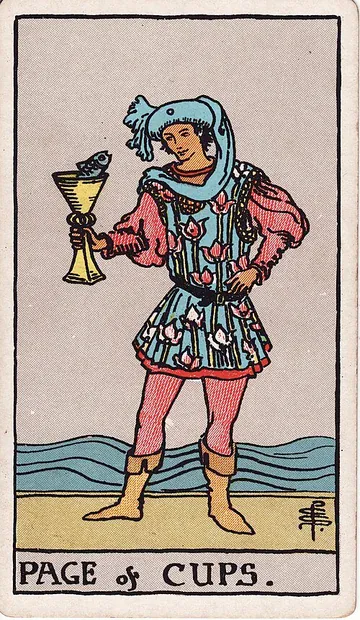
Page of Cups
Not a helmet — a covering that lets the mind stay soft and able to hear.
· Read this card →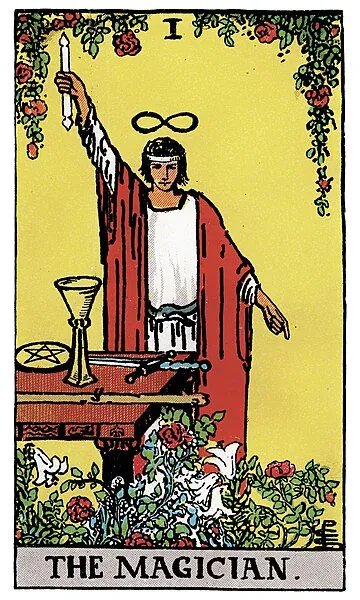
The Magician
On the Magician the red is the outer robe, with the white undershirt beneath — will worn outward, intention kept clean. The pairing is the entire reading: red without white is force; white without red is silence; the Magician needs both at the body for the work to land.
· Read this card →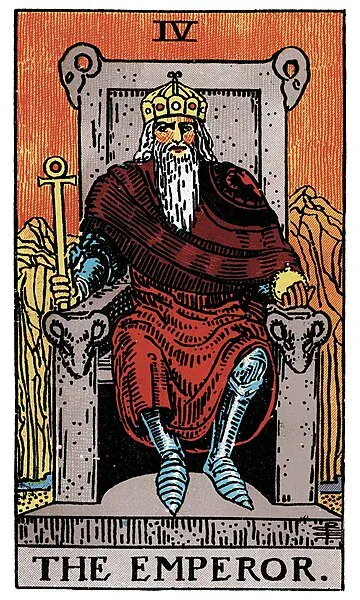
The Emperor
On the Emperor the red is doubled — the long imperial robe and the dry red mountains behind the throne. The mountain has been through fire and remains; the robe says the same of the rule. Red here is the color of authority that has paid its temperature.
· Read this card →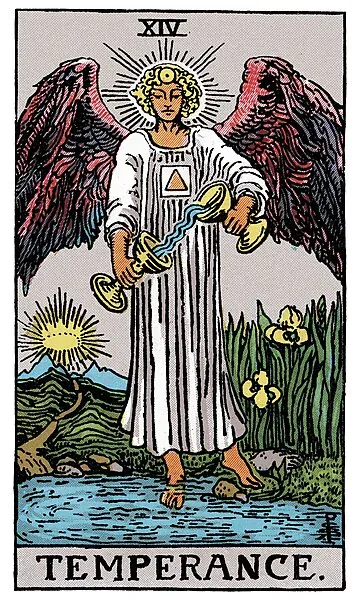
Temperance
A tempering spirit belonging to neither water nor fire — by standing still it draws both currents into one flow.
· Read this card →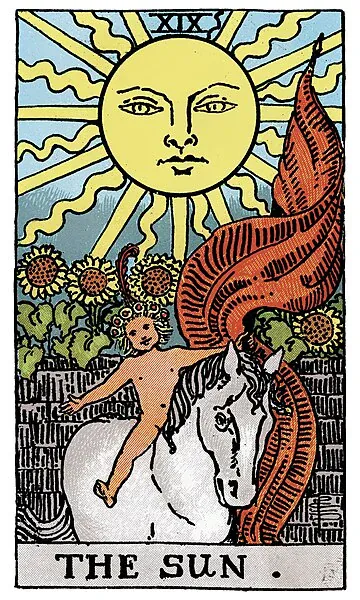
The Sun
On The Sun the red is banner and plume — flame red and blood red at the same time. At full daylight, under the laughing solar face, the life-fire is finally vivid without scorching. This is the only place in the deck where red and the white horse share the same body of light.
· Read this card →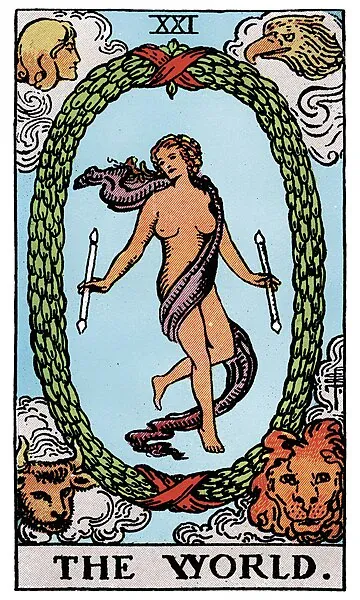
The World
On The World the two red ribbons knot the wreath top and bottom — the two ends of the infinity sign. Red has stopped burning and started framing; completion is being held inside continuing. This is the rubedo at rest.
· Read this card →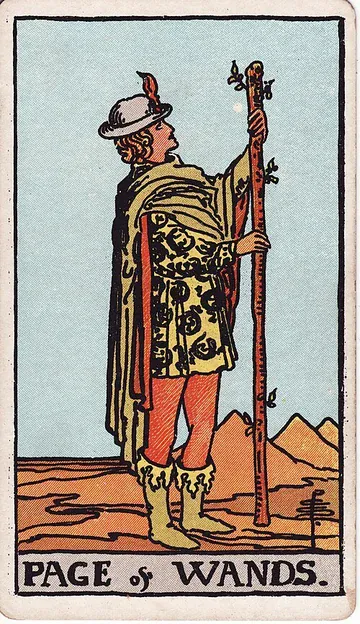
Page of Wands
Not a helmet — a messenger's cap; it announces he is on the road, not on the battlefield.
· Read this card →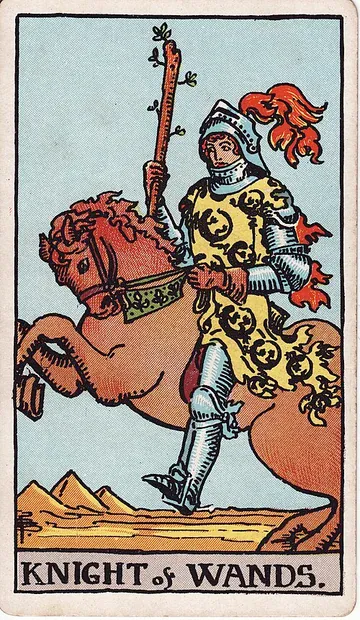
Knight of Wands
The flame above his head — even at gallop, it stands upright in the wind, unbent.
· Read this card →Other Symbols Nearby
Red belongs to the Color category — the painted hues that carry doctrinal weight inside the scene. Its formal pair in the alchemical sequence is white (albedo): white is the washed soul, red is the completed work. The two are best read together — see the entry on white for the other half of the arc. Other colors in the atlas (black, grey, golden, blue, green) are catalogued in the index, with long-form essays still forthcoming.
Older Sources
Red is the oldest pigment ground by human hands — the ochre of the burial caves and the cinnabar of the temple walls precede every other color in the painted record. The Hebrew Bible threads scarlet and crimson through the sanctuary cloth (Exodus 26:1) and into the rite of purification (Numbers 19:6); the Roman triumphator was painted red in his face for the day of his victory, his color borrowed from Jupiter Capitolinus. The Christian liturgy assigns red to two great charges — the Holy Spirit at Pentecost (Acts 2 records the tongues of fire descending on the disciples) and the blood of the martyrs — both reasons for which the cardinal still wears the color in the Roman church. Imperial red runs alongside: the murex purple of Tyre shaded toward red in actual dye, and Byzantine emperors restricted that crimson-purple to the throne.
The technical reading runs alongside again. From the early Latin alchemical treatises through Paracelsus and into the seventeenth-century rosicrucian compendia, the Hermetic stream names the four color stages of the Great Work — nigredo, albedo, citrinitas, rubedo — and assigns rubedo to the completed end. Rubedo is the philosopher's stone made visible, the king restored in his color, the matter that has gone through dissolution and whitening and yellowing and now wears red as the proof that the fire is finished. C.G. Jung's Mysterium Coniunctionis (1955-56) reads the entire sequence as a psychic process and reserves rubedo for the integrated self — the Self with its full energetic charge restored, no longer pale. Pamela Colman Smith's reds — Magician's robe, Emperor's mountain, Temperance's wing, Sun's banner, World's ribbon — sit on top of this stack. They are the figure of the moment after the work, when the color has been earned.