
What the Castle Means
Across the iconographic vocabulary of the Western mystery stream the castle is the figure of the home not yet reached. Medieval Europe used the word for at least four overlapping things: the seat of a sovereign whose authority radiates from a single tower; the defensive enceinte that decides who is inside the wall and who is not; the spiritual home, the shape onto which the soul's longing for return projects itself; and, most of all, the unattained goal — the painted point in the distance toward which the chivalric romance is structured. To read the castle is to admit that the painted scene has somewhere it is meant to end, and that the figure in the foreground is in some specific posture toward that ending.
The structural inheritance the painter is drawing from is the medieval Arthurian quest. Chrétien's Grail castle in the 1180s is the originating image: the Fisher King's hall, encountered once and lost, is the unreached home that the rest of the hero's life is organised around. By the time of Malory's 1485 Le Morte d'Arthur the convention is settled — Camelot at the centre, the surrounding castles of trial and refuge, Galahad and Perceval and Lancelot each defined less by what they wear than by what they are riding toward. By the time Wagner writes Parsifal in 1882, Montsalvat — the high castle where the Grail is kept — is read as a figure of the inner home that asks an entire life of wandering before its gates will be recognised. The painter who places a small towered shape on the far hill of a 1909 tarot is invoking eight hundred years of that convention: the soul has a home, and the home is at altitude, and the road is the body of the picture.
How the Castle Appears in the Deck
The castle is one of the few symbols that distributes itself almost as a typology. Four cards in the Rider-Waite-Smith deck place a castle in their painted scene, and the remarkable thing about that quartet is that it constitutes a complete spectrum of the relationships a figure can hold to her unreached home. On the Five of Cups the castle stands across the river, with a bridge already built — the figure has turned away from a home that is still there and still reachable, and the iconographic claim is that grief is sometimes the inability to look up. On the King of Pentacles the castle stands at the edge of the garden, behind and slightly to the right of the seated king — a home already attained, a stability so settled that he need not look at it to know it is there. On the Eight of Swords the castle stands on the far hill, behind the bound and blindfolded figure on the marshy plain — a home she has left, the system whose rules she once helped make, now visible only as something she is still obeying though she has walked beyond its wall. On the Ace of Wands the castle stands at the far end of the landscape, ahead of the freshly leafing staff — a home not yet reached, painted small enough that the foreground gift does not have to compete with it, but always present so that the gift is understood as having a destination.
Read across these four cards together and the symbol resolves into one statement of unusual clarity. The deck does not paint a castle to fill the corner; it paints a castle to assign each figure a specific posture toward home. Five of Cups: home left, still reachable — the grief of not turning around. King of Pentacles: home attained, no longer questioned — the stability of arrived life. Eight of Swords: home left, no longer wanted, but still legislating — the bondage of a system one has technically walked out of. Ace of Wands: home not yet reached, freshly oriented — the staff sprouts knowing where its road ends. There are exactly four relationships a person can hold to her unreached home, and the deck has painted all four. This is not a coincidence; it is a small piece of design.
Cards That Carry the Castle
Four cards in the deck place a castle within the painted scene — and together they form a complete typology of the relationships one can hold to one's unreached home.
Hover a pin to see where the symbol sits on the card.
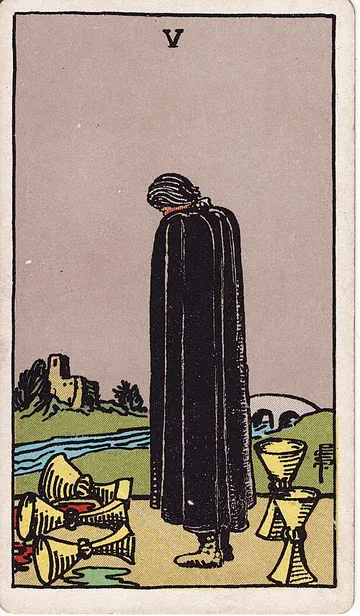
Five of Cups
On the Five of Cups the castle stands on the further bank with a bridge already built. The home is still there, the road is already laid; the figure's grief is the temporary inability to lift his head from the spilled cups long enough to see it.
· Read this card →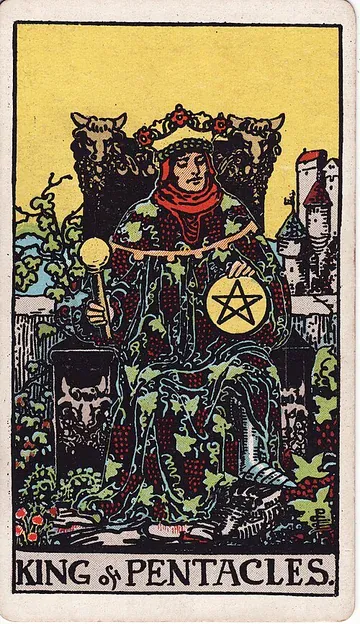
King of Pentacles
On the King of Pentacles the castle stands at the edge of the garden, behind the seated figure. He does not look at it; he does not need to. Real stability does not require repeated checking — the home that has been built no longer asks to be re-counted by the eyes.
· Read this card →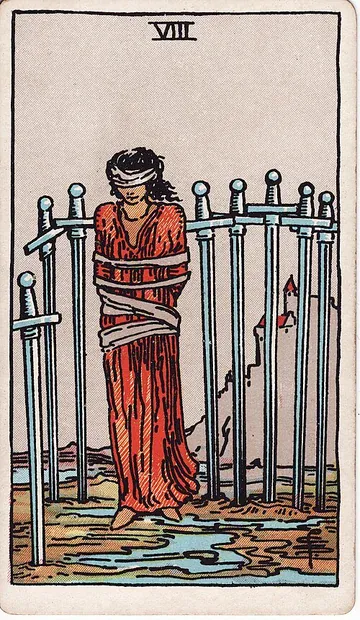
Eight of Swords
On the Eight of Swords the castle stands on the far hill, behind the bound figure. It is the system she once helped author and has technically left. She stands at the system's edge now and yet still obeys it — the home she has departed, but whose rules continue to govern the body that departed.
· Read this card →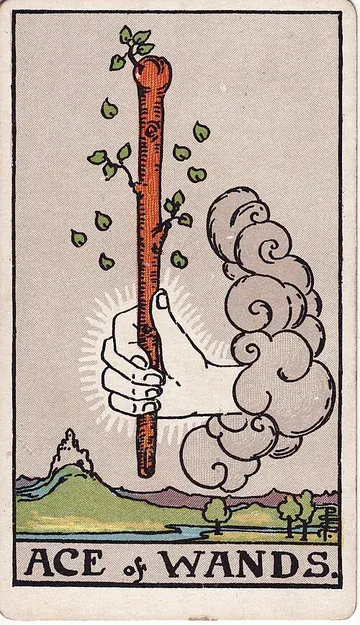
Ace of Wands
On the Ace of Wands the castle stands at the far end of the landscape, ahead of the staff. It is not the goal of this moment but of the whole road — painted small precisely because to paint it close would be to lie. Let the staff sprout first.
· Read this card →Other Symbols Nearby
The Castle belongs to the Landscape category — the slow features of sky, ground, and water that frame the human figure. It sits beside the mountain, the sun, the moon, and the path that runs toward all of them. Read these alongside it.
Older Sources
The castle's iconographic depth predates tarot by several centuries and is layered from at least three streams. From the practical military architecture of medieval Europe comes the literal castle — keep, curtain wall, gatehouse, towered enceinte — the home of a sovereign whose authority is built into stone. From the courtly literature of the high Middle Ages comes the romance castle — the Fisher King's hall in Chrétien de Troyes' Perceval (1180s), the trial-and-refuge castles of Malory's Le Morte d'Arthur (1485), the towered habitations of allegory in The Romance of the Rose. From the late nineteenth century, just before Smith painted the deck, comes Wagner's Parsifal (1882) and its Montsalvat — the high castle where the Grail is kept and to which the wandering hero must finally return. By 1909 these three streams had been fused for centuries: the painted castle on a tarot card is at once a real keep, a romance destination, and an inner home, and the painter is not required to disambiguate.
Pamela Colman Smith's particular contribution is the reduction. She paints the castle small — a few towers on the far hill, a bridge across the middle distance, an outline against the horizon — and lets that smallness do the work. A castle painted close would be the figure's present circumstance; a castle painted far is the figure's relationship to her unreached home. The decision to paint it always far is what allows the four castle cards to read as the typology they form.