What the Horizon Means
Across the iconographic vocabulary of the Western mystery stream, the horizon is the most easily missed of the landscape symbols, because it is the line by which every other feature is measured rather than a feature itself. In oil and watercolour painting the placement of the horizon is treated as a declaration about the painter's eye: a low horizon makes the figure tall and the sky vast, a height that reads as monumental; a high horizon makes the foreground intimate and the world close, a near-ground readable in detail. Ruskin in Modern Painters frames the choice as moral — the painter who places the horizon decides what scale of human life she is willing to permit the picture.
The horizon is also the figure of a specific philosophical structure: the boundary between the known and the not-yet-arrived. As you walk toward it, it walks with you; you can never reach it, only push it further out. The phenomenologists of the early twentieth century — Husserl writing in 1913, Heidegger writing in 1927 — gave this everyday geometric fact a name: the horizon is the always-implicit limit of any present experience, never itself given as object, always co-given as the edge beyond which more world is waiting. To paint a horizon line on a tarot card is to admit the picture has a beyond; to paint it deliberately at the height it sits is to assert that the figure inside the picture, and the reader looking at it, share the same eye-level — that what one sees, the other is also seeing.
How the Horizon Appears in the Deck
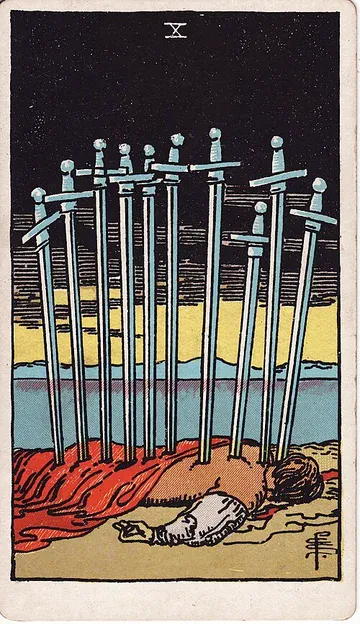
The horizon is present, as a line, in nearly every Rider-Waite-Smith card; what makes it a symbol on three particular cards is what is happening on it. On the Ten of Swords the horizon at the back of the painting is touched by a thin band of brightening sky — the dawn the figure cannot yet see, the pictorial proof that this is the moment after which it cannot get any worse. The despair is in the foreground; the answer is on the horizon, and the answer is unconditional, because dawn does not depend on whether the figure is ready to receive it.
On the Page of Wands and the Knight of Wands the horizon carries pyramidal shapes — the three triangular forms that read at once as Egyptian monuments and as the geometry of a chosen direction. On the Page the pyramids are the apprentice's distance: ancient, unmoved, a goal that has been there longer than the youth has been alive and will be there long after he is gone. On the Knight the same shapes mark the heading already taken — the rider has chosen, the horse has reared, and the pyramids name not the speed of the journey but the direction of it. Read across these three cards together and the symbol resolves into a single statement: the horizon in tarot is the line between what one is already inside and what is still being walked toward, and what the painter places on it is the painter's claim about which way to keep walking.
Cards That Carry the Horizon
Three cards in the deck make the horizon itself the meaning of the painted scene — what sits on it, and how the figure stands toward it.
Hover a pin to see where the symbol sits on the card.
Ten of Swords
On the Ten of Swords the brightening band at the back is the answer the foreground cannot yet see. Dawn arrives unconditionally — not as rescue, not as miracle, but as the hour at which day was always going to come. The horizon is the picture's permission to keep reading past the body in the foreground.
· Read this card →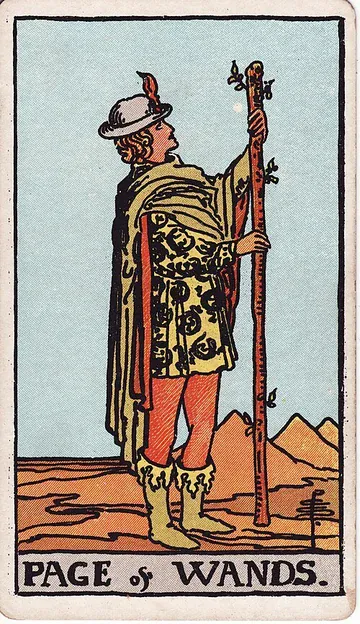
Page of Wands
On the Page of Wands the pyramids at the horizon are the apprentice's distance — ancient, unmoved, present long before he was and present long after. He does not yet know how far the road will take him; the horizon already does.
· Read this card →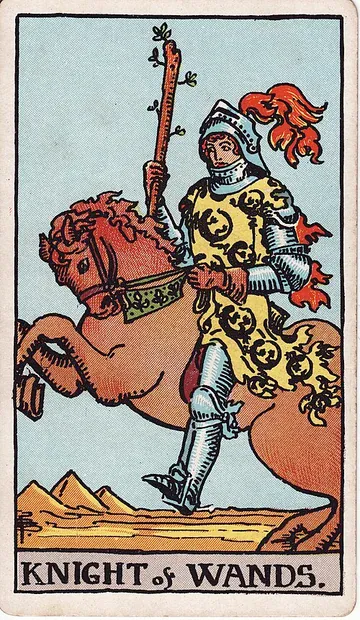
Knight of Wands
On the Knight of Wands the same pyramidal horizon marks not speed but heading. The rider has chosen — the rearing horse, the leafing wand, the desert beyond — and the horizon names the direction the choice has already committed to.
· Read this card →Other Symbols Nearby
The Horizon belongs to the Landscape category — the slow features of sky, ground, and water that frame the human figure. It is the line every other landscape symbol is measured against; read it beside the mountain (which rises from it), the castle (which stands on it), the sun (which crosses it), and the field (which lies below it).
Older Sources
The horizon's iconographic depth comes from two streams that converge in Smith's hand. From the European painting tradition, codified through the Renaissance treatises on perspective and elaborated in Ruskin's nineteenth-century Modern Painters, comes the discipline of the horizon as the painter's first declaration: where it sits decides whether the picture is monumental or intimate, public or private, sky-led or ground-led. Smith's published 1908 essay "Should the Art Student Think?" makes the same claim in plainer language — picture-making begins with a decision about where to place the eye. Across the Rider-Waite-Smith deck she places the horizon almost always at human eye-level: not low and grand, not high and intimate, but at the height a standing reader would see it from. The pictorial effect of this decision is a kind of communion — figure, reader, and distant goal all share one eye-level, so that what the figure sees, the reader is also looking at.
From philosophy comes the horizon as a structural feature of any experience whatsoever. The phenomenologists of the early twentieth century — Husserl in Ideen (1913), Heidegger in Being and Time (1927) — used the word for the always-implicit boundary of present consciousness: never itself the object of attention, always co-given as the edge beyond which more world is waiting. They were naming, in technical prose, what every walker already knows — that the line ahead recedes as you walk toward it, that you cannot reach it, that the act of moving toward it is what reveals more of it. Smith was not reading Husserl; she was painting the horizon her own teachers and the European tradition had handed her. But the symbol the philosophers named in 1913 is the symbol the deck of 1909 had already painted: the line that proves the picture has a beyond, and that the road does not end where the foreground does.