What the Field Means
Across the iconographic vocabulary of the Western mystery stream, the field is the figure of cultivated ground. It is decisively not wilderness — not the forest the Fool walks out of, not the meadow on which beasts wander untended. The field is earth that has been opened, ploughed, sown, and agreed to a contract with the people who work it. Where the mountain is the unreached altitude and the horizon is the distance always receding, the field is the part of the landscape that has said yes — that has consented to a calendar, a rotation, a name. To paint a field on a tarot card is to claim that some part of nature has already been brought into community, and that what grows there grows because hands have been laid on it.
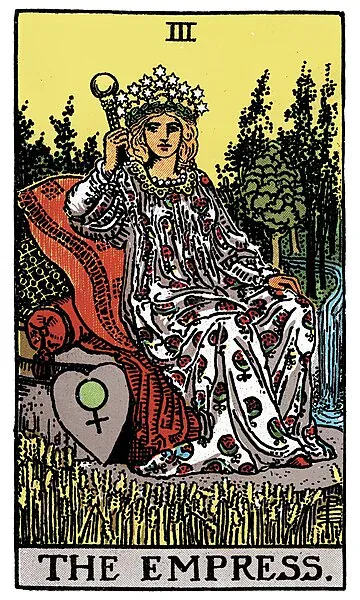
The field also carries the double charge of fertility itself. The sacred fertility of the Empress, with corn at her feet and pomegranates on her gown, is one register: ground as the body of Demeter, mother of grain, whose grief halts the harvest and whose recovery feeds the city. The economic fertility of the Pentacles suit — vine-fields and ploughed plains and the patient cultivator — is the same ground read in another key: as yield, as labour rewarded, as the slow accumulation of what the medieval three-field system called the winter grain, the spring grain, and the fallow that lets the soil rest. The field on a Smith painting is always both at once: the body of the goddess and the ledger of the village.
How the Field Appears in the Deck
Four cards in the Rider-Waite-Smith deck place a field within the painted scene, and together they constitute almost a complete grammar of the symbol. On III The Empress the wheat is ripe at her feet — a field that is also the body of the goddess, fertility as sacred gift rather than economic yield. The corn does not need to be harvested for the card to work; the picture is of fullness consented to, abundance permitted to be visible. On the Seven of Pentacles the field is hung with vines or pentacle-bearing leaves and the cultivator pauses over his hoe — the picture of the long arc between effort and result, the field that has been worked and that now demands the older work of waiting.
The two Pages and Knights of Pentacles complete the typology in the minor register. The Page of Pentacles stands on a ploughed plain holding a single coin aloft — the apprentice on his field, learning to read what the earth he is standing on can mean. The Knight of Pentacles sits on his stationary horse at the edge of a freshly turned field — the steward of slow industry, the guardian of land that has been prepared but not yet sown. Read across these four cards the symbol resolves into a single statement: the field in tarot is the figure of fertility under contract, the part of the world that grows because civilisation has agreed to keep its end of the bargain. The Empress sanctifies it; the Pentacles work it.
Cards That Carry the Field
Four cards in the deck place a cultivated field within the painted scene.
Hover a pin to see where the symbol sits on the card.
The Empress
On The Empress the wheat at her feet is the field as the body of the goddess — fertility consented to, not extracted. The harvest is permitted, not demanded; the field is full because she has agreed to be looked at full.
· Read this card →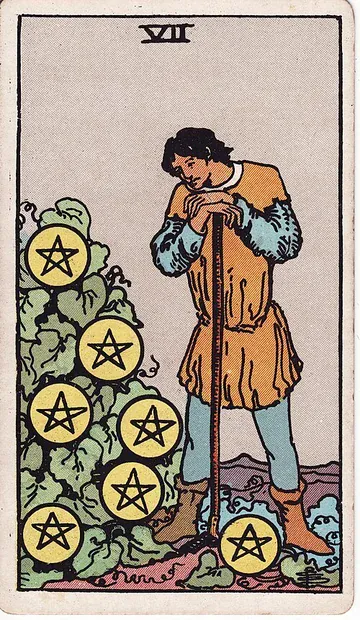
Seven of Pentacles
On the Seven of Pentacles the field is hung with vines and pentacles, and the cultivator pauses over his hoe. The field has been worked; the older labour now is waiting. The painting names the gap between effort and yield as a real distance, not a failure of either side.
· Read this card →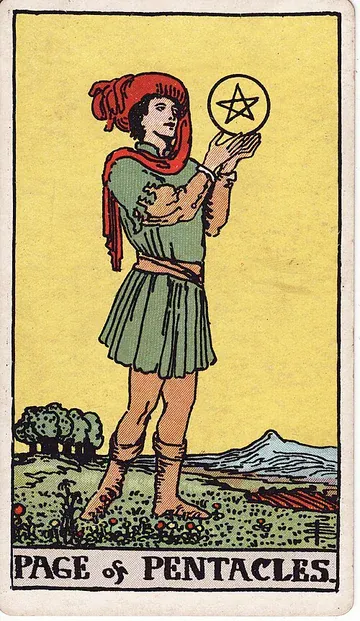
Page of Pentacles
On the Page of Pentacles the ploughed plain underfoot is the apprentice's first field — the ground the youth is learning to read, the surface on which the single coin he holds aloft is meant to land and grow.
· Read this card →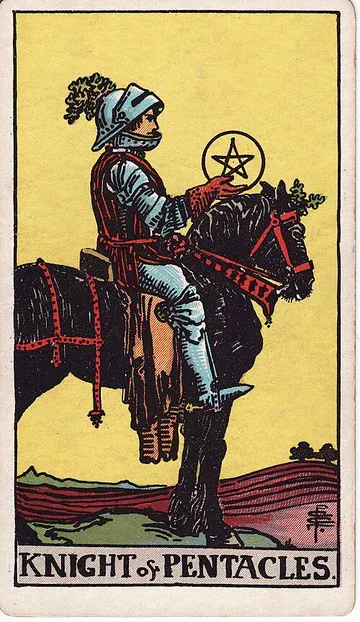
Knight of Pentacles
On the Knight of Pentacles the freshly turned earth at the horse's hooves is land prepared but not yet sown. He is the steward of slow industry, the guardian of a field whose second act — the sowing, the waiting, the harvest — is still ahead and still his.
· Read this card →Other Symbols Nearby
The Field belongs to the Landscape category — the slow features of sky, ground, and water that frame the human figure. It sits beside the mountain, the castle, the horizon, and the sun whose light it ripens under. Read these alongside it.
Older Sources
The cultivated field's iconographic depth predates tarot by several thousand years. The Homeric Hymn to Demeter, recorded in Greek somewhere in the seventh century BCE, gives Western literature its founding statement on the field: when the grain-mother grieves, the field stops; when she is restored, the field consents to grow again. Hesiod's Works and Days, of about the same period, organises peasant life around the agricultural calendar — when to plough, when to sow, when to reap — and in doing so treats the field not as wilderness but as the disciplined surface on which civilisation depends. The Latin grammar took the same goddess as Ceres, gave her the same authority, and bequeathed to European agriculture the word cereal.
Closer to Smith's painting hand is the medieval three-field system — winter grain, spring grain, fallow rotated across three plots so that the village always had ground sown and ground resting. By the thirteenth century this system was the structural rhythm of pre-industrial Europe; it persisted in some places into the eighteenth and even early nineteenth centuries, and was still inside cultural memory when Pamela Colman Smith painted these cards in 1909. The Empress's wheat is Demeter's; the Pentacles' fields are the village's; the painter does not have to choose, because the agricultural imagination of Europe has been treating the two as one register for at least two and a half millennia.