What the Moon Means
Across the Western mystery stream, the Moon is read as the figure of reflected, not original, light. Where the Sun is direct address, the Moon is intimation — the field of dreams, intuition, the unconscious, and everything in the psyche that arrives indirectly through image and tide rather than through statement. Its monthly cycle of waxing and waning is also its meaning: the Moon teaches that knowledge does not necessarily arrive whole, that some things must be approached in phases.
In the Hermetic Qabalah inherited by the Golden Dawn, the Moon is the lamp of the sephirah Yesod — foundation, the astral substrate, the dream-body that links waking ego to the body of the world. Its currents are the tides of feeling: pulled by an unseen body, predictable in form, never argued with directly. To read the Moon is to admit that the inner life has weather of its own.
How the Moon Appears in the Deck
The trump that bears its name, XVIII The Moon, paints a chilled night scene: a great moon-face descends with eyes nearly closed, dropping yodh-shaped flames; below, a wolf and a dog bay upward from either side of a path that runs between two towers, while a crayfish or scarab climbs from a pool at the foreground. A.E. Waite reads this as the path of the unconscious, the long way the soul must walk before the daylight of the next card can take it.
The same crescent appears in a different mood on the Eight of Cups, where the moon hangs low and partially eclipsed over a still bay as a cloaked figure walks away from eight neatly stacked cups, climbing out of frame toward darker country. Here the moon is not the dread of XVIII but its quieter relative: a sky that knows the figure is leaving, and lights the threshold without comment. Two cards, two distances — but in both the moon is the witness of an interior decision that cannot be talked out of.
Cards That Carry the Moon
Two cards in the deck place the Moon within the painted scene.
Hover a pin to see where the symbol sits on the card.
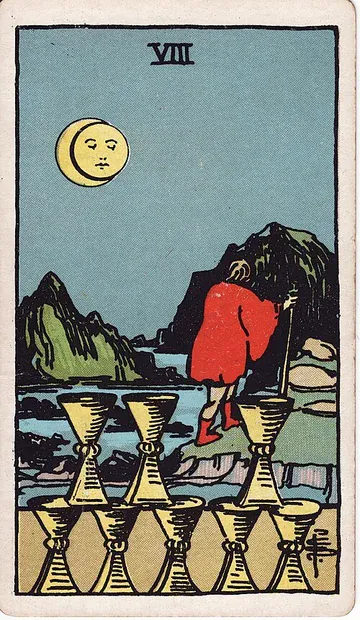
Eight of Cups
On the Eight of Cups the moon hangs low and partially eclipsed — both shown and hidden at once, the exact shape of a mind that already knows it is leaving but has not yet found language for why.
· Read this card →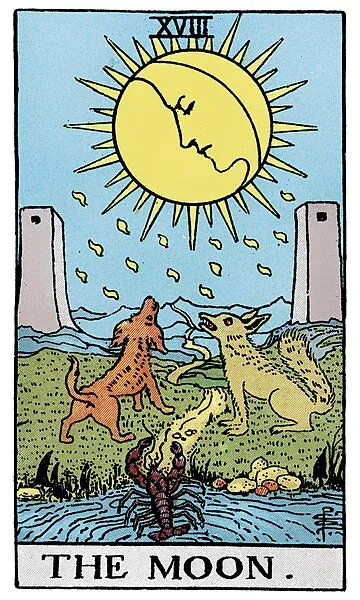
The Moon
On the Moon trump the moon is the whole upper sky — face turned downward, eyes nearly closed, yodh-flames falling. The cards that follow it (Sun, Judgement, World) cannot arrive without this nocturnal corridor first being walked.
· Read this card →Other Symbols Nearby
The Moon belongs to the Landscape category — the slow features of sky, ground, and water that frame the human figure. Read these alongside it.
Older Sources
The Moon's iconographic depth predates tarot by millennia. Sumerian Sin / Akkadian Nanna is a male moon-god whose lapis crescent boat sails the night sky; the Egyptian Khonsu and Thoth carry the lunar disc on their headdresses; Hellenistic Selene drives a two-horse chariot opposite Helios's four. By the medieval period the Moon is firmly a feminine figure in Christian and Hermetic art — Diana, the Virgin's footstool, the changeable element below the sphere of the fixed stars. The Latin Picatrix lists her among the seven planets governing magical attribution; the Golden Dawn, in the late nineteenth century, pins her to the path of Qoph (the back of the head, sleep, the watery deep) on the Tree of Life. Pamela Colman Smith's wolf, dog, towers, and climbing crayfish are her own staging — a 1909 English picture standing on a foundation older than writing.