What the Crown Means
The crown is the deck's figure of authority made visible at the place where it is most exposed — the head. Across the Western mystery stream the symbol carries four superimposed senses, and the deck refuses to let any one of them stand alone. There is the sacerdotal crown — the papal tiara of three tiers, naming a sovereignty over nature, soul, and spirit at once. There is the royal crown — the gold circlet of temporal power, conferred by ritual in front of witnesses. There is the inner crown — the sephirah Kether at the head of the Tree of Life, named in Hebrew simply 'Crown,' the point through which divine emanation enters the rest of the diagram. And there is the suffering crown — the Crown of Thorns of the Christian passion (cf. John 19:2; Matthew 27:29), where authority arrives precisely as mockery and wound.
These four readings are not parallel. Hermetic teaching from Lévi forward holds them in tension: a crown that has not been earned is merely a thing on a head; a crown that has been earned is the consecration of a fact already present in the wearer; a crown lifted from above is a gift; a crown cut from briars is a price. So when a crown appears in tarot, the question the picture asks is rarely 'who rules?' but 'how did this end up there, and what would happen if it came off?' The deck cares about the second question more.
How the Crown Appears in the Deck
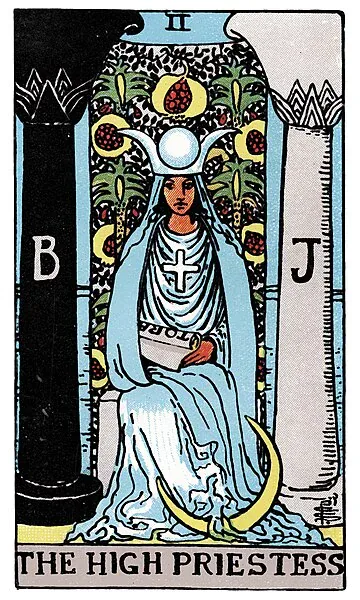
The crown appears in seven places across the deck — six major arcana plus one minor court — and each appearance is a different reading of the same symbol. The High Priestess (II) wears the horned lunar crown — a crescent and a full disc and a crescent, the three phases of the moon set on a single brow; her authority is reflective, drawn from the body of the moon she sits within. The Empress (III) wears a crown of twelve stars, Pollack reads this as the zodiac made into a circlet — a fertile, full-round authority that is the year itself. The Hierophant (V) wears the three-tiered papal tiara, and Waite is explicit that this is the crown of consecration, the sovereign of the visible religion. Justice (XI) wears a small crown set with a square stone — the stone of the law she serves rather than embodies; her crown is a reminder, not a license.
Then the symbol turns. On Temperance (XIV) the crown is no longer worn but distant — a point of gold visible on the far summit toward which the iris-bordered path leads; one is not crowned yet, only walking toward the place where one might be. On The Tower (XVI) the crown is the most violent picture in the deck — a gold crown knocked clean off the top of the tower by the lightning bolt, falling through the air alongside the two figures, the picture of authority that was usurped or hubristic and that the strike has arrived to dislodge. And on the King of Wands (Wands XIV) the crown takes the shape of flame itself — he is not crowned by fire, he is fire's act of crowning itself, the whole suit's heat condensed into the diadem. Read across these seven, the crown is a single object asked seven different questions about consent: did the head consent to it, does the world, and what falls when it does not?
Cards That Carry the Crown
Seven pin points across the deck place a crown within the painted scene — six major arcana plus the King of Wands.
Hover a pin to see where the symbol sits on the card.
The High Priestess
On The High Priestess the crown is the horned lunar diadem — crescent, full disc, crescent — the three phases of the moon set as a single circlet. Her authority is not declared; it is held in reflection.
· Read this card →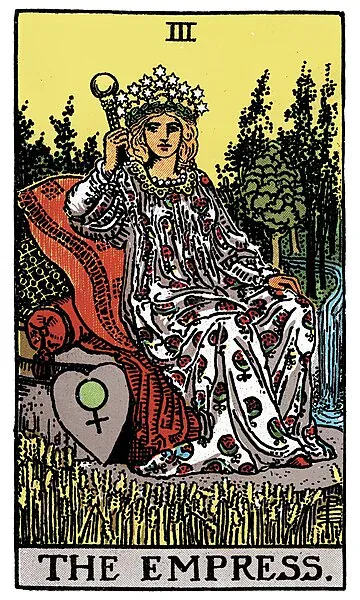
The Empress
On The Empress the crown is twelve stars — a full zodiacal round set on the brow. Pollack reads it as the year itself made into a circlet, fertile authority that does not preside but contains.
· Read this card →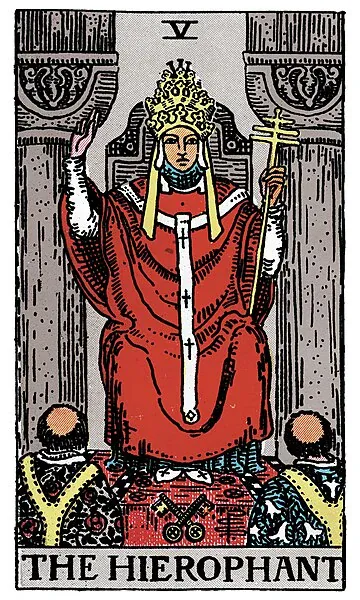
The Hierophant
On The Hierophant the crown is the three-tiered papal tiara — the sovereignty of the visible religion, claiming nature, soul, and the sacred at once. It is the deck's most explicit picture of conferred sacerdotal authority.
· Read this card →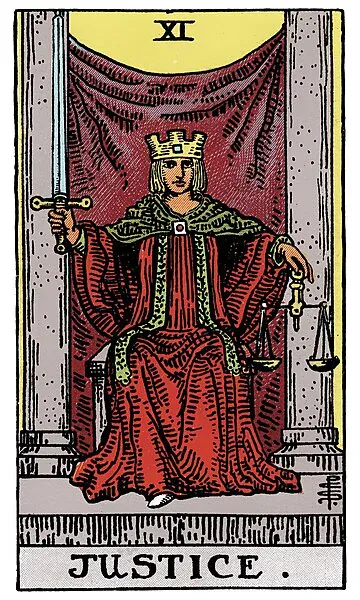
Justice
The small crown — set with a square stone that reminds her the seat of judgment lies not in private will but in law.
· Read this card →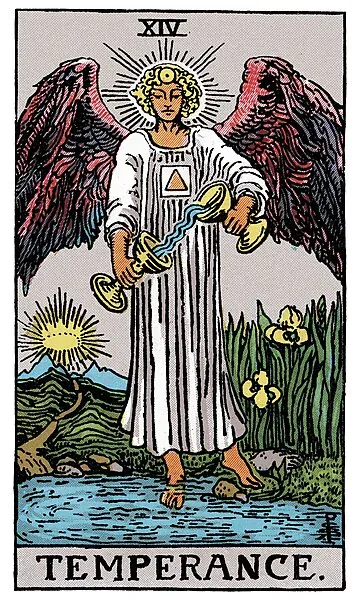
Temperance
A crown of gold on the distant summit — tempering is not the destination but the posture one assumes on the road there; yellow irises along the path stand as silent markers.
· Read this card →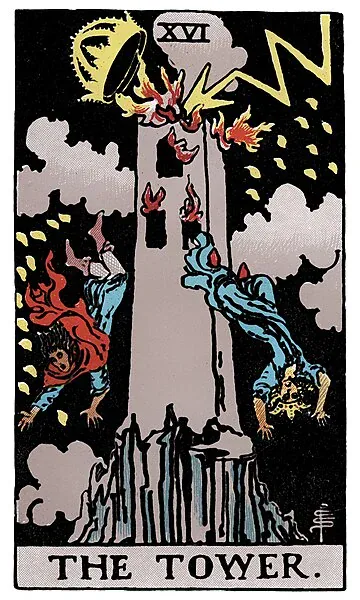
The Tower
On The Tower the crown is dislodged — knocked clean off the top by the lightning bolt and falling through the air with the two figures. The picture is unequivocal: an authority that was unearned, and that the strike has arrived to remove.
· Read this card →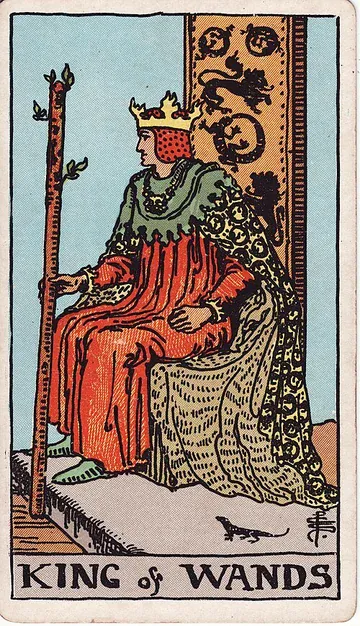
King of Wands
The crown is shaped like flame — he is not crowned by fire; he is fire's act of crowning itself.
· Read this card →Other Symbols Nearby
The Crown belongs to the Object category — the deck's tools, vessels, and worn things. Read it alongside its kin; cup, sword, pillar, and pentacle thread through the deck's other figures of conferred place.
Older Sources
The crown reaches the deck through layered traditions in tension with one another. The diadems of ancient Near-Eastern kingship — the Egyptian pschent uniting Upper and Lower Egypt, the Mesopotamian horned crown of divinity worn by gods and divinised kings — establish the head as the consecrated site of rule. The Roman corona civica of oak leaves and the imperial diadem of late antiquity carry the gesture forward as civic merit and dynastic claim. The papal triregnum or three-tiered tiara, fixed in roughly its Renaissance form by the late thirteenth century, names a sovereignty layered over nature, soul, and the sacred — and is the crown Smith paints onto The Hierophant. The Christian Crown of Thorns of the passion narrative (John 19:2; Matthew 27:29) inverts the figure entirely: authority confessed in suffering, the diadem cut from briars. The Hermetic stream then reads the crown inward — Lévi names it the figure of consecrated will, and the Golden Dawn fixes it to Kether, the first sephirah of the Tree of Life, named in Hebrew simply 'Crown,' the supernal point through which the rest of the diagram unfolds. Smith's painted crowns — twelve stars, three tiers, lunar phases, a flame, a circlet falling through air — stand on a foundation roughly five thousand years deep.