What the Pentacle Means
The pentacle is the deck's figure of matter received as form. It is at once a coin — weight, value, the part of life that can be counted and exchanged — and a five-pointed star inscribed on that coin, the pentagram that Hermetic ritual treats as the seal by which spirit governs the four elements. To set the pentagram on a disc of gold is to insist that the most material thing in the deck is also already a piece of order: that earth, when looked at carefully, is never raw stuff but stuff that has agreed to take a shape.
The pentagram itself reaches the deck through a long chain. Pythagoras, in the sixth century BCE, treated five as the number of the human body and the marriage of the first odd and first even number; Heinrich Cornelius Agrippa, in De Occulta Philosophia (1531-33), drew the pentagram as the diagram of the five elements — fire, air, water, earth, and the quintessence of spirit at the apex; Eliphas Lévi, in Dogme et Rituel de la Haute Magie (1854-56), fixed the convention by which the upright pentagram is read as spirit ruling the four elements and the inverted as the four elements without that governance. Smith and Waite's painted coin in 1909 sits on this exact line: an upright pentagram on a yellow disc, every appearance of which is a small claim that this material thing belongs to a structured world.
How the Pentacle Appears in the Deck
The pentacle is the emblem of an entire suit, and the suit reads as an essay on what money — and by extension all material substance — does when it is asked to slow down. On the Two of Pentacles two coins are tied together by a green lemniscate; the figure juggles them not to choose between but to keep both moving at the rhythm of a tide drawn in the sea behind him. On the Three of Pentacles three pentacles are carved into a stone arch — the craftsman's labour lodged where weather will not wash it out, recognition fixed in masonry rather than in praise. The Four of Pentacles is the suit's hard turn: a crowned figure clutches one coin to his chest, fixes another to his crown, and pins two more beneath his feet — possession at four points of the body, and not one of them free.
From here the suit walks down the lesson. The Five of Pentacles places its five coins inside the leaded glass of a stained-glass window the two ragged figures pass beneath without looking up — the help is already inlaid above them. The Six of Pentacles weighs coins on a literal balance, dropping them one by one into the open hands below, restraint built into the act of giving. The Seven of Pentacles studies a vine of seven still-ripening pentacles, the pause between sowing and reaping. The Ten of Pentacles arrays its ten coins across the painted scene in the geometry of the kabbalistic Tree of Life — wealth as inheritance arranged so it can flow rather than pile. Read together, the suit's pentacle is the deck's instrument for studying matter under restraint: how to hold, how to tend, how to give, and how to belong.
Cards That Carry the Pentacle
Thirteen pins across the deck place a pentacle within the painted scene — the entire Pentacles suit composes a single argument about matter.
Hover a pin to see where the symbol sits on the card.
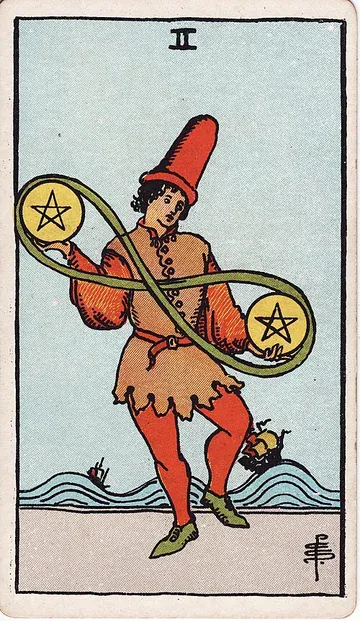
Two of Pentacles
A double burden of matter — not a choice between, but a carrying of both.
· Read this card →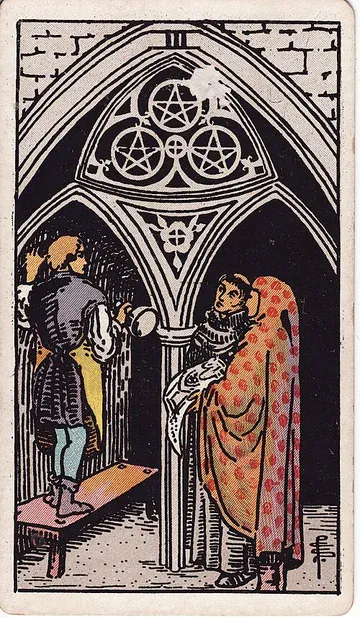
Three of Pentacles
Recognition carved into stone — the craft lodged where it will not wash out.
· Read this card →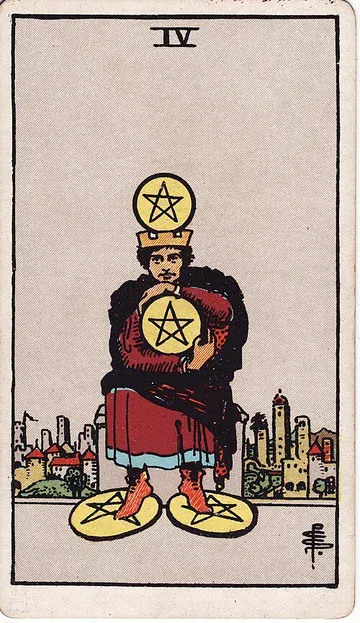
Four of Pentacles
On the Four of Pentacles the same coin recurs at four points of the body — clutched to the chest, fixed to the crown, pinned beneath each foot. The card is built as a closed circuit: every pentacle the figure owns is doing the work of holding the figure in place.
· Read this card →Four of Pentacles
On the Four of Pentacles the same coin recurs at four points of the body — clutched to the chest, fixed to the crown, pinned beneath each foot. The card is built as a closed circuit: every pentacle the figure owns is doing the work of holding the figure in place.
· Read this card →Four of Pentacles
On the Four of Pentacles the same coin recurs at four points of the body — clutched to the chest, fixed to the crown, pinned beneath each foot. The card is built as a closed circuit: every pentacle the figure owns is doing the work of holding the figure in place.
· Read this card →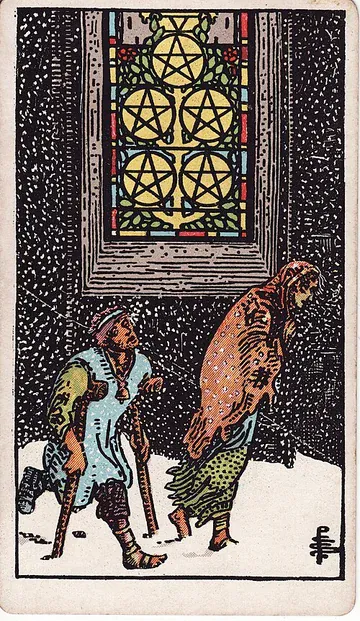
Five of Pentacles
Help and abundance are already inlaid in this window — they need only look up.
· Read this card →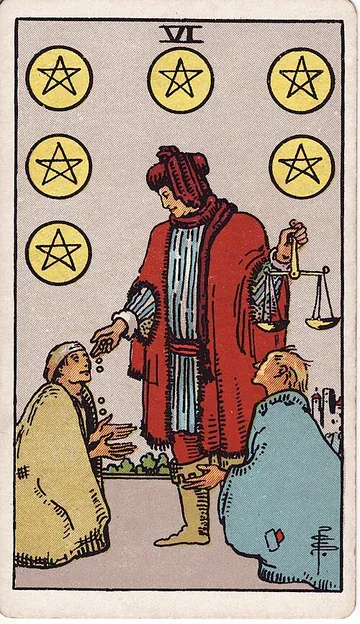
Six of Pentacles
On the Six of Pentacles the central pentacles are released one at a time onto a literal balance scale, not scattered into the receiving hands below. The act of giving is itself measured — restraint built into generosity rather than added afterwards.
· Read this card →Six of Pentacles
On the Six of Pentacles the central pentacles are released one at a time onto a literal balance scale, not scattered into the receiving hands below. The act of giving is itself measured — restraint built into generosity rather than added afterwards.
· Read this card →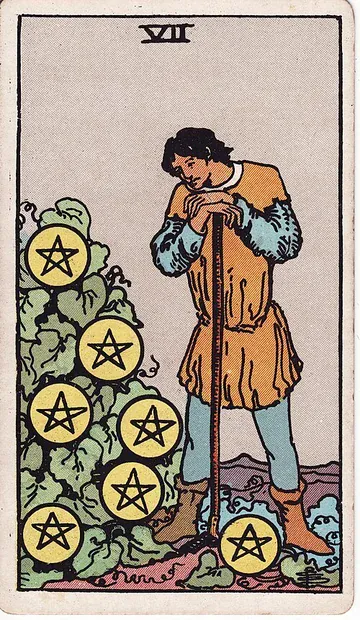
Seven of Pentacles
On the Seven of Pentacles seven coins hang on the vine he leans on his hoe to study; one more rests at his foot. Smith paints the pause between sowing and reaping as the same posture either way — the pentacle here is the patience the season requires of the hand that planted it.
· Read this card →Seven of Pentacles
On the Seven of Pentacles seven coins hang on the vine he leans on his hoe to study; one more rests at his foot. Smith paints the pause between sowing and reaping as the same posture either way — the pentacle here is the patience the season requires of the hand that planted it.
· Read this card →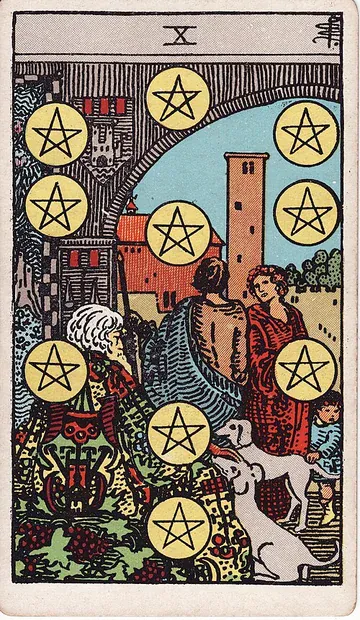
Ten of Pentacles
On the Ten of Pentacles ten coins are arrayed across the courtyard in the geometry of the kabbalistic Tree of Life — Kether at the top, Malkuth at the foot. Wealth is painted as a structure, not a pile; the pentacles describe the shape an inheritance has to take if it is to keep flowing through a household.
· Read this card →
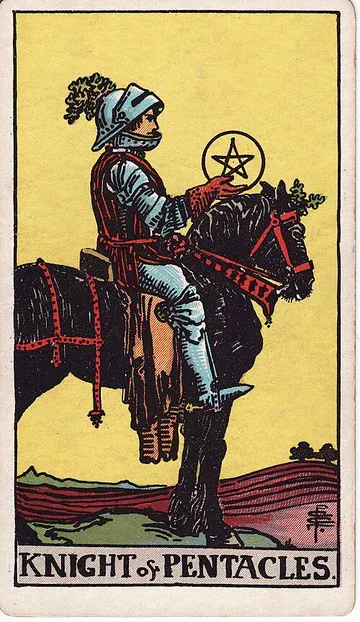
Knight of Pentacles
He holds the coin up to read — not for its value, but as homework still to be done.
· Read this card →Other Symbols Nearby
The Pentacle belongs to the Object category — the deck's painted tools, vessels, and worn things. Read it alongside the cup (the vessel of feeling), the sword (the blade of mind), and the pillar (the architecture of the threshold) to see how the four implements share one Hermetic vocabulary.
Older Sources
The pentagram on the coin is one of the oldest figures in Western magical thought. Pythagoras, in the sixth century BCE, took five as the number of the human body — head, two arms, two legs — and gave the figure to his school as a recognition sign. Heinrich Cornelius Agrippa, in the second book of De Occulta Philosophia (1531-33), redrew it as the diagram of the elements: fire and earth at the lower points, air and water at the upper, the quintessence of spirit at the apex. Eliphas Lévi, in Dogme et Rituel de la Haute Magie (1854-56), fixed the orientation that the Golden Dawn would inherit: the upright pentagram reads as spirit governing the four elements, the inverted as those elements without that governance. The Hermetic Order of the Golden Dawn, founded in 1888, drilled the lesser ritual of the pentagram into every initiate — a banishing figure traced in the air at each of the four cardinal directions. When Pamela Colman Smith painted an upright pentagram on a yellow disc in 1909, the gesture was not decoration: it was the deck announcing, on every Pentacles card, that the most material substance in the world was being received here as something already ordered, already in relation to spirit.