What the Cup Means
Across the Western mystery stream, the cup is read as the vessel of the soul — the shape feeling takes when it agrees to be carried rather than drunk all at once. Where the wand is the will and the sword is the thought, the cup is the body of emotion given a container precise enough to hold it without distortion. Hermetic ritual seats it on the western quarter of the altar as the implement of the element of Water; in the Golden Dawn's grade rituals it is the lustral chalice the candidate is purified from. The container, not the liquid, is what is being studied: how full, how level, how covered, how offered.
Rachel Pollack, summarising a long Hermetic and Christian inheritance, names the cup the 'vessel of the soul,' and the phrase tracks across the deck. The shape on the cards is genealogically the same shape as the Christian Grail of Chrétien de Troyes' twelfth-century romance — itself layered over the Celtic Cauldron of Cerridwen, the Mesopotamian libation cup, and the laver of bronze in the Solomonic Temple. To watch a cup tilt, fill, spill, lid, or be raised in tarot is therefore to watch a Hermetic philosophy of feeling — emotion as something that has a form and can be held with care, given away, or set down.
How the Cup Appears in the Deck
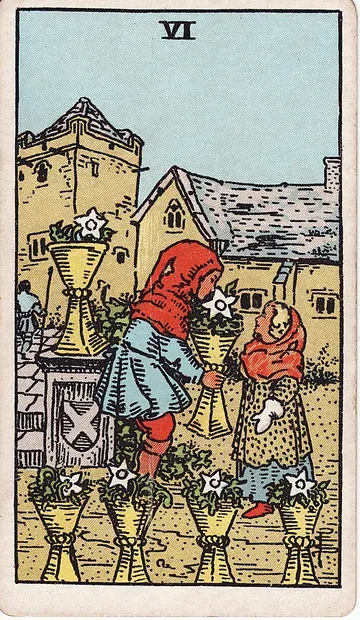
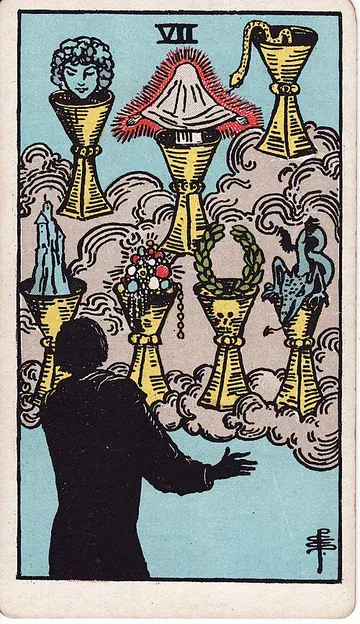
The cup is the central emblem of an entire suit; it is also the only minor implement that recurs in the major arcana. Read the Cups suit as a single arc and the vessel itself does the storytelling. It begins full and lifted — two cups raised between equals on the Two of Cups, three lifted in resonance on the Three. It tilts and refuses on the Four, where three full cups stand before a man whose attention has gone elsewhere and a fourth is offered from a cloud he does not see. It spills on the Five — three cups overturned in front of the cloaked figure, two still standing behind him — and is repaired in remembrance on the Six, where six cups are filled with white flowers instead of water. It dilates on the Seven into a cluster of mirages; stacks unfinished on the Eight; arches itself on the Nine; and on the Ten dissolves into a rainbow of seven cups tilted into the sky.
The court rounds the suit: the Page on the Twelve carries a level cup with a fish lifted from it; the Knight on the Thirteen rides forward holding a covered chalice — the lid the most important fact on the card; and the King on the Fourteen sits enthroned with a cup in one hand and a scepter in the other, refusing to set either down. Beyond the suit itself, the cup returns three times in the major arcana — on Temperance (XIV), where a winged figure pours water between a gold cup and a silver one in a single unbroken stream that defies physics, naming the Hermetic operation of the suit; and as the chalice on the Magician's table, beside the wand, sword, and pentacle, where the four implements name the four worlds the magus is consenting to work across. Read together, the Cups arc is an essay in what feeling becomes when it is given a shape and asked to hold.
Cards That Carry the Cup
Fifteen pins across the deck place a cup within the painted scene — the Cups suit itself plus Temperance and the Magician's altar.
Hover a pin to see where the symbol sits on the card.
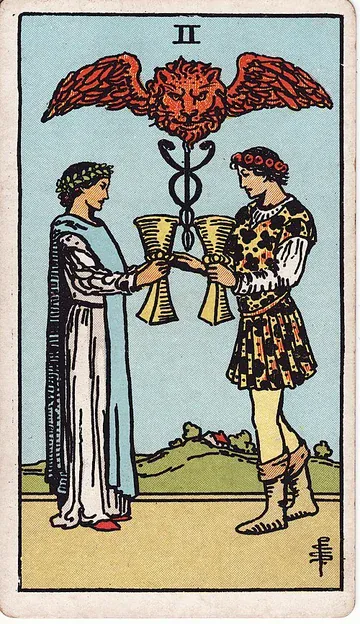
Two of Cups
On the Two of Cups the two vessels are held at exactly the same height — a parity test in pictorial form. Lower one and the gesture becomes a presentation; lower the other and it becomes a request. The vow is in the levelness.
· Read this card →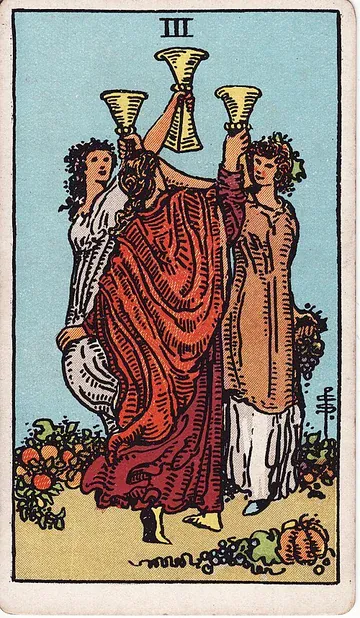
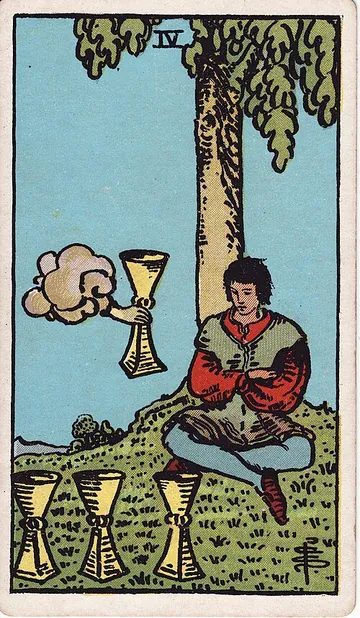
Four of Cups
On the Four of Cups three cups stand at his foot and a fourth is extended from a cloud beside him. The painted detail that makes the card work is the difference of plane: he is reading the lower three from above, while the fourth waits at the height of his closed eyes — the gift that asks to be looked up at, not down at.
· Read this card →Four of Cups
On the Four of Cups three cups stand at his foot and a fourth is extended from a cloud beside him. The painted detail that makes the card work is the difference of plane: he is reading the lower three from above, while the fourth waits at the height of his closed eyes — the gift that asks to be looked up at, not down at.
· Read this card →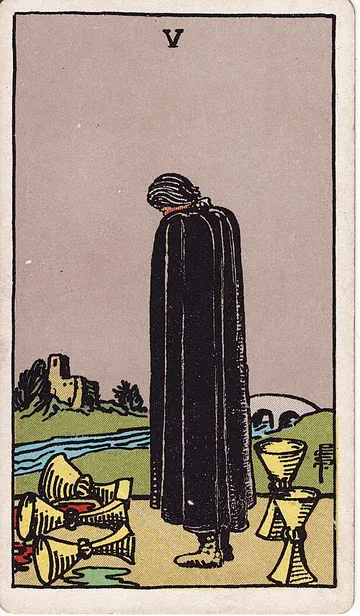
Seven of Cups
Possibilities glowing evenly — and the evenness is itself a confusion.
· Read this card →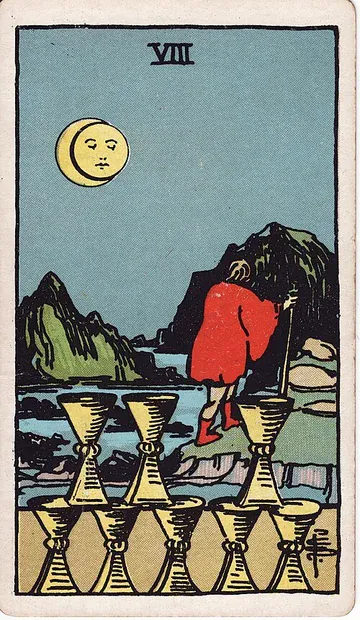
Eight of Cups
On the Eight of Cups the stack is geometrically incomplete — the top row is one short of round. The shape itself is a rebuke that a finished arrangement is not yet a finished feeling, which is what makes the figure put on his cloak and walk.
· Read this card →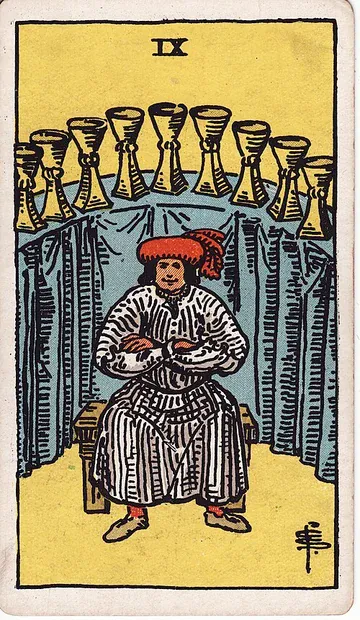
Nine of Cups
The arch is the night before roundness — nine has arrived, ten has not. This moment is 'in place,' not 'ended.'
· Read this card →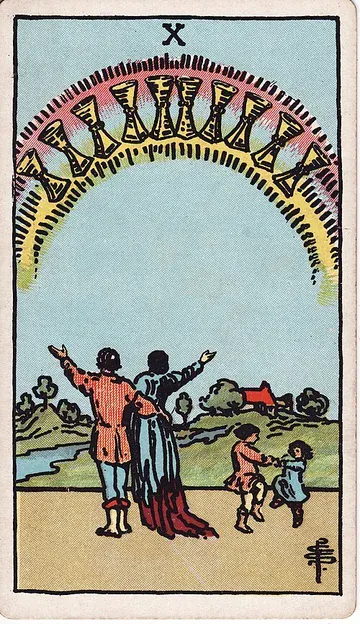
Ten of Cups
A full cycle of emotional water tilted into light — not new feeling, but the crystallization of what already is.
· Read this card →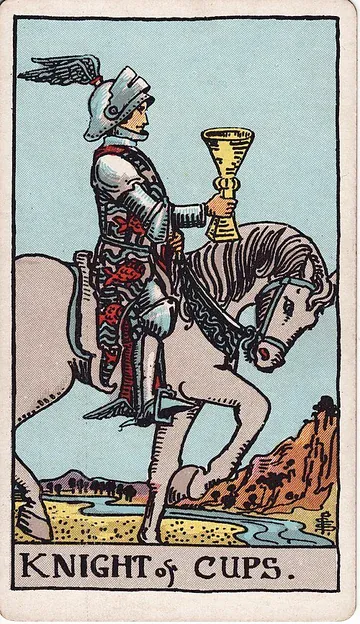
Knight of Cups
Not a trophy held up for show — something to be put into another's hand, which is why not a drop may spill.
· Read this card →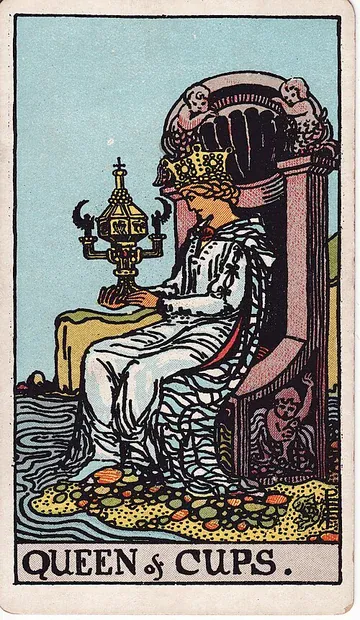
Queen of Cups
On the Queen of Cups the chalice is lidded — the most important fact on the card. The cover is not a refusal to feel but a reservation of timing: the lid lifts when the bearer is ready, not when the recipient is.
· Read this card →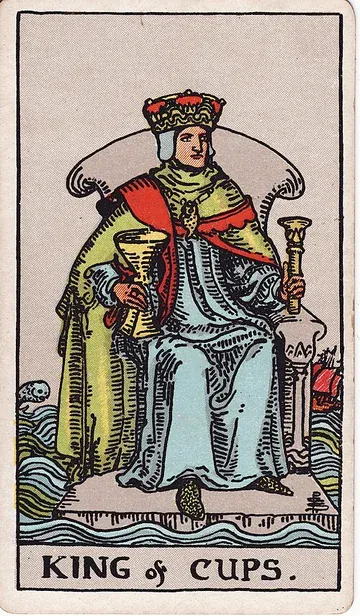
King of Cups
One hand for feeling, one hand for order — he refuses to set either down, and that is the weight of this card.
· Read this card →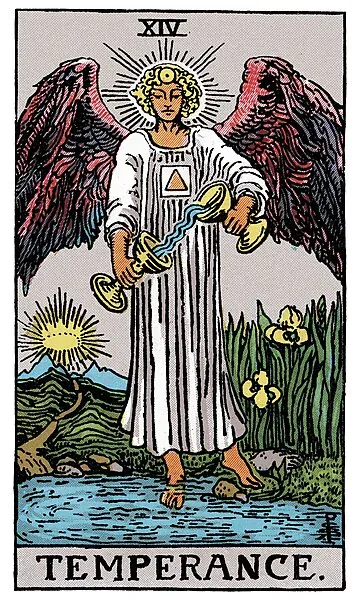
Temperance
On Temperance the two cups are gold and silver — sun and moon, conscious and unconscious — and the figure pours water between them in a single unbroken arc that defies physics. The cups themselves are the Hermetic operation: opposites named into separateness, then mediated by a flow that touches both.
· Read this card →Other Symbols Nearby
The Cup belongs to the Object category — the hand-held implements that the figures in the deck carry as proof of which world they are working in. Read it alongside the wand, the sword, the pentacle, and the other vessels and instruments that share the foreground of the cards.
Older Sources
The cup's iconographic depth predates tarot by millennia and is layered from at least four traditions. From Mesopotamia comes the libation cup, the vessel that pours wine or water at the threshold of a temple — feeling externalised as offering. From the Hebrew Bible comes the laver of bronze in the Solomonic Temple, the great basin in which the priests purify their hands and feet before serving. From Celtic Britain comes the Cauldron of Cerridwen, the goddess's bronze vessel of inspiration and rebirth — drink from it knowingly and you become a poet, drink from it unknowingly and you are unmade. From the Christian Middle Ages comes the Grail, first named as a literary object in Chrétien de Troyes' Perceval, le Conte du Graal in the 1180s and elaborated by Robert de Boron a generation later as the cup of the Last Supper.
By the time A.E. Waite commissioned the 1909 deck, these four streams had been fused for centuries — the Grail of medieval romance was already understood, in his Hermetic context, as a shape that gathered up the cauldron and the laver and the libation cup into a single emblem of the soul as a vessel. The Golden Dawn ritual placed an actual chalice on the altar's western quarter as the implement of Water; the deck in your hands paints that same chalice fifteen times. Pamela Colman Smith's painted cups — full, spilled, lidded, level, raised — are particular flowerings of a stem that runs uninterrupted from a Sumerian temple terrace to her London studio.