What the Heart Means
In the iconographic vocabulary of the Western mystery stream, the heart on the card is never an anatomical organ. It is a symbolic figure — the symmetrical balloon-shape with a cleft at its top and a point at its base — that emerges in late-medieval European manuscripts of the thirteenth and fourteenth centuries and stabilises into a fixed sign before the close of the Middle Ages. The shape is geometric, not biological; its precision is the precision of a sigil, not of dissection. By the time tarot inherits it, the figure carries a doubled meaning that no single picture can resolve: the heart is the form love takes when it consents to be carried, and the same outline is the only one a sword can leave a clean shape inside.
Two iconographic traditions converge on this single form. The first is Venusian: the shield of the goddess of love in classical and Renaissance allegory, often bearing her glyph (♀), naming her authority as not the parry but the welcome — a defence that takes in rather than turns aside. The second is Marian: the heart of Mary pierced by swords, fulfilling Simeon's prophecy in Luke 2:35 ("and a sword shall pierce through thy own soul also"), which late-medieval devotion concretises as the Mater Dolorosa, the Seven Sorrows, and the painted or sculpted heart with seven blades sunk into it. Read these two together and the figure resolves: the same outline that gives love a shape it can hold is the only outline that can show love wounded without being unmade. A heart broken into shards has no story; a heart pierced cleanly retains its shape and so retains the possibility of healing.
How the Heart Appears in the Deck
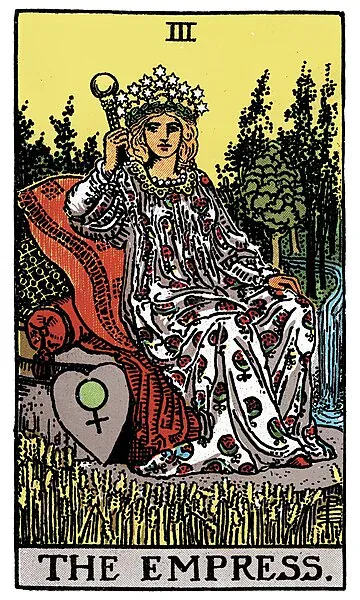
The heart appears on only two Rider-Waite-Smith cards, and the two appearances form a precise pictorial inversion of each other. On The Empress (III), a heart-shaped cushion or shield rests beside her seat, bearing the astrological sigil of Venus (♀). A.E. Waite, in The Pictorial Key, identifies the Empress with Venus and with the generative principle of nature in fruit; the painted detail that does the work is that her insignia is not a sword or a sceptre but a heart held flat — her authority is the welcome, the field that takes in rather than the blade that turns aside. The shape on her shield is the Venusian heart in its protective register, the form love takes when it has chosen to be the place a thing is brought to.
On the Three of Swords, the same outline is rotated and inverted: a single large heart hovers in a grey storm-sky, three blades driven through it cleanly, no figure visible below. Smith and Waite stage this card not as the destruction of the heart but as its piercing — the blades leave clean wounds with discernible shapes, and the heart itself is intact enough to bear them. The Marian iconography is direct: the seven swords of the Mater Dolorosa reduced to three, the prophecy of Luke 2:35 painted as image rather than narrated as scene. Read across the deck, the heart on the Empress and the heart on the Three of Swords name the same outline twice — first as the shield that welcomes, then as the shield turned target. The visual echo is the card's argument: a wound that retains its shape can eventually be closed, but only because the form was sound enough to keep that shape in the first place.
Cards That Carry the Heart
Two cards in the deck place a heart-shaped figure within the painted scene — the Empress's shield and the central heart on the Three of Swords.
Hover a pin to see where the symbol sits on the card.
The Empress
On The Empress the heart appears as her cushion or shield, bearing the sigil of Venus (♀). Her authority is named on this object: not the sceptre, not the sword, but the heart held level — love as governance, welcome as power, the form in which a fruitful field consents to be approached.
· Read this card →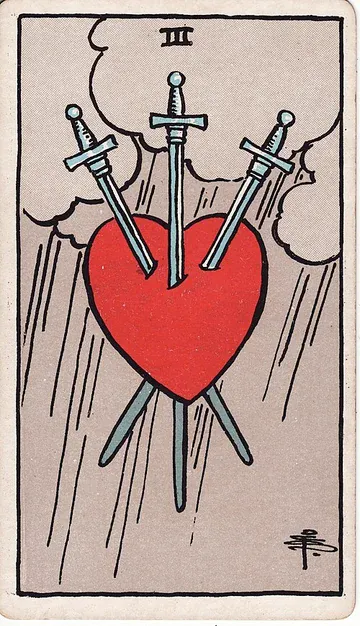
Three of Swords
On the Three of Swords the same outline returns, rotated and pierced — three blades driven cleanly through a single large heart in a grey storm-sky. The Marian iconography is direct: the swords of the Mater Dolorosa reduced to three. The heart is not destroyed but shaped; a wound with a shape can eventually be healed.
· Read this card →Other Symbols Nearby
The Heart belongs to the Object category in the Tarot Atlas — the hand-figured devices the painted scene carries on its surface. Read the heart alongside the cup, with which it shares the deepest semantic root (both are vessels — forms that take in rather than parry); alongside the sword and pentacle and wand for the wider register of named instruments and emblems on the cards.
Older Sources
The heart-shape itself is a medieval European invention. No classical or biblical tradition produces this exact symmetrical balloon-figure with cleft and point; what survives from antiquity is the anatomical organ described by Aristotle and Galen and the leaf-shape (often ivy or fig) used in Greco-Roman decoration. The stylised heart-shape that tarot inherits emerges in thirteenth- and fourteenth-century European manuscripts — early examples include the Roman de la Poire (c. 1255), where a lover offers his heart in the now-recognisable form, and a thickening corpus of fourteenth-century courtly love-allegory and devotional painting that fixes the geometry. By the fifteenth century the figure is so settled it appears on the playing-card suit known as cœurs in French and Herzen in German — the direct ancestor of the tarot suit of Cups.
Two pre-existing iconographic streams converge on this newly-stable form. The Venusian stream, traceable through Renaissance allegorical painting back to classical descriptions of Aphrodite's shield, gives the heart its sense as the emblem of love-as-authority — the device on the goddess's protective gear, naming her power as welcome rather than refusal. By the time of the Hermetic recovery in the Renaissance and Golden Dawn, Venus is firmly assigned to the seventh sephirah, Netzach, and to the trump that becomes The Empress; A.E. Waite, commissioning the 1909 deck, places the Venusian sigil directly on the Empress's heart-shaped insignia. The Marian stream, traceable through late-medieval devotional painting and sculpture, fulfils Simeon's prophecy in Luke 2:35 — "and a sword shall pierce through thy own soul also" — by showing Mary's heart pierced by seven blades, the Mater Dolorosa or Seven Sorrows. The Three of Swords reduces these seven to three but keeps the iconography exact. Read the two cards together and the painted argument is precise: the Venusian shield on the Empress and the Marian wound on the Three of Swords are the same outline, the same heart, seen first as the form love takes when it can take in, and then as the form love retains when something has been driven through it. The shape is what survives the difference.