What the Lion Means
Across the Western mystery stream, the lion is read in three braided registers at once. He is the figure of sovereignty — the lion-of-Judah, the king-of-beasts, the throne-mark whose presence behind a seated figure says authority before any word is spoken. He is the figure of strength — not abstract force, but fire with a body, the heat of unnamed desire and the courage required to live near it. And he is the figure of the fire kerub — one of the four Living Creatures whose iconographic life predates tarot by millennia and whose elemental signature anchors the whole symbolic deck.
The Golden Dawn inherits this kerubic schema directly: lion → fire, man → air, eagle → water, bull → earth. On the trump conventionally numbered VIII the lion is therefore not generic ferocity but the visible body of fire itself, and the woman who closes his jaw is performing not domination but the older operation Waite names with care: the sovereignty of innocence over brute force — a hand that can rest upon the heat without being burned by it, because nothing in her is at war with what the heat is.
How the Lion Appears in the Deck
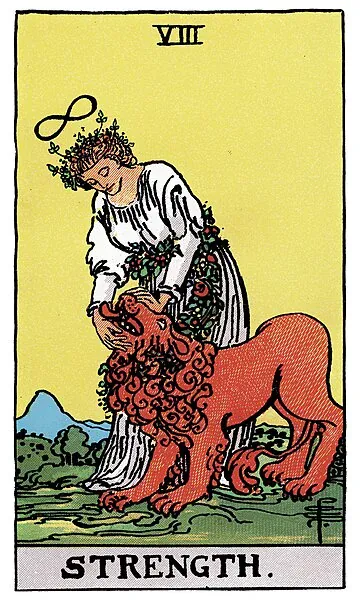
The lion is most fully present on the trump A.E. Waite numbered VIII Strength. Pamela Colman Smith paints a woman in a flower-crowned dress closing the great cat's jaws with both hands — gentle, unhurried, the lion's tongue still visible. The lemniscate floats above her head, the same infinity-loop she shares with the Magician. Read with Waite's preface in The Pictorial Key, the picture is not a contest but a continuation: the same fire that gives a body its heat is the fire that, when met without fear, consents to be walked beside.
The lion returns more quietly on the Queen of Wands (the Queen on card 13 of the Wands suit). Her throne is engraved with two lions facing outward — the heraldic lion-rampant repeated as a sigil — and a third lion sometimes reads in the carved arms beneath her seat. She holds a sunflower in one hand and a wand in the other; a black cat sits at her feet. The lions on her throne are not decoration. They are the stated proof of her authority — the seat speaks her sovereignty before she does, and the fire-element of her suit is made visible in the kerub her chair carries.
Read across the two cards a single statement comes into focus. On Strength the lion is the heat being walked beside; on the Queen of Wands the lion is the heat the seat itself has integrated. The same animal — sovereignty and combustion in one body — appears once in the foreground as a question (can this be met?) and once as a fact (this has been met, and the throne is built on it).
Cards That Carry the Lion
Two cards in the deck place the Lion within the painted scene.
Hover a pin to see where the symbol sits on the card.
Strength
On Strength the lion is the foreground body of fire — golden mane, slow tongue, jaw closing under a hand without resistance. The woman is not subduing him; she is walking along his spine. Read the lemniscate above her head as the same one the Magician carries: this is mastery, not victory.
· Read this card →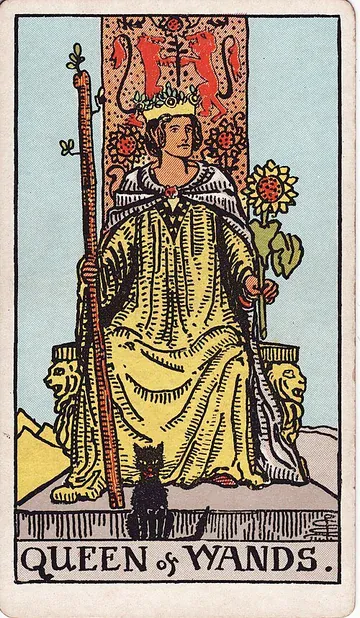
Queen of Wands
On the Queen of Wands the lions are heraldic — two facing-outward sigils on the back of her throne, the kerub of fire repeated as the proof her seat carries her element. Pair with the sunflower in her hand: she does not require the lions to roar; the chair has already said it.
· Read this card →Other Symbols Nearby
The Lion belongs to the Animal category — the bestiary of creatures that act as elemental and moral witnesses to the human figures. Read it alongside the serpent, the sphinx, and the angel: lion (fire) and the other three Living Creatures form a single kerubic ring around the deck.
Older Sources
The lion's iconographic depth predates tarot by thousands of years. In Mesopotamia he flanks the gates of Ishtar; in Egypt the lion-headed Sekhmet is the solar fire of justice; in Hebrew scripture the lion-of-Judah is the tribal sigil of kingship and Daniel in the lions' den (Daniel 6) is the figure of the upright preserved among the predators. The Christian Evangelists inherit a fragment of this stem when Mark is given the lion as his attribute — one of the four Living Creatures of Ezekiel 1:10 and Revelation 4:7, the kerubim whose forms split the four elements between them.
The Golden Dawn in the late 19th century pinned this kerubic schema explicitly to the tarot: lion = fire, man = air, eagle = water, bull = earth. Strength VIII received the path of Teth (ט) and the sign of Leo, anchoring the lion as the deck's visible fire-element. In 1904 Aleister Crowley, dictating Liber AL vel Legis, was instructed to redistribute the trumps — VIII Strength was renamed XI Lust and given the lion-riding figure of Babalon, while VIII became Adjustment (the older Justice). Whether one reads with Waite (a hand on the jaw) or with Crowley (riding the back), the lion in the deck is not an animal among animals but the visible face of a single element — fire as the kerub the deck cannot be drawn without.