What the Mountain Means
Across the iconographic vocabulary of the Western mystery stream, the mountain is the figure of the unreached. It is height seen from below, a destination registered before it can be visited, and the proof that the painted scene has depth — that there is more world behind the figure than the figure has yet walked. Where the path teaches movement and the horizon teaches scale, the mountain teaches time: it tells you how long the work will take by being visible from where you start.
The mountain is also a figure of separation and of purification. Sinai, Tabor, the Daoist mountains where adepts withdrew to perfect the body, the "Mountain of the Adepts" repeatedly invoked in Hermetic prose — all carry one shared structural claim: certain knowings cannot be obtained inside the village, and the journey out of the village is itself a condition of the seeing. To read the mountain is to admit that some things ask altitude before they ask cleverness, and altitude is the slow currency of the body the foot has to mint, step by step.
How the Mountain Appears in the Deck
The mountain is one of the few symbols that runs as a quiet thread across both major and minor arcana, and almost always at the back of the painted scene rather than in its foreground. On VI The Lovers it rises between the two figures, the weight of choosing translated into a feature of the land. On the Eight of Cups it is the destination toward which the cloaked figure climbs, having stacked his eight cups neatly behind him — a height that has no name yet, only altitude. On the Ace of Pentacles and the Eight of Pentacles the distant mountains are the long arc of physical mastery: the gift in the first hand is going somewhere, and the apprentice on his bench cannot yet see how far the craft will take him.
On the Ace of Swords the mountains are different in mood — serrated, low, beneath storm cloud — the ground over which thought rises when it has finally lifted free of matter's tangle. Read across these five cards together and the symbol resolves into one statement: the mountain in tarot is the figure of what has not yet been reached, painted small enough to fit in the corner but always present in the corner, so that no scene reads as the whole world. There is more, and it is uphill.
Cards That Carry the Mountain
Five cards in the deck place a mountain in the painted scene.
Hover a pin to see where the symbol sits on the card.
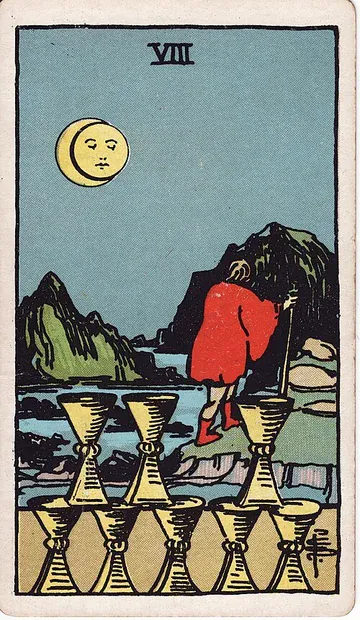
Eight of Cups
On the Eight of Cups the mountain is the named-but-unnamed destination — the figure does not point at it, does not announce it, simply turns and walks toward it. The mountain is what the eight cups behind him are no longer enough to keep him from.
· Read this card →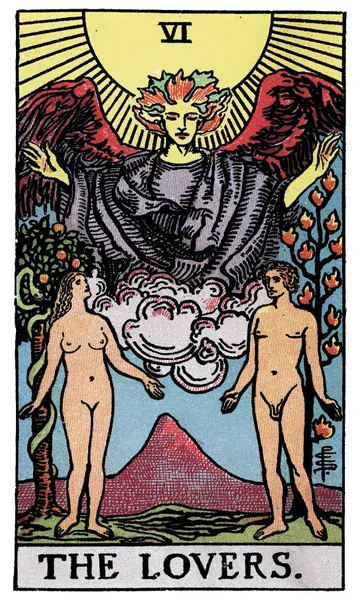
The Lovers
On The Lovers the mountain rises between the two figures — the deciding has weight, and the painter gives that weight a body in the land. To choose between them is also to choose to climb.
· Read this card →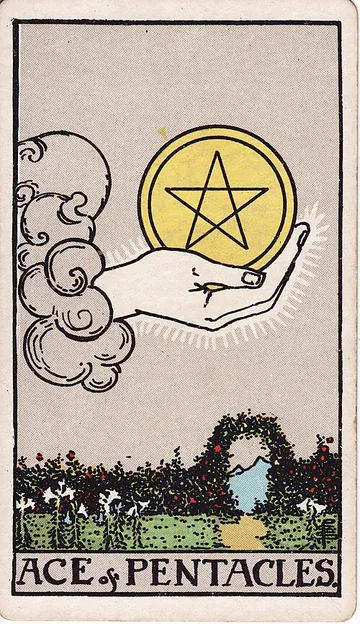
Ace of Pentacles
Where the gift is going — it does not end here, but asks to be carried far and planted.
· Read this card →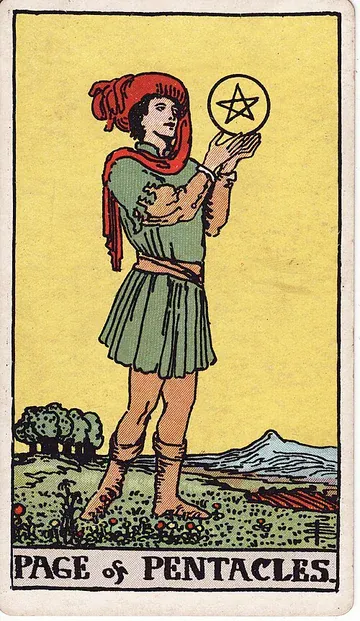
Page of Pentacles
The long arc the student does not see yet — the craft will take him that far.
· Read this card →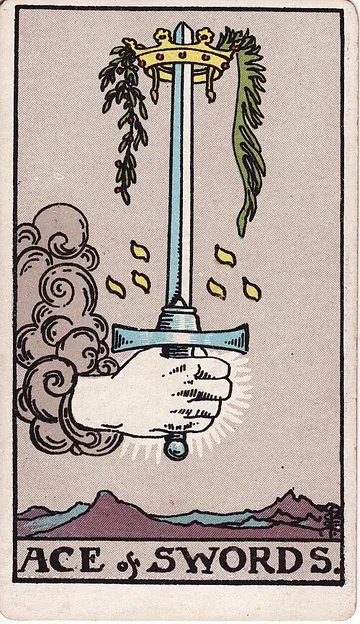
Ace of Swords
On the Ace of Swords the mountains are below the cloud, serrated and low — the ground over which thought finally has the altitude to look down. The blade has not yet met what it will distinguish; the mountain is where it sees from.
· Read this card →Other Symbols Nearby
The Mountain belongs to the Landscape category — the slow features of sky, ground, and water that frame the human figure. Read these alongside it.
Older Sources
The mountain's iconographic depth predates tarot by millennia. Sinai in Exodus 19 is cloud and fire, ascended alone; Tabor in Matthew 17 is the height where the disciples see what was always there but could not be seen from the plain. The Daoist tradition sends its adepts into the mountains to refine breath and body away from the noise of the village. Hermetic prose, from Renaissance Picatrix forward, returns again and again to the "Mountain of the Adepts" — the unreached center toward which the work is oriented, painted small in the distance precisely because to paint it close would be to lie. Pamela Colman Smith's distant mountains across the Rider-Waite-Smith deck stand in this long lineage: they are the part of the picture that admits the picture is not finished.