
What the Pillars Mean
A pillar in the iconographic vocabulary of the Western mystery stream is never a single object — it is half of a pair, and the pair is never decoration. Two pillars define a threshold. They mark the line where outside becomes inside, where the unconsecrated ground ends and the temple begins, where the candidate stops being a passerby and becomes someone who has chosen to enter. The meaning lives in the gap between them: a doorway is the negative space that two columns hold open.
The pair is also a diagram of how a polarity can be balanced. One column is dark, one is light; one is severity, the other is mercy; one is the principle that contracts, the other the principle that gives. Standing alone, either is a force. Standing as a pair, with a path between them, they become a structure through which a third thing — the walker, the priestess, the initiate — can travel. To read the Pillars is to read the architecture of any decision that asks both rigor and grace at once.
How the Pillars Appear in the Deck
Within the Rider-Waite-Smith deck the Pillars belong most decisively to one card: II The High Priestess. Pamela Colman Smith paints them flanking the seated figure — the left pillar black and inscribed with the letter B for Boaz, the right pillar white and inscribed with J for Jachin. Between them hangs a veil patterned with pomegranates and palms, and on the veil the Priestess sits, neither inside nor outside the temple but exactly on its line. A.E. Waite, in The Pictorial Key, treats this scene as the secret church: the door has been left open, but the threshold itself is the teaching.
Two pillars also frame the Hierophant on V, where the symbolic load shifts from polar mystery to public office — the same architecture, now used for the visible church rather than the hidden one. (The aggregator does not catalog those pillars under this key; they are noted here for completeness.) Read together, the High Priestess and the Hierophant show the same structural insight from two sides: every institution worth entering is built from a polarity it has not collapsed, and the doorway is the proof.
Cards That Carry the Pillars
One card in the deck pins the Pillars within its painted scene. Hover the pin to see exactly where on the image the symbol sits.
Hover a pin to see where the symbol sits on the card.
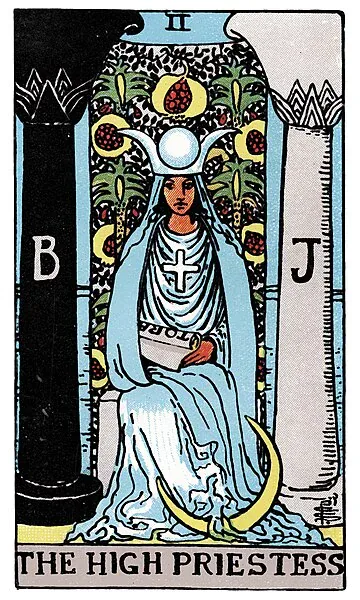
The High Priestess
On the High Priestess the pillars stand to her left and right — Boaz black, Jachin white, the veil of pomegranates strung between. She does not sit before the doorway or behind it. She sits on it, which is the whole secret: the threshold is the seat of the office.
· Read this card →Other Symbols Nearby
The Pillars belong to the Object category — temple furniture, ritual implements, and the carried things that turn a body into a figure. Read these alongside.
Older Sources
The pair Boaz and Jachin is older than tarot by about three thousand years. The First Book of Kings (7:13–22) and the Second Book of Chronicles (3:15–17) describe how Hiram of Tyre cast two bronze pillars for the porch of Solomon's Temple in Jerusalem. He set the right one and called its name Jachin — "he will establish" — and he set the left one and called its name Boaz — "in him is strength." They flanked the entrance to the holy place; one entered the sanctuary by passing between them. The pillars were destroyed when the temple was destroyed, but the names and the geometry survived in the textual tradition.
When Hermetic Qabalah gave the Tree of Life its modern diagram, that geometry was promoted from temple-porch to cosmology. The Tree's ten sephiroth are arranged in three vertical columns: the right Pillar of Mercy (Chesed and the gentler outpouring), the left Pillar of Severity (Geburah and the contracting force), and the central Pillar of Mildness through which Tiphareth, Yesod, and Malkuth descend. Boaz is read onto the left, Jachin onto the right, and the candidate's task is to stay on the middle column long enough to become the connecting axis. Israel Regardie's account of the Golden Dawn passes this directly into ritual: in the Neophyte ceremony the candidate is brought to a literal pair of pillars in the temple and required to walk between them, the gesture and the diagram fusing into a single act.
Smith's High Priestess crystallizes all of this in one image. She sits on the threshold the temple-pillars define; the diagram she belongs to is centered on her; the ancient names are inked onto the columns either side. The page you are reading uses "Pillars of Boaz and Jachin" as the canonical full name; the shorter "The Pillars" is the working title under which the rest of the deck — and, eventually, the rest of this guide — quietly references the same pair.