What the Serpent Means
Across the Western mystery stream, the serpent is read as a creature of two faces held in a single body. It is the bringer of gnosis — the one who, in Genesis 3, opens the eye of the human mind to the difference between this and that — and at the same time the venomous tempter, the figure who makes a forbidden knowing irreversible. Hermetic and Gnostic readings have always insisted on this doubleness rather than resolving it: the same animal that strikes is the one that sheds its skin, that knows the underworld and survives the surface, that climbs and that descends.
The serpent is therefore a symbol of cycle as well as of crossing. The Caduceus of Hermes carries two of them coiled around a central rod — the medical sign that came down to the modern pharmacy is, before that, a Hermetic emblem of polar currents brought into balance. The Ouroboros, the serpent biting its own tail, names eternity not as endlessness but as a closed circuit: the moment where the descending arc returns into the rising one. In tarot, where the serpent appears it almost always carries this charge — the place on the card where the cycle becomes visible, where venom and medicine are revealed to be the same draught measured differently.
How the Serpent Appears in the Deck
The serpent surfaces only twice in the Rider-Waite-Smith deck, and both occurrences are precise. On the Wheel of Fortune (X), a serpent slides down the left rim of the great wheel — the figure A.E. Waite identifies, after the Golden Dawn lecture papers, as Typhon, the descending current. He is paired on the right by Hermanubis, the rising jackal-headed figure, and crowned by the Sphinx at the top. The picture is therefore not a random menagerie but a single statement about turning: a thing only descends because another thing rises through the same rotation, and the serpent is the half of the wheel that lets the wheel be a wheel.
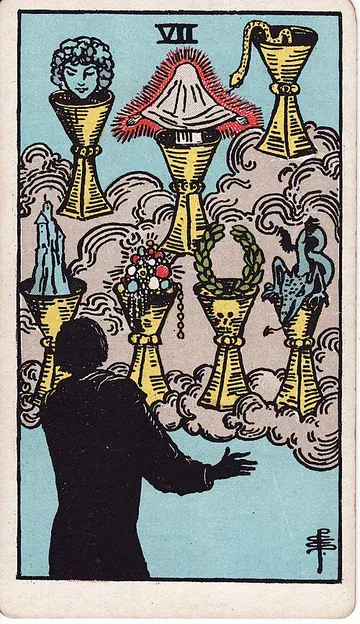
On the Seven of Cups, the serpent coils inside one of the seven chalices that float above a cloaked figure on the foreground — among a wreath, a head, a glowing veiled form, a tower, jewels, and a dragon. Pamela Colman Smith places the serpent as one of the seductions of the mirage, and Waite reads the card as the picture of a mind unable to choose because every option is half-real. Read together, these two appearances stage the same teaching from opposite sides: on the Wheel the serpent is the necessary descent inside an honest cycle; on the Seven of Cups it is the venomous gleam inside a cluster of half-promises. The figure is the same; only the willingness to see it accurately changes.
Cards That Carry the Serpent
Two cards in the deck place the Serpent within the painted scene.
Hover a pin to see where the symbol sits on the card.
Seven of Cups
The dangerous seductions — mirages are not only sweet; some of them bite.
· Read this card →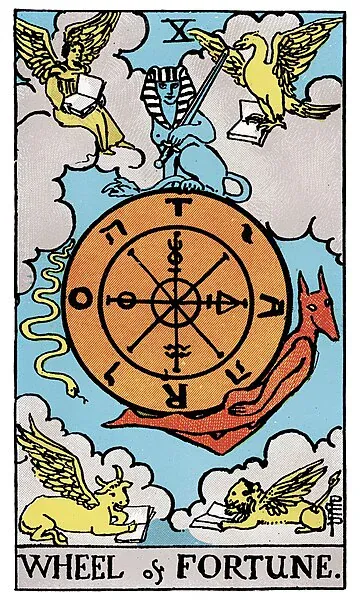
Wheel of Fortune
On the Wheel of Fortune the serpent occupies the descending left rim — paired across the wheel with Hermanubis rising and the Sphinx steady at the crown. Read with the other two figures: descent here is not a loss but the half of the cycle that makes return possible.
· Read this card →Other Symbols Nearby
The Serpent belongs to the Animal category — the bestiary of creatures that act as moral and elemental witnesses to the human figures. Read it alongside the lion, the bull, the eagle, the cherub, and the other animals that watch the cards from beside or above the action.
Older Sources
The serpent's iconographic depth predates tarot by thousands of years and crosses every culture the deck inherits from. In Mesopotamia the snake guards the herb of immortality from Gilgamesh; in Genesis 3 it speaks the words that begin human moral history; in Egypt the cobra Wadjet rises on the pharaoh's brow and Apophis is the underworld serpent the sun-bark must pass each night. The Greek Asclepius bears a single snake-twined rod that survives as the modern medical caduceus; Hermes bears a doubled one, two serpents coiled in opposing directions around a winged staff, an emblem of polar currents brought into balance.
The Hermetic and alchemical traditions inherited by the Golden Dawn took up the Ouroboros — the serpent biting its own tail — as the picture of the eternal return: a closed circuit in which descent and rising are the same line read in opposite directions. By the time A.E. Waite commissioned the 1909 deck, the serpent was already understood, in his Hermetic context, simultaneously as Typhon (the destructive descending current of the Wheel) and as the gnostic teacher whose bite is also a medicine. Pamela Colman Smith's two paintings are particular flowerings of a stem that runs uninterrupted from Eridu to her London studio.