What the Sphinx Means
Among the bestiary tarot inherits, the sphinx is the densest composite — a single body that gathers four otherwise separate creatures into one. The Hebrew prophet Ezekiel sees four living beings around the divine throne — a man, a lion, a bull, an eagle — and the Christian Apocalypse repeats the four at the corners of the new Jerusalem; the medieval church reads them as the four Evangelists, and the Hermetic stream reads them as the four fixed signs of the zodiac (Aquarius / Leo / Taurus / Scorpio) and the four elements (air / fire / earth / water). The Egyptian sphinx, with its human head and lion's body, is the same fourfold compressed into one shape: the riddler that already is what it asks about.
Eliphas Lévi, writing in Paris in the 1850s, names this compression as the four powers of the magus — Savoir, Vouloir, Oser, Se taire: to know, to will, to dare, to keep silent. Each of the four animal natures houses one of the four powers, and the sphinx is the figure in whom they no longer fight. Aleister Crowley, half a century later, writes the sphinx atop the Wheel of Fortune as the unchangeable centre of nature — the seat that does not turn even when the wheel turns. Where a sphinx appears on a card it is therefore never decorative: it is the picture's claim that something stable is present in the middle of the motion, and that the stability is the sum of four currents held in equilibrium rather than any one of them suppressing the others.
How the Sphinx Appears in the Deck
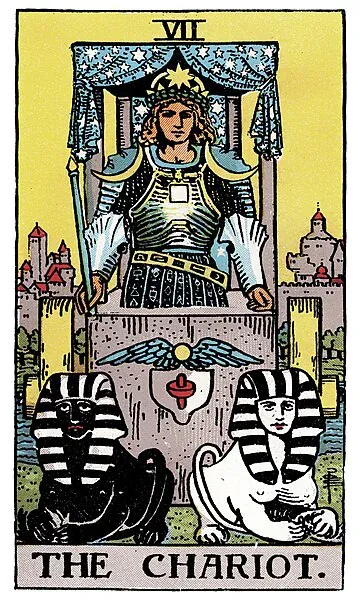
Sphinxes surface twice in the Rider-Waite-Smith deck, and the two appearances are the same teaching framed differently. On The Chariot (VII), two sphinxes — one black, one white — draw the canopied car. There is no rein in the prince's hand and no harness on their backs; what holds the team together is the will of the rider standing above them. A.E. Waite, in the Pictorial Key, reads the pair as opposition harnessed: divergence gathered into a single line of forward motion. The Hermetic gloss is that the two beasts carry the polar currents (Mercy and Severity, masculine and feminine, light and shadow) and the chariot moves only because the driver has consented to be pulled by both at once.
On the Wheel of Fortune (X), the sphinx returns alone and unmoving — blue, calm, sword resting horizontal across its lap, seated at the very crown of the great wheel. Below it, Typhon as serpent slides down the left rim; opposite, Hermanubis with his jackal head rises along the right. The picture is therefore a three-figure cosmology: a thing only descends because another thing rises through the same rotation, and the sphinx at the top is what does not get flung off. Read the two appearances together and the figure resolves into one statement: on The Chariot the sphinx is the fourfold harnessed into motion; on the Wheel it is the fourfold gathered into stillness. Same composite animal — different position relative to the turning.
Cards That Carry the Sphinx
Two cards in the deck place the Sphinx within the painted scene.
Hover a pin to see where the symbol sits on the card.
The Chariot
On The Chariot the sphinxes come in pair — one black, one white — drawing the canopied car without rein or harness. Opposition itself becomes the motive force; their divergence is gathered by the will of the rider standing above into a single forward line.
· Read this card →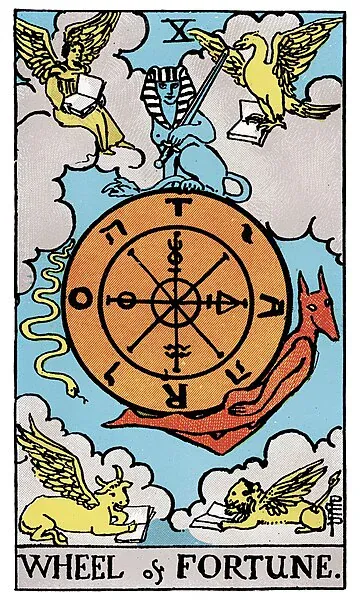
Wheel of Fortune
On the Wheel of Fortune the sphinx is single, blue, and unmoving — sword resting horizontal across its lap, seated at the wheel's crown. With Typhon descending on the left and Hermanubis rising on the right, it is the centre that does not get flung off by the turning: seeing, but not competing.
· Read this card →Other Symbols Nearby
The Sphinx belongs to the Animal category in the Tarot Atlas — the bestiary of creatures that act as moral and elemental witnesses to the human figures. Read it alongside the serpent, with whom it shares the Wheel of Fortune, and the other animals listed below.
Older Sources
The sphinx's iconographic depth runs through three civilizations the deck inherits from. In Egypt, the Great Sphinx of Giza — Old Kingdom, roughly 2500 BCE — is carved as a colossal lion-bodied figure with a human head, and the New Kingdom Dream Stele of Thutmose IV identifies it with the solar god Ra-Horakhty. The Egyptian sphinx is a guardian: it sits at the threshold between desert and city, between the world of the dead and the world of the living, watching without speaking. In Greece, Sophocles' Oedipus Tyrannus stages the sphinx of Thebes as the riddler at the gates — knowledge made into a checkpoint, the threshold-keeper who lets only those pass who can name the human at three ages. The Greek sphinx is the figure who already knows, and whose knowing is the test.
The medieval and Hermetic streams compose these inheritances with Ezekiel's vision of the four living beings around the divine throne — man, lion, bull, eagle — read by the Christian church as the four Evangelists and by the Hermeticists as the four fixed signs and the four elements. Eliphas Lévi, in Paris in the 1850s, gathers the composite under the four powers of the magus: Savoir, Vouloir, Oser, Se taire — to know, to will, to dare, to keep silent. Israel Regardie inherits the kerubic reading from the Golden Dawn lecture papers. Aleister Crowley, in the 1944 Book of Thoth, writes the sphinx atop the Wheel as the unchangeable centre of nature, the seat that does not turn even when the wheel turns. Pamela Colman Smith's two paintings — the rein-less pair on The Chariot, the still blue figure on the Wheel — stand on a stack of inheritances roughly four and a half millennia deep.