What the Staff Means
The staff is the deck's figure of three meanings carried in one piece of wood: authority, journey, and survival. As authority it is the rod of office — the Egyptian was-sceptre held by gods and pharaohs, the herald's wand of Hermes, the bishop's crozier — a length of wood that says the bearer has the right to direct what happens here. As journey it is the pilgrim's staff, the third leg that comes out of the closet only when the road is long enough to require it. As survival it is the shepherd's crook of Psalm 23 — 'thy rod and thy staff, they comfort me' — the wood that walks into the valley because the body cannot walk it alone. Tarot keeps all three meanings live and refuses to choose between them: the same shape carries each weight depending on whose hand it is in.
Where the wand is the will fully extended — short, decorated, held outward as instrument — the staff is the same length of wood admitted to be longer than the arm. Rachel Pollack reads the Hermit's staff as the Magician's wand grown old; the elemental fire of Wands has been lived with long enough that it no longer points outward but holds the body up. The deck makes this point by letting the staff cross suits the wand never does: it appears in the Wands minors as work, in the Cups Eight as the hiker's stick at midnight, and on the major arcana as the Hermit's lantern-pole. Three meanings, one piece of wood — the symbol's authenticity in tarot is that none of the three is ever quite separable from the others.
How the Staff Appears in the Deck
The staff threads through three suits at once. In the Wands suit it is the suit's whole working vocabulary — the same length of wood rotated through every posture work can take. The Three of Wands plants two staves into the earth and leaves a third in the figure's hand, the part of the project already done versus the part still being held. The Four of Wands raises four staves vertically into a structure that no longer needs holding — work standing on its own. The Five of Wands crosses five staves at incompatible angles, each insisting it is the main axis. The Six of Wands tilts five staves at one shared angle behind the rider — alignment more than victory. The Seven of Wands plants a rough staff against six others rising from below; the Eight of Wands lets eight fly in straight parallel lines, momentum without bearer. The Ten of Wands clutches all ten in a single bundle and lets the bundle block the figure's own line of sight to the gate ahead.
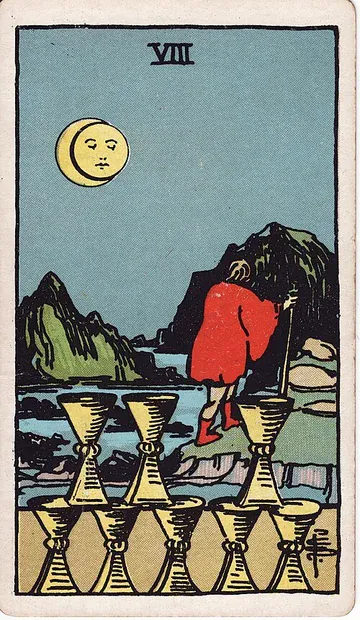
Beyond the Wands, the staff returns twice. On The Hermit (IX) the same length of wood Pamela Colman Smith painted on the Magician's table reappears in the old man's left hand — held now as a third leg rather than as an emblem of office, the staff that walks into a darkness the lantern in the right hand can only narrowly light. On the Eight of Cups a staff is taken up by a cloaked figure leaving the eight unfinished cups behind him to walk under a waning moon — the wood admitted as necessary for what the body alone cannot carry through. Read together, the staff is the deck's quiet thesis on long work: that authority, journey, and survival are three faces of the same hand-held thing, and that to take up one is sooner or later to take up all three.
Cards That Carry the Staff
Twelve pins across the deck place a staff within the painted scene — the Wands suit treats it as work, The Hermit treats it as a third leg, and the Eight of Cups treats it as the admission that a long road has begun.
Hover a pin to see where the symbol sits on the card.
Eight of Cups
On the Eight of Cups the staff is picked up by the cloaked figure precisely as he turns away from eight unfinished cups. The wood is the admission inside the gesture — that this departure is a long enough walk to require what the body alone cannot supply, and that the leaving has been planned for at the level of equipment.
· Read this card →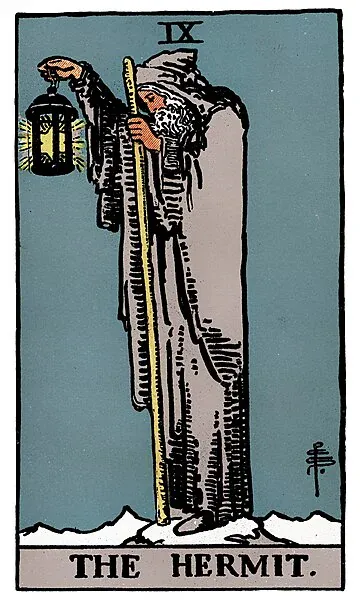
The Hermit
On The Hermit the staff is held in the left hand, planted forward at each step, while the lantern is held in the right. Smith paints it as the same length of wood as the Magician's wand on card I, simply lived with long enough that it no longer points outward as an instrument of will but supports the body that is still walking.
· Read this card →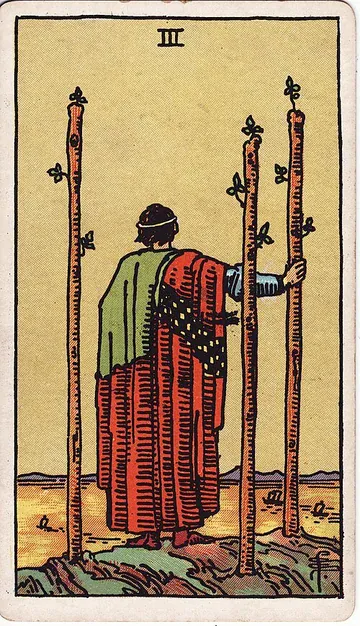
Three of Wands
The remaining tie between your body and this plan. You are not yet ready to put it down — and you do not need to.
· Read this card →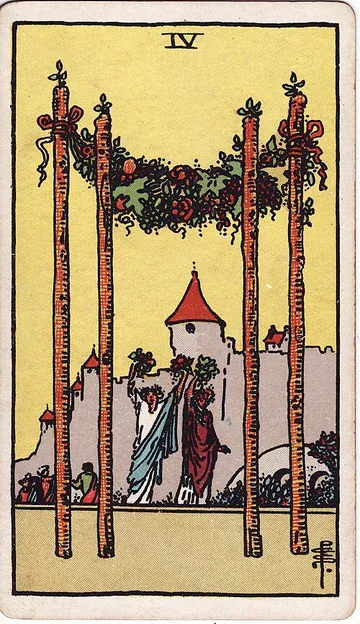
Four of Wands
The first structure of the work; that they can stand on their own means they can be let go of.
· Read this card →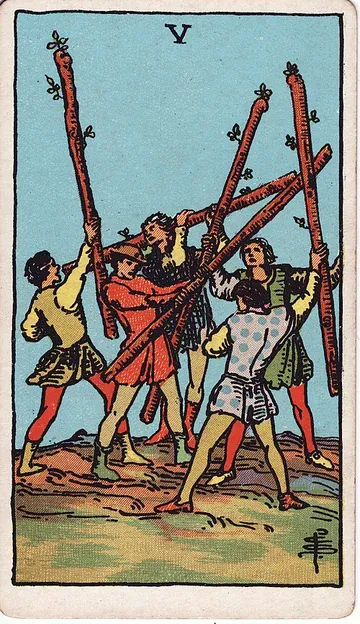
Five of Wands
On the Five of Wands five staves are crossed at five incompatible angles — none of them yet a weapon, none of them yet aligned. The staff here is each figure's claim that his angle is the axis the others should yield to; the card is the suit's portrait of friction without finished damage.
· Read this card →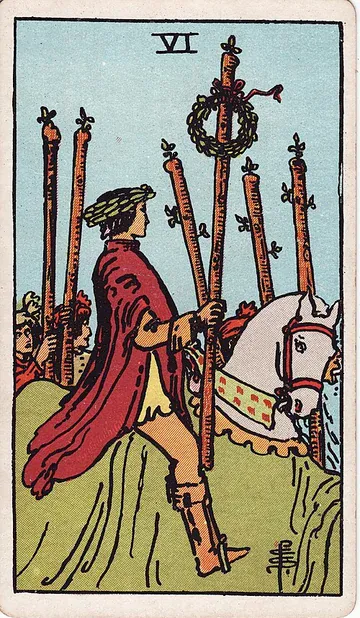
Six of Wands
What actually brought you here is not the horse — it is these five, who chose to tilt their staves to the same angle as yours.
· Read this card →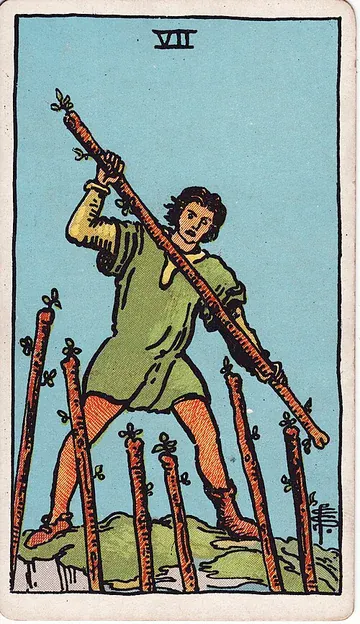
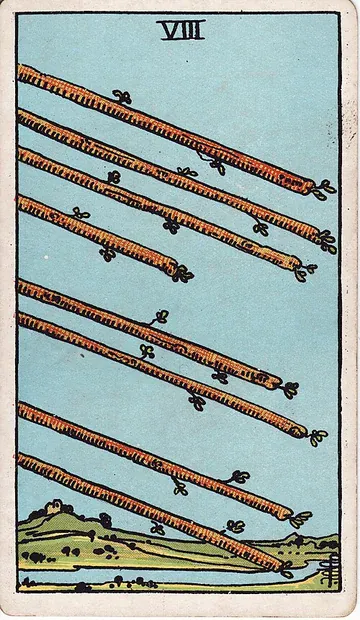
Eight of Wands
Orderly, parallel, not interfering with one another — the purity of momentum lies not in force but in not turning back.
· Read this card →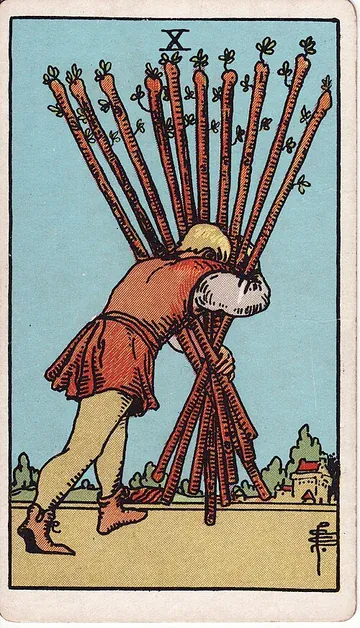
Ten of Wands
On the Ten of Wands all ten staves are clutched against the chest in one bundle, and Smith composes the figure so the bundle itself blocks his line of sight to the gate ahead. The wood that was authority on the Hermit and momentum on the Eight is here a load — necessary, complete, and one motion past the body's actual capacity.
· Read this card →Ten of Wands
On the Ten of Wands all ten staves are clutched against the chest in one bundle, and Smith composes the figure so the bundle itself blocks his line of sight to the gate ahead. The wood that was authority on the Hermit and momentum on the Eight is here a load — necessary, complete, and one motion past the body's actual capacity.
· Read this card →Other Symbols Nearby
The Staff belongs to the Object category — the deck's painted tools, vessels, and worn things. Read it alongside the sword (the blade of mind), the cup (the vessel of feeling), and the pillar (the architecture of the threshold) to see how four lengths of matter share a single Hermetic vocabulary of will, judgement, feeling, and standing.
Older Sources
The staff's three meanings reach the deck along three layered traditions. The was-sceptre of pharaonic Egypt, carried by Anubis and Set and granted to the king, fixed the staff as a sign of governance over the visible world for roughly three millennia; the caduceus of Hermes — a herald's wand later twined with two serpents — fixed it as the implement of the messenger and of the boundary between the living and the dead. The Hebrew Bible installs the second meaning. In Exodus 4:2-4, the rod in Moses' hand is told to drop to the ground, becomes a serpent, and is taken up again as a staff by its tail; the same wood walks Moses out of Egypt and parts the sea. In Psalm 23, the shepherd's rod and staff are what comfort the speaker in the valley of the shadow of death — survival imagery that the Christian Middle Ages folded into the bishop's crook and the pilgrim's staff that walked the routes to Compostela. The Hermetic tradition ties this knot. The Golden Dawn assigns the wand to Fire and to the will, and the staff is what the wand becomes when the road is long. When Pamela Colman Smith painted the Hermit's third leg in 1909 she was holding three thousand years of authority, journey, and survival in a single piece of wood — and by leaving the same wood in the Hermit's hand and on the Wands work-cards and on the Eight of Cups departure, the deck refuses to settle which of the three a given staff is.