What the Sun Means
In the iconographic vocabulary of the Western mystery stream, the Sun is the figure of conscious light. It is not only the solar body of the sky but the whole faculty of waking attention — the ego in its noblest form, the self that has stepped into the open and accepts being seen. Where the Moon governs reflection, intuition, and the half-said, the Sun is direct address: clarity, vitality, the warmth that ripens what has already been planted in shadow.
Hermetic readings going back to the Renaissance Picatrix and forward to the Golden Dawn assign the Sun to the heart-center of the Tree of Life — the sephirah Tiphareth, beauty as the harmonized point through which the higher and lower meet. In tarot the Sun therefore carries a double weight: it is the daylight under which growth becomes visible, and it is the archetype of the integrated self, the one who can be looked at without flinching.
How the Sun Appears in the Deck
The sun is most fully present on the trump that bears its name, XIX The Sun, where Pamela Colman Smith paints it as a great many-rayed face hovering above a walled garden, sunflowers turned upward, a naked child riding a white horse beneath a banner. A.E. Waite, in The Pictorial Key, presents this scene as the soul having come at last out of darkness into a plain and unhidden joy.
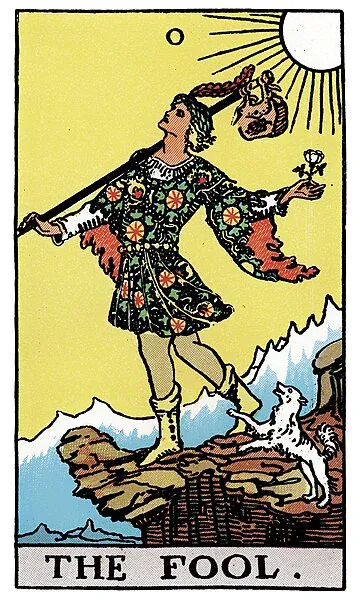
The same body returns more quietly on other cards. Behind The Fool it rises low in the sky — the dawn the wanderer steps out into, both witness and guarantor of return. On Death, it sits between two distant towers on the horizon line: a setting sun that is also a rising sun, the pictorial proof that the gate works in both directions. Read across these three cards together and the symbol resolves into a single statement: the Sun marks the moments where life consents to be illuminated, whether at threshold, at ending, or at the fullness of arrival.
Cards That Carry the Sun
Three cards in the deck place the Sun within the painted scene.
Hover a pin to see where the symbol sits on the card.
The Fool
On The Fool the sun sits low and behind, lighting the wanderer's first step without insisting on being looked at — the patient witness rather than the destination.
· Read this card →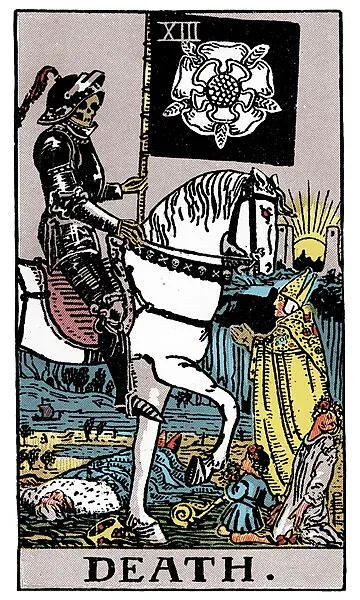
Death
On Death the sun is reduced to a small disc threaded between two towers — illumination at the exact threshold where one form ends and another rises through the same gate.
· Read this card →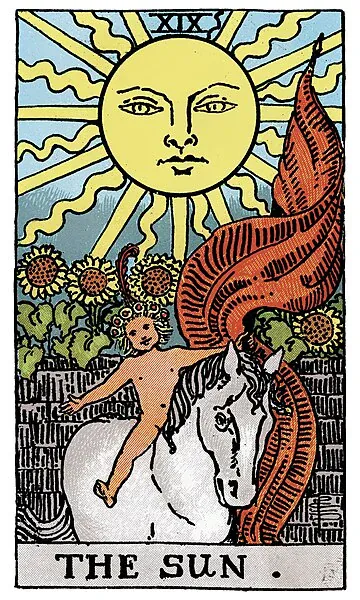
The Sun
On The Sun trump the sun is the whole sky — eyes open, rays alternating straight and undulant for masculine and feminine current, the daylight under which a self can finally be naked.
· Read this card →Other Symbols Nearby
The Sun belongs to the Landscape category — the slow features of sky, ground, and water that frame the human figure. Read these alongside it.
Older Sources
Waite did not invent the solar imagery he commissioned. The Babylonian Shamash, the Egyptian Ra and the disc of Aten, the Hellenistic Helios driving the four-horse chariot — all stand in a long lineage where the visible sun is read as the visible face of conscious order. The Picatrix, the Latin Hermetic textbook that reached Europe in the 13th century, lists the Sun among the seven planets governing magical attribution; the Golden Dawn in the late 19th century inherits this and pins the Sun to the path of Resh on the Tree of Life and to the sephirah Tiphareth at the Tree's heart. Smith's painted child, sunflowers, and walled garden are her own contribution — a 1909 English picture standing on a foundation roughly four millennia deep.