What the Sword Means
The sword is the deck's figure of discriminating intellect — the faculty that separates this from that, true from false, mine from not-mine. In the Hermetic stream inherited by the Golden Dawn it is assigned to Air: the moving, invisible element of speech, breath, and thought, and the quickest of the four to draw blood. Every sword in tarot carries this load. To pick one up is to claim the right to decide.
It is also, always, double-edged. The blade that cuts a knot also cuts the hand that holds it badly — Rachel Pollack's reading of the Swords suit turns on this paradox, the way mind corners itself with the same instrument it uses to clear ground. So the sword is never simply triumphant. It is the figure of the cut that defines, and of the price of having defined: clarity bought at the edge of something now severed, neat answers paid for in what they refused to consider. The deck never lets the symbol drift far from its own cost.
How the Sword Appears in the Deck
The sword sits at the core of two structures at once. On Justice (XI) it is held upright in the right hand, blade pointing straight up, perfectly vertical — A.E. Waite, in The Pictorial Key, presents this as the neutral verdict, the cut that has to be impartial because both parties watch the same edge. The scales weigh; the sword decides. It is the only sword in the deck held this still.
Then it becomes the suit. Across the fourteen Swords cards the same blade is rotated through every posture mind can take — the single sword crowned at the Ace; three swords crossed through the heart; four laid level above a tomb of rest; eight planted around a bound figure; nine hung above a sleeper's bed; ten pinning a body face-down at the close. The four court figures inflect it differently: the Page watching warily over a shoulder, the Knight charging forward with the blade horizontal, the Queen seated upright with the sword raised but still, the King steady and unflourished. Read together, the suit is a single argument staged through one object — what the mind does to itself when given an edge.
Cards That Carry the Sword
Sixteen anchor points across the deck place a sword within the painted scene — Justice plus the entire Swords suit. The pins below show four of the most symbolically loaded; hover any to see exactly where on the image the blade sits.
Hover a pin to see where the symbol sits on the card.
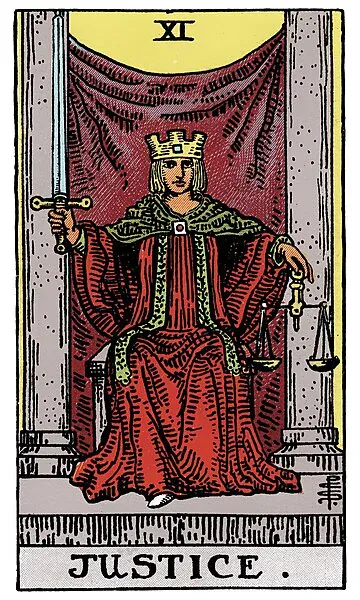
Justice
On Justice the sword is held perfectly vertical in the right hand — neither raised nor lowered, the only sword in the deck depicted at total rest. It is the figure of the verdict that does not yet flatter either side.
· Read this card →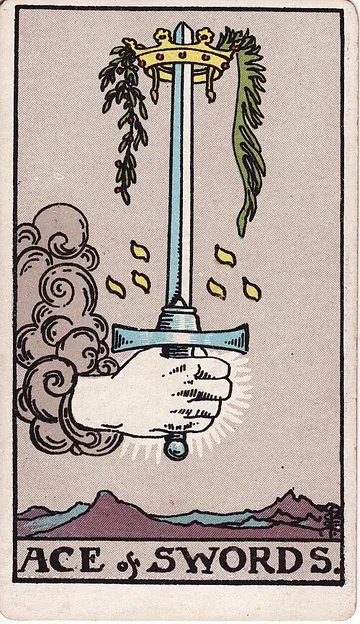
Ace of Swords
The point rises — the blade's first task is to stand up, not to fall. It names first, and only then decides whether to strike.
· Read this card →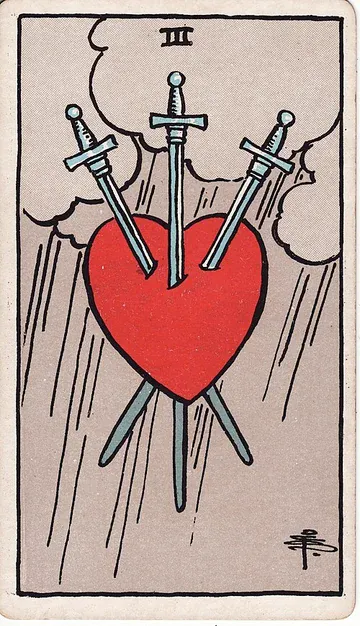
Three of Swords
On the Three of Swords three blades pass through a single red heart under a grey sky — the cut at its most literal, the moment when discrimination has already happened and grief is the receipt.
· Read this card →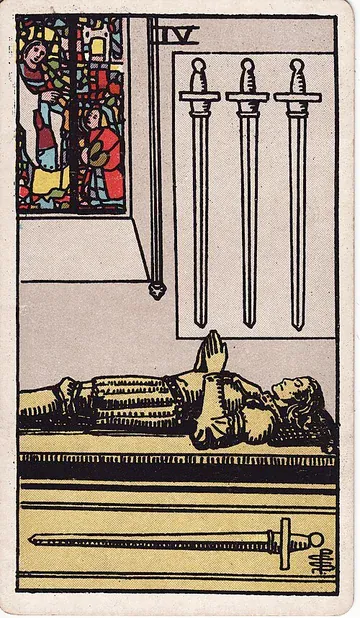
Four of Swords
Swords hung with points downward — reminders only. The three past battles are within sight, but no longer in hand.
· Read this card →Four of Swords
The fourth sword is not yet hung but rests along the coffin's side — the blade from the most recent battle has not yet been cleaned and stored. The withdrawal is freshly done, not long past.
· Read this card →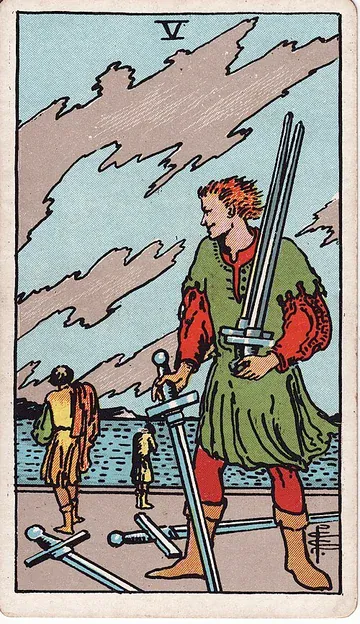
Five of Swords
He won — but what he holds is not a medal, only the weapons others gave up. The weight in his arms reminds him: each blade was once aimed at him; now each belongs to him, and he carries them all alone.
· Read this card →Five of Swords
Two no one wanted even to retrieve — they have ceased to be weapons, only the scrap metal left by the quarrel. There is always something this useless at the scene of a victory.
· Read this card →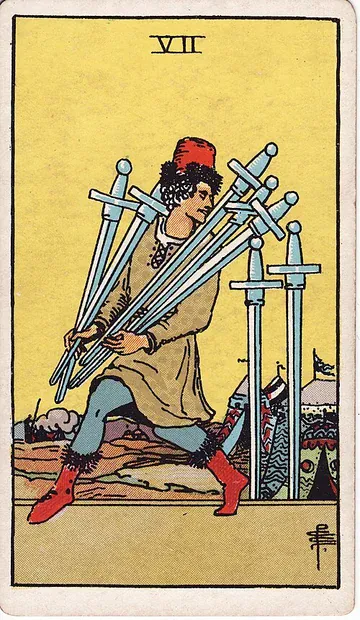
Seven of Swords
Five swords bundled awkwardly against his chest — no practiced carry, but an improvised smuggling. By count he can still justify himself; by posture, his haste has already betrayed him.
· Read this card →Seven of Swords
The two swords left planted are a ritual concession — 'I didn't take them all' becomes a form of self-justification. Yet these two are also what will let him be identified later.
· Read this card →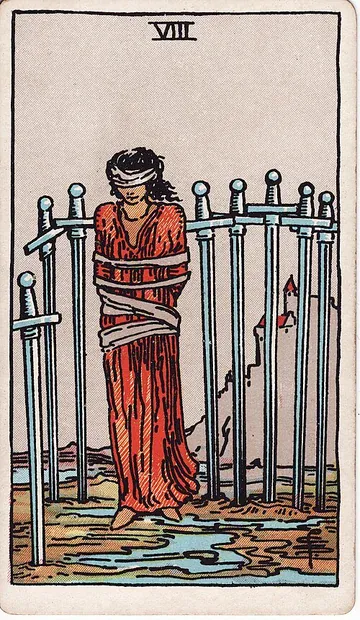
Eight of Swords
On the Eight of Swords eight blades stand planted in the ground around a bound and blindfolded figure — the swords are upright but they are not the captor; the bindings are loose, the cage is the mind's own arrangement of its tools.
· Read this card →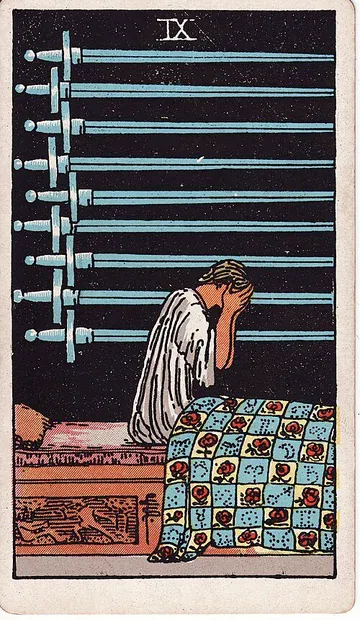
Nine of Swords
Not the blades currently wounding you — the ones you yourself have catalogued and filed again and again. The length of the list is proof of your earnestness; it is not proof of the truth.
· Read this card →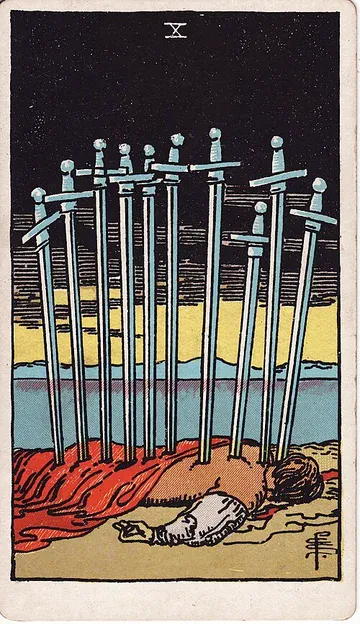
Ten of Swords
On the Ten of Swords ten blades pin a prone figure face-down beneath a black sky beginning to break at the horizon — completion as it actually arrives in this suit, the only direction left being up.
· Read this card →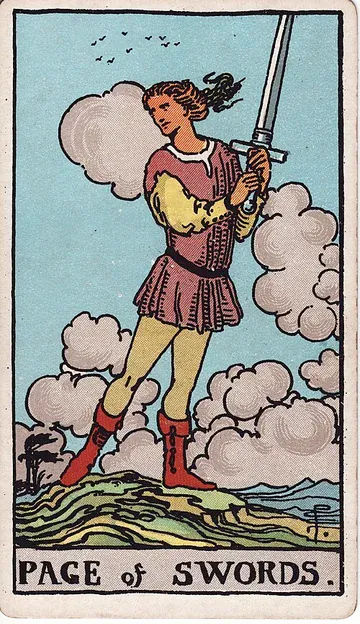
Page of Swords
The blade has not yet been used to cut — it is still only an intention. The young mind grips its own sword and learns, before any strike, simply to let it stand upright.
· Read this card →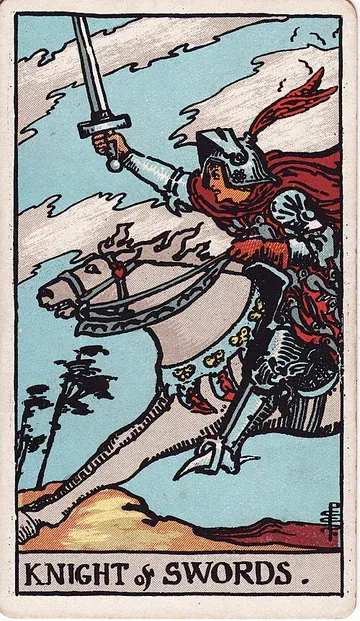
Knight of Swords
Not a blade striking anyone — the blade leading at the very front. The leading blade must first learn not to let itself fall early.
· Read this card →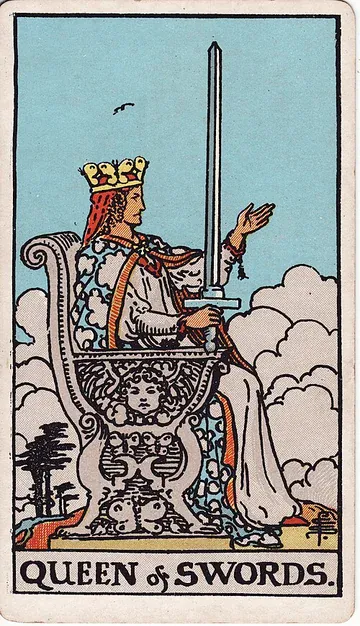
Queen of Swords
The blade points upward, not at any person — her sharpness aligns her own direction, not bears down on another.
· Read this card →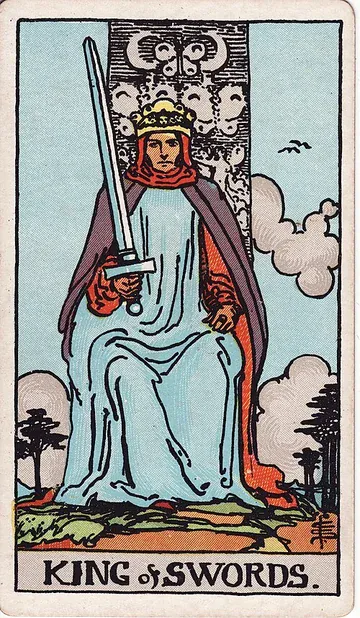
King of Swords
The sword neither comes down like the warrior's nor waits like the scout's — it stands, a median line beyond dispute. The blade of judgment earns that name only when held perfectly upright.
· Read this card →Other Symbols Nearby
The Sword belongs to the Object category — the deck's painted tools, vessels, and worn things. Read these alongside it; pillar, throne, and crown thread through related verdict scenes.
Older Sources
The discriminating sword reaches the deck through layered traditions. Roman Iustitia carried scales and a sword from at least the late Empire; the gladius of judgement is older still in the Hebrew Bible, where Solomon proposes to halve a contested child with one (1 Kings 3:24-25) and the cherubim guarding Eden bear a flaming sword that turns every way (Genesis 3:24). The Hellenistic Themis and the Christian archangel Michael inherit the iconography — judgement that is also defense, defense that is also severance. The Hermetic Picatrix and the Golden Dawn fix the sword to the airy quarter of the magical circle, the eastern dawn, the rising breath. Pamela Colman Smith's 1909 painted blade — held still on Justice, multiplied through the Swords suit until the suit becomes a study of mind cutting itself — stands on a foundation about three thousand years deep.