What the Wand Means
The wand is the deck's figure of will rendered in wood. Hermetic teaching from Lévi forward reads it as the simplest of the four magical implements — a length of branch carried by an arm, the directed extension of intent into the world. The Golden Dawn fixed it to the element of Fire and to the eastern path of the candidate's first inner work: the Fire Wand of the outer order is the tool by which a beginner learns that the will is not loud assertion but accurate aim. To pick up a wand is to declare a direction.
The wand is therefore distinct from the staff — its longer cousin in the deck's vocabulary. A staff supports a body; a wand directs a current. RWS prose blurs the two, but Pamela Colman Smith's pictures keep the distinction: where a figure leans on a length of wood, it is a staff; where a figure points or holds vertically, fire-flickered or living, it is a wand. The famous gesture of the Magician — right hand up, left hand down, the wand a vertical relay between sky and earth — is the most concentrated reading of the symbol the deck offers. The wand is not what one carries; it is what one channels.
How the Wand Appears in the Deck
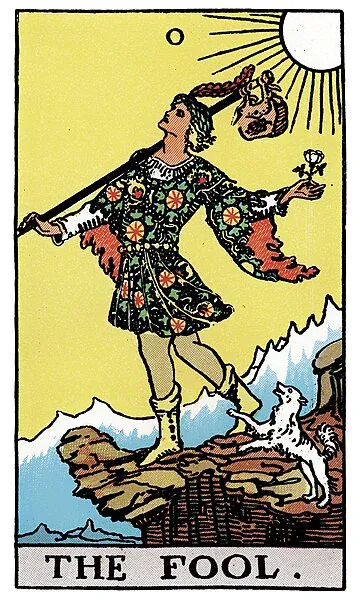
The wand sits across two registers of the deck. Among the major arcana it is the Magician's vertical implement (I), the wallet-pole shouldered by the Fool as he steps off the cliff (0), the directing rod the Charioteer holds in lieu of reins (VII), and on the World it is doubled — two short wands held one in each hand by the dancing figure, points alternating, an explicit picture of the Hermetic axiom 'as above, so below' resolved through a single body (XXI). Each appearance is an inflection of the same idea: a tool short enough to be held, vertical enough to relay, charged enough to be doing work whether or not one notices.
The wand then becomes the suit. The Ace shows a hand emerging from a cloud and gripping a freshly-cut branch — leaves still sprouting from it, smoke or sparks rising at the tip — Pollack reads this as Smith's pictorial argument that fire in tarot is not combustion but unfurling, the living branch lit from within. The Two of Wands plants one wand into the wall of a parapet while the figure holds the other in his hand: the half of the will already established, set; the half that still requires the body. By the Nine the wands have multiplied to a fence around the wounded figure — eight planted behind, one held — the archive of past rounds and the current line of defense. Read across the suit and the wand is a single object passed through every stage in the life of an intention: kindled, planted, defended, and finally borne as crown (the King's flame-shaped diadem on Wands XIV is the suit's own crown made of wand-fire).
Cards That Carry the Wand
Eight pin points across the deck place a wand within the painted scene — four major arcana plus the most loaded moments of the Wands suit.
Hover a pin to see where the symbol sits on the card.
The Fool
On The Fool the wand is a long shouldered pole — half walking-staff, half banner-pole — with an embroidered wallet tied at its end. He carries the seeds of past journeys on the wand he uses to step into the next.
· Read this card →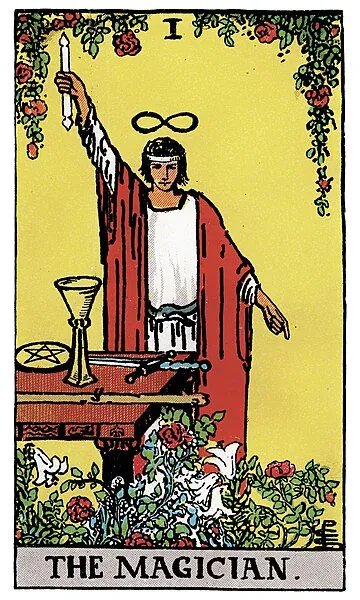
The Magician
On The Magician the wand is held vertically above the head in the right hand while the left hand points down to the table — the picture of 'as above, so below' as a single body's posture. The wand is what makes the relay legible.
· Read this card →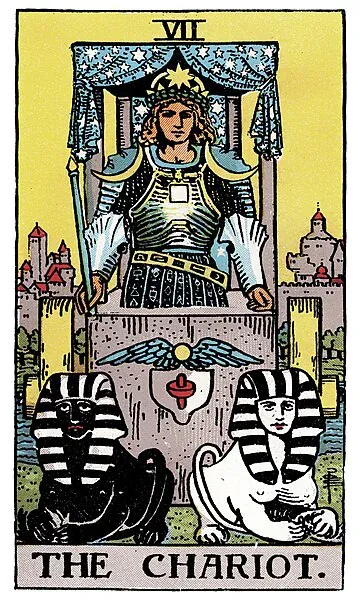
The Chariot
The wand in his hand does not strike; it points — direction itself is the form of governance.
· Read this card →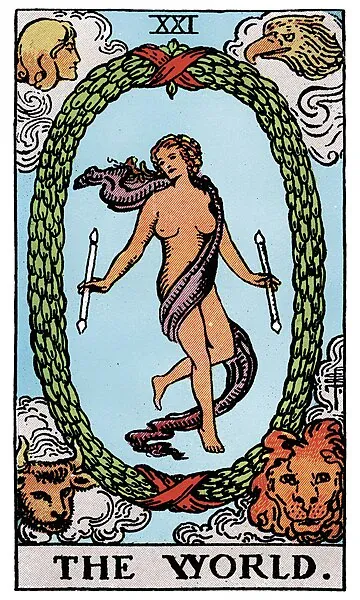
The World
On The World the figure holds two short wands, one in each hand, points alternating up and down. The Hermetic axiom is no longer a vertical body relaying current — it is a moving body holding the polarity itself in both palms.
· Read this card →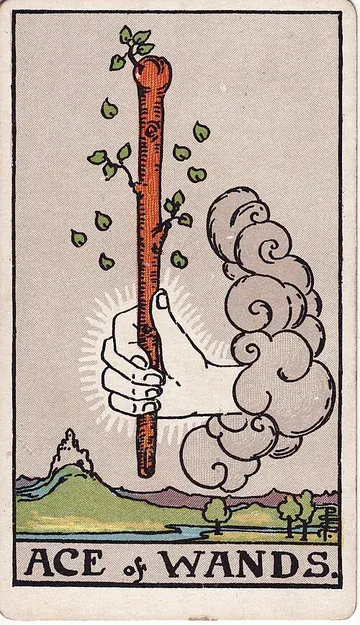
Ace of Wands
On the Ace of Wands a hand emerges from a cloud gripping a freshly-cut branch — leaves still sprouting at the tip, smoke rising — fire as something living rather than combusting.
· Read this card →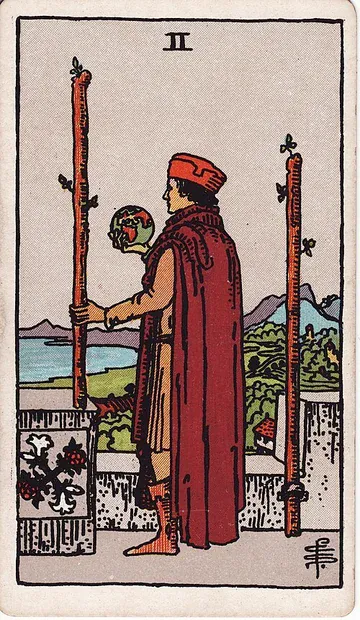
Two of Wands
The half of the will already established — it no longer needs to be held.
· Read this card →Two of Wands
The half that still requires a hand — because the intent has not yet arrived.
· Read this card →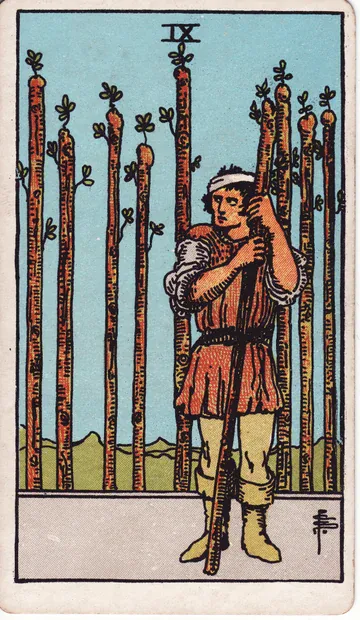
Other Symbols Nearby
The Wand belongs to the Object category — the deck's tools, vessels, and worn things. Read it alongside its kin; cup, sword, pentacle, and the longer staff thread through related implements.
Older Sources
The directed wand reaches the deck through a long lineage. The hieratic rod of the Egyptian priest, the caduceus of Hermes-Mercury entwined with two serpents, the rod of Aaron that buds in a single night (Numbers 17:8), the augur's lituus marking the quarters of the Roman sky — each is a precursor reading of a held branch as a tool of directed force. Eliphas Lévi, in Dogme et Rituel (1854–1856), formalises the magical wand as the figure of will, naming the double-tipped wand the picture of polarity reconciled. The Golden Dawn in the late nineteenth century inherits this and gives the wand a precise grade-ritual function: the Fire Wand the candidate carries from Zelator upward is what the World card's two wands are pictures of. Smith's painted branches — the Magician's vertical relay, the World's doubled palms, the Ace's living shoot — stand on a foundation about three thousand years deep.