
What White Means
White is the most candid color the deck owns. In the Western symbolic tradition it carries five overlapping readings that the painted scene is allowed to draw on at any moment: purity (the unconcealed body, the consecrated bride), holiness (the priest's linen, the descent of grace), mourning (the white worn at funerals across much of medieval and early-modern Europe before black supplanted it), enlightenment (the inner light made outward), and the unsentimental finality of death (the bone left after the flesh is gone). The color says no in five different keys — no defense, no decoration, no return.
Hermetic alchemy gives the same color a precise technical sense. After the nigredo, the dark putrefaction in which the matter is broken down, the next stage of the Great Work is the albedo — the whitening, the washing — when the soul rises out of its first dissolution and is purified before further fire. Every white in the deck can be read against this stage: the dawn after the long night, the body after the wound, the banner after the trial. White is what is left when the work has burned off everything that could be burned off and the colorless ash turns out to be luminous.
How White Appears in the Deck
The deck stages white as a moving line through the major arcana. On The Fool (0) it is the white rose held lightly in the wanderer's hand and the small white dog at his heel — the unspoiled departure, innocence not yet tested. On Strength (VIII) it is the long white robe on the figure who tames the lion without armor — defenselessness as the higher form of strength. On Justice (XI) it is the single white slipper just visible beneath the robe — the verdict is given by one who still walks on the earth.
Then the color hardens. On Death (XIII) it is the great white horse the skeleton rides — the pale horse the Book of Revelation names as Death's mount — and the white five-petalled rose on the black banner: a flag of surrender that is also a flag of refusal, the rose painted white because what passes through this gate is no longer the matter of passion. On The Sun (XIX) the same white horse returns at full daylight under the laughing solar face: the body that survived Death is the body that rides into the garden. On Judgement (XX) the angel's banner is white with a red cross — the four directions wakened at once, the colorless ground on which the new sign can be cut.
Read the line in order — Fool · Strength · Justice · Death · Sun · Judgement — and white draws an arc: from innocence, through gentleness, through neutrality, through death, into joy, and out the other side as the cleared ground that lets the trumpet be answered. The Knight of Swords joins the line as the smaller-key reprise: the same galloping white horse beneath a young warrior who has not yet earned the stillness the others have.
Cards That Carry White
Nine pinned instances of white across the deck — major arcana plus the Knight of Swords and the Six of Wands. Its meaning shifts from cloth to flesh to flag.
Hover a pin to see where the symbol sits on the card.
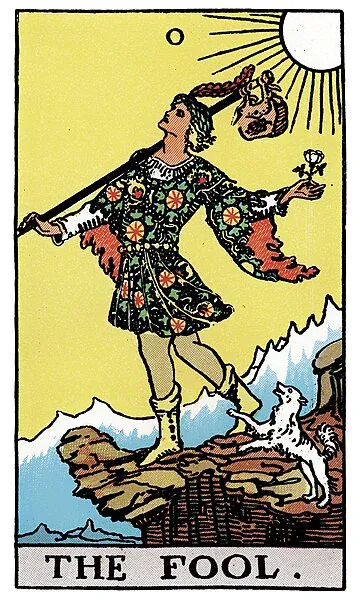
The Fool
Instinct bounding at his heel — a loyal companion that warns as it encourages.
· Read this card →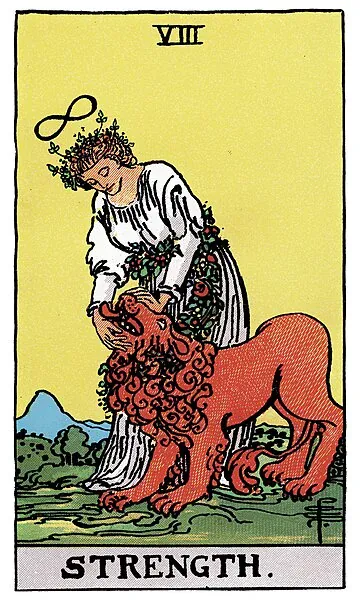
Strength
On Strength the white is the entire robe — a color with no armor in it. To stand before a lion in white is to refuse the body as the line of defense; the strength is the willingness to be unprotected.
· Read this card →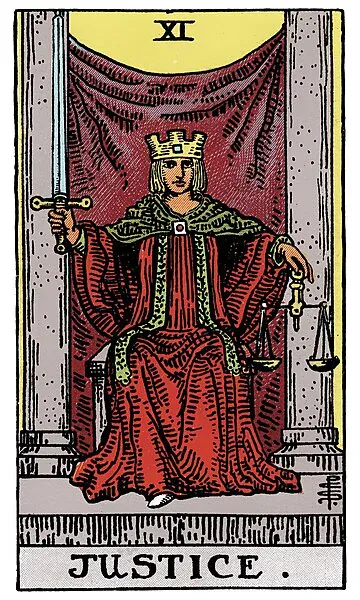
Justice
The single white slipper just visible beneath the robe — she is not a statue; she is one who also walks out of doors. The law is in her hand, but her foot still rests on the ground.
· Read this card →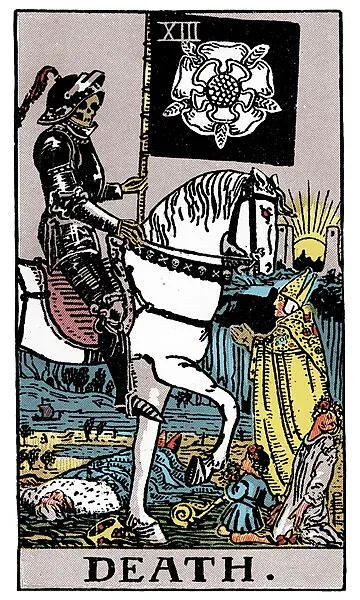
Death
On Death the white is doubled — the pale horse the Book of Revelation calls Death's mount, and the five-petalled rose on the banner washed white where it was once red. What passes through this gate is no longer the matter of desire; the rose is repainted in the color of what survives.
· Read this card →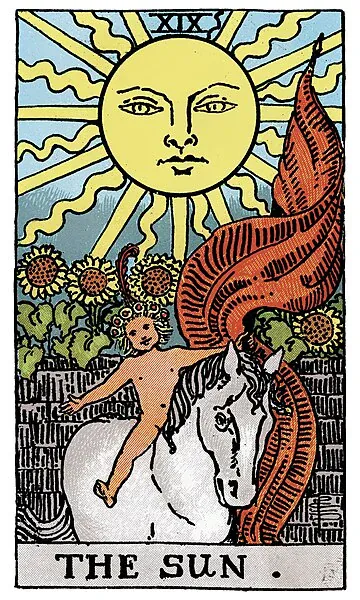
The Sun
On The Sun the same white horse returns — but reinless, in full daylight, carrying a naked child. The body that was Death's mount has become the body of joy. The whiteness has not changed; the light that falls on it has.
· Read this card →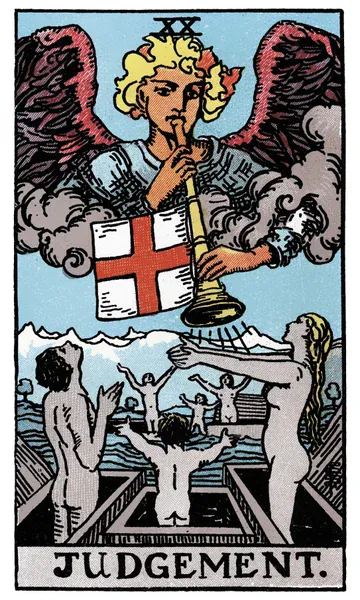
Judgement
On Judgement the white is the field of the banner over the angel's trumpet — the cleared ground on which the red cross of the four wakened directions can be cut. White first, then sign; the sound calls the colorless surface back into form.
· Read this card →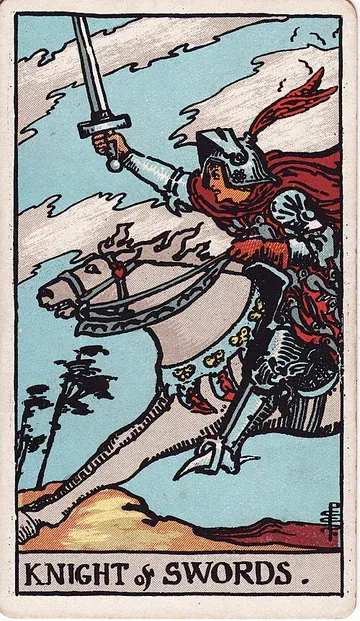
Knight of Swords
This horse does not need to be pulled forward on the rein — it already wants to run. The rider has to find direction inside the speed, not let the speed carry him off.
· Read this card →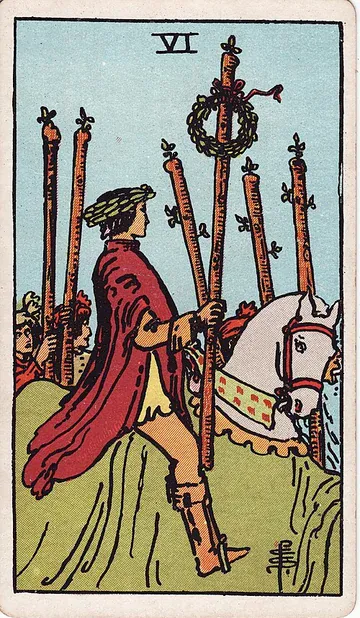
Six of Wands
The force that carried you this stretch — it has been dressed in formal cloth, meaning you are not the rider now; you are the one being carried.
· Read this card →Other Symbols Nearby
White belongs to the Color category — the painted hues that carry doctrinal weight inside the scene. Its formal opposite in the alchemical sequence is red (rubedo), and the two are best read as a pair: white is the washed soul, red is the completed work. Other colors in the atlas (black, grey, golden, blue, green) are catalogued in the index even where the long-form essay is still forthcoming.
Older Sources
Pamela Colman Smith did not invent white as a sacred color. The Hebrew Bible dresses the high priest in linen for the holiest service (Leviticus 16:4); Roman religion knew the white-robed flamen and the candidate (candidatus, the whitened one) before public office. Christian iconography reads the white lily as the Marian rosa alba — purity figured as a flower without color — and dresses the resurrected Christ and the angels in radiant white. Across medieval Europe, white was the color of mourning for queens (le deuil blanc, retained at the French court into the sixteenth century) before black settled in as the dominant funeral hue. The two readings — bridal and funereal — were never far apart; both name a body that has been removed from ordinary use.
The technical reading runs alongside. The Hermetic alchemists from the early Latin treatises through Paracelsus and into the seventeenth-century rosicrucian compendia name the four color stages of the Great Work — nigredo, albedo, citrinitas, rubedo — in which the albedo is the whitening, the soul washed clean of its first darkness before the further fire. C.G. Jung's Mysterium Coniunctionis (1955-56) reads this entire sequence as a psychic process: the albedo as the moment the unconscious has been illumined enough to be looked at without flinching but before its full integration. The deck's whites — Fool's rose, Strength's robe, Death's horse, Sun's horse, Judgement's banner — sit on top of this four-millennia stack. They are the figure of the moment after the dark, before the gold.