What the Wolf Means
Across the Western mystery stream, the wolf is read as the figure of the wild — the instinct that did not consent to the village, the appetite that did not learn the table, the part of the natural mind that still answers to the moon rather than to the bell. He is paired again and again with his domesticated brother the dog, and the pairing is the symbol: the wolf is what the dog was before it was named, what the dog will return to if the bond breaks, the older animal that the younger one wears like a coat over.
In the lunar register the wolf carries a particular charge. Where the sun governs the daylight self that consents to be seen, the moon governs the unsorted, ancestral, half-recognized layer beneath it — and the wolf is the visible body of that layer's appetite. He is not, in the symbolic stream, a moral figure: not a villain and not a hero, but a witness to what in us was not built by the city. The gospel injunction against false prophets in sheep's clothing (Matthew 7:15) belongs to a separate register entirely; it warns against a wolf disguised, not against the wolf as such. Read at his proper depth, the wolf is the question every lunar card forces — what in me is tame and what in me is wild, and have I yet learned the difference?
How the Wolf Appears in the Deck
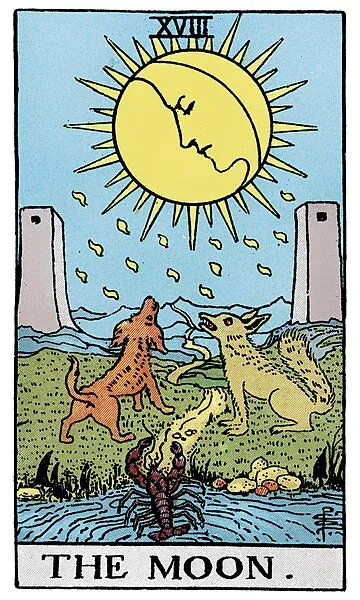
The wolf surfaces only once in the Rider-Waite-Smith deck, but the appearance is precise. On The Moon (XVIII), Pamela Colman Smith paints two animals on the foreground earth, raising their voices toward a face-bearing moon. On the right stands a domesticated dog — ears alert, posture trained. On the left stands a wolf — leaner, lower-headed, the same howl rising from a body that was never brought indoors. Behind them two towers mark the gate to a path that climbs into a far ridge; in front of them a crayfish climbs out of a still pool.
Read across the whole picture, the wolf and the dog are not two animals but a single split inside one nature. A.E. Waite, in his Pictorial Key, calls them the fears of the natural mind in the presence of the place of exit — and the moon as the only light by which that exit is found. Strength VIII gives us a hand on the lion (sovereign heat met by daylight innocence); The Moon XVIII gives us no hand, only the howl — the wolf is not subdued here, not paired with a tamer, not asked to consent. He is the animal half of the moonlit self standing on the same ground as his domestic brother and answering the same call. The card asks the same question of every reader who turns it: which of the two voices is mine, and have I made my peace with the other?
Cards That Carry the Wolf
One card in the deck places the Wolf within the painted scene. Hover the pin to see exactly where on the image the symbol sits.
Hover a pin to see where the symbol sits on the card.
The Moon
On The Moon the wolf stands on the left foreground — leaner, lower-headed than the dog opposite him, both howling toward the face of the moon between the two towers. Read him beside the dog rather than against: the same call enters both throats from a body that was named and a body that was not.
· Read this card →Other Symbols Nearby
The Wolf belongs to the Animal category — the bestiary of creatures that act as elemental and moral witnesses to the human figures. Read it alongside the serpent: both are figures of the un-domesticated, the half of the self the city did not raise.
Older Sources
The wolf's iconographic life predates tarot by millennia and arrives at Pamela Colman Smith's 1909 painting through several distinct streams. In Roman foundation myth (Livy, Ab Urbe Condita 1.4) the she-wolf — the lupa — suckles the infant twins Romulus and Remus on the Tiber bank: the wild mother who keeps human history alive across the gap between abandonment and city-building. In Norse cosmology (Snorri's Prose Edda, Gylfaginning) Fenrir is the wolf bound by the gods with a ribbon of impossible substances, who breaks free at Ragnarök and devours the sun: the wild that the city imprisons but cannot abolish. These two stems alone — the nursing she-wolf and the world-ending wolf — already carry the doubleness Smith's painting inherits.
The Christian register layered another reading on top. In the parable of false prophets (Matthew 7:15) the wolf appears in sheep's clothing — the dangerous appetite that has learned to dress as the safe one. From late antiquity onward, European Christendom tended to read the wolf chiefly through this lens: predator at the edge of the flock, devil at the edge of the parish. By the high Middle Ages the wolf was the bestiary's standing emblem of ravenous appetite, and many of the wolf-fears that landed in nineteenth-century European folktales descend from this layer rather than from the older mythic one.
Egyptian iconography offers a useful counterpoint Smith's London context would have been aware of. Anubis, the jackal-headed (often read in popular sources as wolf-headed) guide of the dead, is not the European wolf at all — he is a psychopomp, an aligned animal, the dog-side of the canid pair raised to a sacred office. Across the ocean, many Indigenous traditions of North America hold their own distinct teachings about Wolf as kin, teacher, or relative; these are not a single "symbol" and not Smith's source — they are noted here only to mark that the European wolf-as-devourer is one cultural reading among many, not a universal one. By the time Waite commissioned XVIII The Moon, the wolf available to him was already this thick stack: she-wolf and Fenrir, parable-wolf and bestiary-wolf, and behind them all the simpler, older fact that the dog beside him was once the same animal and might be again.