
Meeting Lunarcana
An ordinary engineer, and a journey he didn’t see coming
I asked the same question five times. It took me a while to see that I only wanted to hear myself say it, just once: go ahead.
If I had to say when the story of Lunarcana began, I think I’d start last year, when I first got interested in metaphysics. Around that time I began exploring all kinds of systems: the traditional Chinese ones first — Bazi (Four Pillars), Zi Wei Dou Shu (Purple Star astrology), Liu Yao, Da Liu Ren — and later, gradually, Western tarot1. I spent a lot of time getting to know them and studying them, and I tried to use these different systems to make sense of some of the things happening in my own life.
The funny thing is, as interested as I was, I never believed any of it could hand us a certain future. The future is always uncertain, and our lives shouldn’t be left entirely to some prediction.
And yet I have to admit that sometimes it does give people something quite special. Not necessarily an accurate answer — but encouragement, a kind of emotional support, sometimes even the nudge that finally gets you to do something. Lunarcana was born out of exactly that kind of nudge.
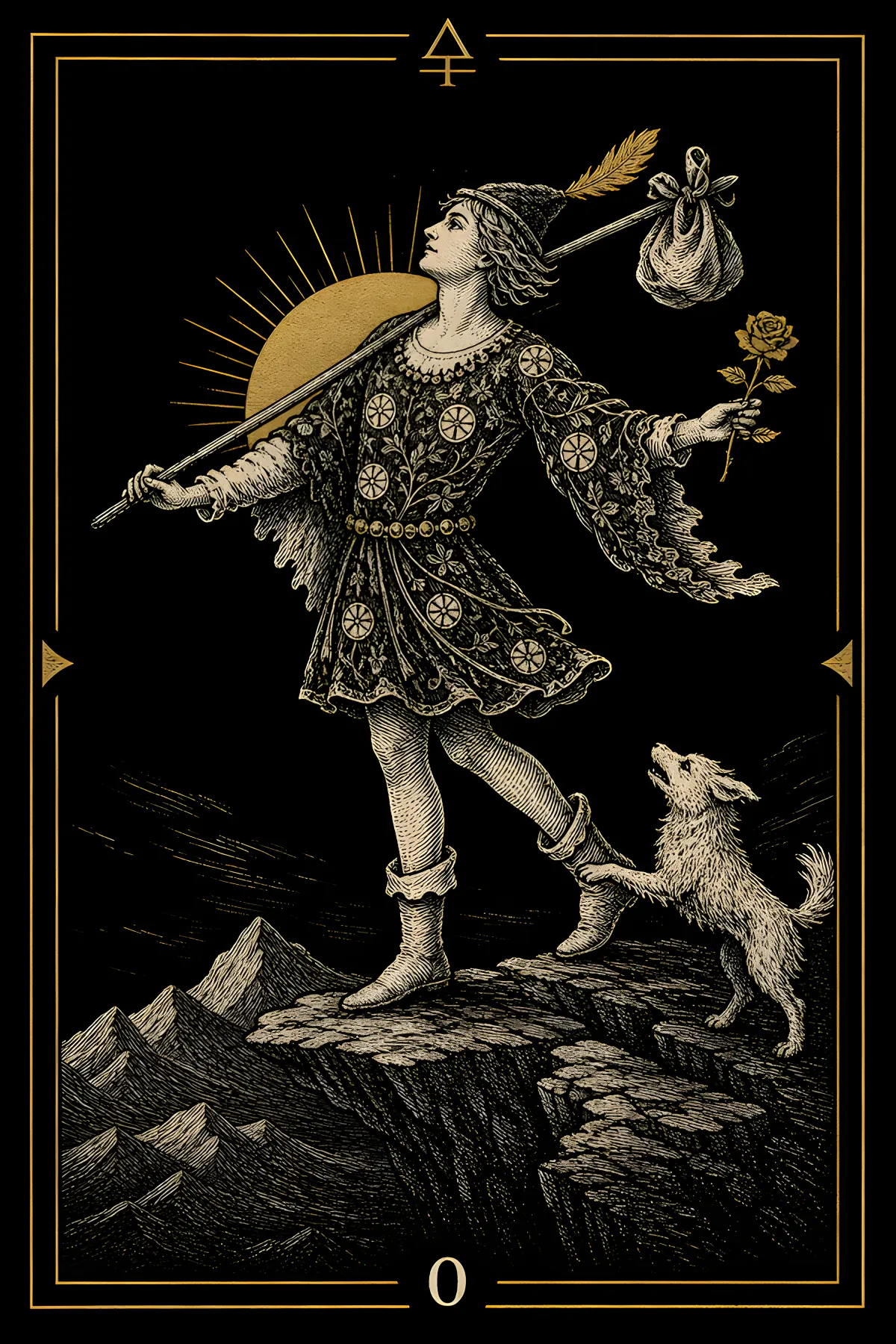
Eight images from the Fool card are hidden across the eleven sections of this essay. When you come across one, glance back at the card above.
A somewhat odd beginning
Motif I: The sun — Behind him the sun has only half risen. Everything is still at the very start.Before I actually decided to build Lunarcana, I did something that still makes me laugh a little when I look back: I asked almost every system I’d ever studied. Liu Yao, Bazi, Zi Wei Dou Shu, Da Liu Ren, and of course tarot. I put the same question to all of them —
Should I really build Lunarcana?
What surprised me was how consistent the answers were. Every one of them read like a gentle push. Honestly, even now I don’t know how much truth there is in them. I’d rather see it this way: the fact that I kept asking, again and again, shows I’d wanted to do it all along. They were just saying back to me what I already wanted to say.
Still, they did give me a very particular kind of drive. Whenever I hesitated, or started to wonder whether I should keep going, I’d sometimes think back to those readings: maybe this really is worth a try?
Looking back, I think that’s the most interesting part. They may not actually tell you what the future looks like, but they might give you the courage to walk toward one. And Lunarcana was the step I took.
An engineer, trying to do something he isn’t good at
Motif II: The bundle — The bundle tied to the end of his staff is small — too small to hold much of anything.Before Lunarcana, I had never really built and run a product for real users on my own. I’m a programmer — more precisely, an engineer who has spent years working on backends and infrastructure. On the technical side I have some experience. But when it came to product design, and above all aesthetics, I was starting almost from zero.
And aesthetics, of all things, was what I most wanted to get right with Lunarcana.
Engineering is mostly rational. Whether a problem is solved, whether a piece of code is correct, whether a system is stable — there are usually fairly clear ways to tell. Aesthetics isn’t like that. It’s hard to explain with a formula why one image feels comfortable, why a certain color feels calm, or why some tiny interaction makes people want to stay a moment longer.
I wanted it to be more than a website that works. I wanted it to be a place worth admiring, worth taking slowly, maybe even worth coming back to again and again. Sometimes it’s just a tiny animation, sometimes the way a component appears, or the rhythm of a card turning over. But I’ll keep adjusting it until it looks natural enough — until it gives off the feeling I’m after.
Why do I care so much about how it looks?
Motif III: The robe — His robe is covered in round flower motifs, each one finely embroidered.Because from the very beginning, I never meant Lunarcana to be just a tool for predicting the future. Rather than telling people what’s going to happen, I’d much rather it help them understand what they’re going through — give them a little peace of mind, maybe even a little healing.
And I’ve always believed that good design has that kind of power on its own. When you arrive on a website and see colors that sit well together, soft imagery, and details someone clearly took care over, your mood may shift a little before you’ve touched a single feature. Maybe you just feel comfortable. Maybe you slow down without noticing. Maybe some of the irritation you came in with settles, for a moment.
When people come to the site, I don’t want it to feel like using any ordinary tool — type a question, click a button, get an answer fast. I want the whole thing to be a little slower, a little more natural, and more worth the time it takes.
Slowing down in a world that keeps speeding up
Motif IV: The mountains — Behind him, ridge after ridge of distant mountains. No one is hurrying him.So much of what we do now seems to be about speed: getting information faster, solving problems faster, finishing work faster. Even when we’re meant to be relaxing, we keep scrolling. And AI has made all of it faster still.
That’s a good thing, of course. But sometimes I wonder whether we’ve mostly stopped letting ourselves really experience anything — especially our own feelings. When we’re confused, anxious, or can’t work out what to decide, do we really need an answer that appears instantly? Or do we need a little time to understand why we feel the way we do?
Here, I hope you can draw a card slowly, turn it over slowly, take a proper look at the picture on it, and then read its interpretation slowly too. If something is still unclear, there’s no rush — you can keep asking, keep thinking. You can even forget about efficiency for a while.
Sometimes what we need may not be a faster answer, but a reason to slow down.
If Lunarcana can be that kind of place, then to me this will all have been worth doing.
Why tarot, and not Liu Yao?
Motif V: The upturned face — His face is tilted up. He is looking at the sky, not at his feet.After all, the traditional Chinese systems were the first I came to, and I’m still deeply interested in them. Liu Yao and tarot actually have something in common: each can be built around one specific question, and each uses a set of symbols to understand it and work it through. So why did I end up starting with tarot? One big reason: tarot is so much richer visually.
In Liu Yao, what you mostly see are yin and yang lines, hexagrams, stems and branches, and the relationships among all kinds of symbols. Behind them sits an intricate, fascinating system, but to someone without the background they aren’t easy to read at a glance. Tarot is different. Every tarot card is a painting in its own right2: it has its own composition, colors, figures and setting, and a wealth of details worth looking at.
When we look at a card, the first thing we notice might be a figure’s expression — or a stretch of sky, a road, some small detail that hardly seems to matter. Why do we fix on that detail in particular? Why does the same card leave different people feeling completely different things? In a way, it’s like looking at ourselves: what we notice sometimes reflects our mood, what we’ve been through, and what’s on our minds right now.
So in the end, I chose tarot. Not because I think it’s more accurate, and not because it’s better at predicting the future, but because, for the kind of experience I wanted to create, its visual language was the better fit.
What do I want Lunarcana to be?
Motif VI: The rose — He holds a rose in his hand, and he hasn’t put it down the whole way.All through development, I’ve had two very clear directions. The first is to make Lunarcana a genuinely worthwhile place to learn tarot — from the meaning of each card, to the different spreads, to ways of reading and the knowledge around them — so that someone new to tarot can slowly build their own understanding here, and someone who already knows a little can keep exploring whatever draws them.
The second direction is the part I care about more: I hope Lunarcana can be a place that helps people explore their inner lives. I don’t want the AI to simply generate a reading — type a question, draw the cards, produce an answer, done. I’d much rather it think things through with you: help you sort out your thoughts when you’re confused; help you slowly find your own words when you don’t know how to say something; and when you’re facing a choice, not decide for you, but help you understand what you actually care about.
We think we’re looking for answers about the future. But often, what we may really be looking for is an understanding of who we are right now. When you feel lost, you can come and sit here for a while; when you’re happy, you can come and write it down. In the end, I hope people remember Lunarcana because, at some moment, it made them feel understood.
The first three months, I thought about giving up more times than I can count
Motif VII: The cliff edge — His next step lands beyond the edge of the cliff. What lies below, the card doesn’t say.Up to this point, it all sounds rather ideal. A direction I love, a clear idea of what the product should be, and the willingness to keep putting in the time to make it better. But once I was actually building and running a product, it slowly dawned on me —
turn out to be two different things.
I can spend a lot of time polishing the design, refining the interactions, rounding out the features. But once all of that is done, a very practical question shows up: who’s going to use it? I know how to build a website, but not how to get people to find one. I also didn’t want to pour a lot of money into ads at the start. I hoped Lunarcana could slowly earn organic traffic through SEO, through content, and through the experience of the product itself. That road turned out to be far harder than I’d imagined.
For the first three months, the site had almost no traffic. Every day I put a lot of effort into improving the product and heard almost nothing back. Hardly anyone visited, hardly anyone signed up, and paying was out of the question. Sometimes I even wondered whether I was making something nobody needed at all. Me thinking it’s good and other people wanting to use it are completely different things — and even if people think it’s decent, that doesn’t mean they’ll pay for it.
During that time I really did think about giving up, many times. Why was I still going? Because I truly believed in the product, or because I’d already put in so much time and effort that I couldn’t bear to let it end like that? Probably both. But that persistence was nowhere near as steady as it sounds. Most of the time I was doubting and carrying on at once — wondering whether I ought to quit, and still unable to stop myself from tweaking the next detail.
Looking back now, I think this may just be what building something on your own is really like. Not every day is full of passion, and not every effort pays off right away. A lot of the time, you’re simply carrying on with what you believe is worth doing, without any answer.
I want it to be a good product — and I want it to make money
I’ve never believed that making a product you love means you shouldn’t think about money. If a product can only ever survive on its developer’s enthusiasm, it’s hard for it to last. I want Lunarcana to be profitable — not because I want it to earn as much as it possibly can, but because I want it to be around for a long time, with enough resources to keep improving it and filling it out.
Of course, there’s a conflict in that. A commercial product usually has to keep thinking about conversion rates and how payment is designed, and some of those approaches can wreck the experience I set out to create — payment prompts that show up far too often, say, or a sense of anxiety manufactured to push people into subscribing. None of that is what I want. If I have to, I’m willing to give up some profit for the sake of the experience, because for me, a good product experience is the one thing I won’t compromise on.
The first person who chose to pay for Lunarcana
Motif VIII: The little dog — A small white dog leaps up at his legs. He isn’t making this journey alone.There’s one moment from building Lunarcana that I think I’ll remember for a long time. On the first day payments went live, Lunarcana had its first user who actually chose to pay for it. I was overjoyed — I could hardly believe it. Someone I didn’t know at all, maybe from somewhere very far from me, someone I’d never met and might never get the chance to know, had given me a very particular kind of encouragement, through a single subscription.
That feeling was nothing like finishing a technical feature or solving a hard problem. So someone really was willing to pay for something I’d made. So the product I’d spent so long carefully polishing might really be worth something to someone. I know a single payment doesn’t prove a product has succeeded; in business terms, it may be only the tiniest of beginnings. But to me personally, it meant far more than the money itself.
If you ever happen to read this, I hope you’ll know: you were Lunarcana’s first paying supporter, in the truest sense. And it was your support that gave a solo developer — one who had doubted himself over and over and even thought about giving up — the will to keep going again.
Even now, whenever I see a new user sign up, or notice more and more people using Lunarcana, it still makes me very happy. The numbers may not be big, and Lunarcana is far from a successful product. But at least it’s no longer just a pile of code on my computer. Other people are actually using it, and it’s slowly beginning to have a life of its own.
Lunarcana, perhaps, has also been a way of getting to know myself
At first, it was an interest in metaphysics that led me to tarot. Later, I turned to all kinds of systems to find out whether I should build this product at all. And now that I’ve actually been building Lunarcana, and been through so much hesitation, doubt and holding on, it has suddenly struck me that the process itself seems to have become a journey of getting to know myself.
I’ve found that I care about aesthetics far more than I knew, and that I truly enjoy the work of making a whole product. At the same time, I’ve seen what I’m not so good at: promotion, the business side, and staying with something that goes a long time without a clear result. Making a product isn’t only about creating a tool. It keeps making you face yourself — your expectations, your limits, even questions you’ve never seriously thought about before.
I hope people will use tarot to look into themselves. As for me, it was while building this place that I began, little by little, to see myself in it.
Everything you’ve read is on this card
- The sunChapter 1
- The bundleChapter 2
- The robeChapter 3
- The mountainsChapter 4
- The upturned faceChapter 5
- The roseChapter 6
- The cliff edgeChapter 7
- The little dogChapter 9
If I had to pair this essay with a card, I’d choose the Fool. Its number in the Major Arcana is 0 — the number from before the counting begins.
Looking back, I’m a lot like the young man on that card. The bundle slung over his shoulder is small — when I set out, all I knew how to do was write code; I didn’t understand design, let alone promotion. His next step is about to land beyond the edge of the cliff, and the card doesn’t tell us what lies below — just as, in those three months, I didn’t know whether anyone would come. There’s a little dog jumping at his feet; some read it as a warning, some as companionship. To me, it’s like those days of doubting and carrying on anyway. And in his hand he holds a flower: the thing he brought with him when he set out, the thing he truly cares about.
I used to think this card was about innocence. Now I’d rather read it like this: it isn’t that he doesn’t know the risk — it’s that he won’t let “I don’t know yet” make the decision for him.
A last word
Even now, I still don’t know where Lunarcana is headed. It may slowly grow and reach more people; it may always stay a small, niche product. But at least for now, I still want to keep making it better. However many features it gains along the way, I hope I don’t forget why I started.
I don’t want people to remember Lunarcana only because it’s an AI tarot reading platform. I’d much rather they genuinely like it: like the images here, the pace here, like drawing a card slowly and then exploring, bit by bit, what it stirs in them.
Maybe one day, when something has you confused, you might think of coming here to sit for a while. Not necessarily for a definite answer — just to give yourself a little time to sort through your feelings and understand yourself, and then go back to your life a little calmer than before.
If you have something you’ve always wanted to do but never started — a project, a hobby, or some small wish you’ve kept to yourself for a long time — I hope you find your own nudge, too. You don’t necessarily have to wait until everything is ready, and you don’t have to be completely sure of the future. It was the same for me: I didn’t know whether Lunarcana would succeed, and even today I still can’t be sure. But if I hadn’t made that decision back then, I wouldn’t have any of what I’ve lived through since.
Maybe we don’t need to know what the future looks like before we find the courage to begin.
It’s by beginning that we slowly come to see what else is possible.
That is the most precious thing meeting Lunarcana has given me. Thank you to everyone who has ever visited, signed up for, used or supported Lunarcana — and especially to the stranger who, on the very first day payments went live, chose to become its first subscriber. Thank you all for giving this journey a reason to keep going.
Lunarcana’s story is only just beginning. And I’m curious to see where it takes me.