
How many shuffles until a deck forgets its past
From birth charts to Markov chains: is it all settled the day we’re born?
Many people hold up a chart and ask: was it all settled the day I was born? I’d like to start with a smaller question: how many shuffles does it take for a deck to forget its old order?
It’s easy to get lost in working out a chart. Enter the year, month, day and hour of a birth and a picture appears: twelve houses and a ring of planets. Or, in the Chinese tradition, four pillars for the year, month, day and hour, eight characters in all.
Looking at that picture, many people have the same thought: this was fixed the minute I was born. So was everything that came after it fixed long ago, too?
The question is older than any chart. Mysticism has answered it and so has science, and science’s answer has at times left even less room than mysticism’s. In this essay I want to set the two side by side. By the end you’ll find it circles back to something very small: shuffling.
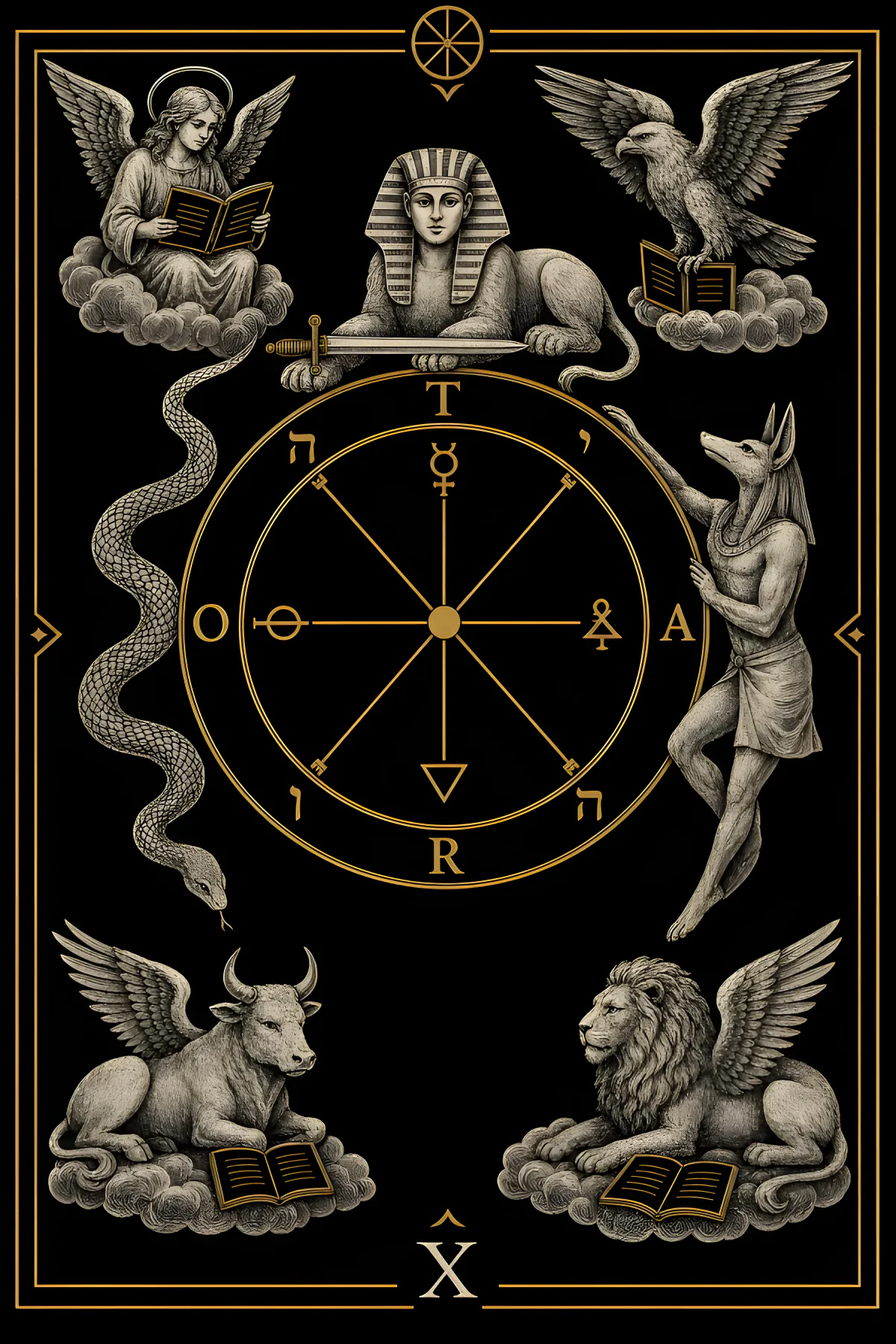
Nine images from the Wheel of Fortune are hidden across the ten sections of this essay. When you come across one, glance back at the card above.
More than two thousand people born back to back
Motif I: The wheel — A great circle with eight spokes, drawn at the center of the card. Everything else gathers around it.If a chart could really decide a person’s life, there would be a way to test it: find people born back to back and see whether their lives resemble each other.
Someone has actually done this. In 2003 Geoffrey Dean and Ivan Kelly published an analysis that drew on a long-term record which had nothing to do with astrology: 2,101 people born in London between March 3 and 9, 1958, with an average of just 4.8 minutes between one birth and the next. These children were measured at ages 11, 16 and 23, and the authors picked out 110 of those measures, including intelligence, personality, occupation and marriage.1
The conclusion was blunt. Two people born back to back did not turn out any more alike for it.
This study can rule out only one kind of “fated”: the kind drawn on the chart. It doesn’t say that life is free. The truly stubborn kind of fate doesn’t come from the stars. It comes from science itself.
The demon and the idler
Motif II: The sphinx — The sphinx lies on top of the wheel, a sword laid across under its paws. The wheel is beneath it, and it doesn’t move at all.In 1814 the French mathematician Laplace, in a small book about probability, imagined an intellect that knows the position of every particle in the universe at this moment and the forces acting on it, and that can do the sums. For such an intellect nothing is uncertain. The future, like the past, lies in plain view.
Later readers named it Laplace’s demon.
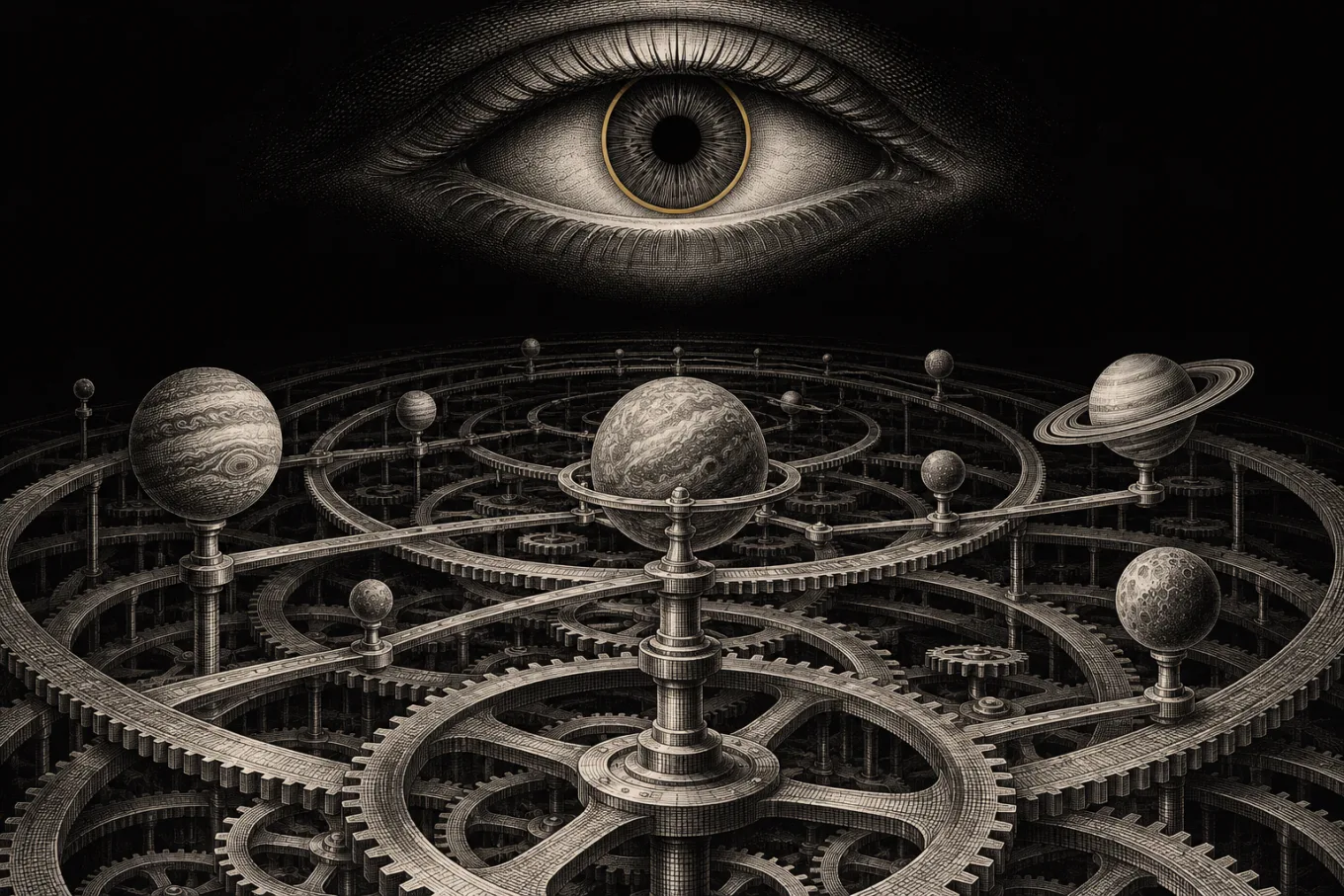
This is determinism. On this view, from the moment you were born, or even the moment the universe began, everything after was already written.
But determinism and fatalism are not the same thing.
There is a famous ancient argument called the Idle Argument, recorded by Cicero in On Fate. It goes like this: if you are fated to recover from your illness, you’ll recover whether or not you call a doctor; if you are fated not to recover, you won’t recover whether or not you call a doctor. So why call a doctor?
The Stoic Chrysippus answered that calling the doctor and getting well are bound together. If you are fated to recover, it is just as much fated that you call the doctor. What you do is itself a link in the chain of causes.
The whole difference is whether you’re counted in.
When “it was settled the day you were born” takes the wind out of people, it’s the first kind at work: whatever you do, the ending is waiting there. Even if the second kind is true, the road to the ending still has to run through you.
The two views do share one thing: both leave the future only one road. A little over a hundred years ago, mathematics produced a third model. Where it came from is even more interesting than the model itself.
A quarrel about free will
Motif III: The books — Four winged creatures each keep watch over an open book. The angel at the upper left has its head bowed, reading.In the early twentieth century, two Russian mathematicians got into a quarrel.
One was Pavel Nekrasov of Moscow, who had studied at a seminary and stood with the Church and the tsar. Statisticians had long since noticed that a society’s yearly counts of marriages and crimes were astonishingly stable. In 1902 Nekrasov offered an explanation. At least as Markov read him, the argument went like this: averages are stable because individual events are independent of one another; and since human actions add up to such stable averages, people must be making their choices independently. In other words, he wanted to draw a mathematical proof of free will out of statistical regularity.
The other was Andrey Markov of St. Petersburg, known for his bad temper, and no believer.2 He thought the reasoning was simply wrong as mathematics. In 1906 he wrote a paper proving that events which are not independent can have stable averages too. To do it he built a new mathematical object: a string of events, each one depending on the one before.
This is what came to be called the Markov chain.
This piece of mathematics, in use everywhere today, was born in a quarrel about free will.
To be clear, Markov did not prove that free will doesn’t exist. He only proved that Nekrasov’s road to it was a dead end.
In January 1913 he did another very patient thing. He copied out the first twenty thousand Russian letters of Pushkin’s Eugene Onegin, stripped out the punctuation and spaces, laid them into two hundred ten-by-ten grids, and counted by hand.
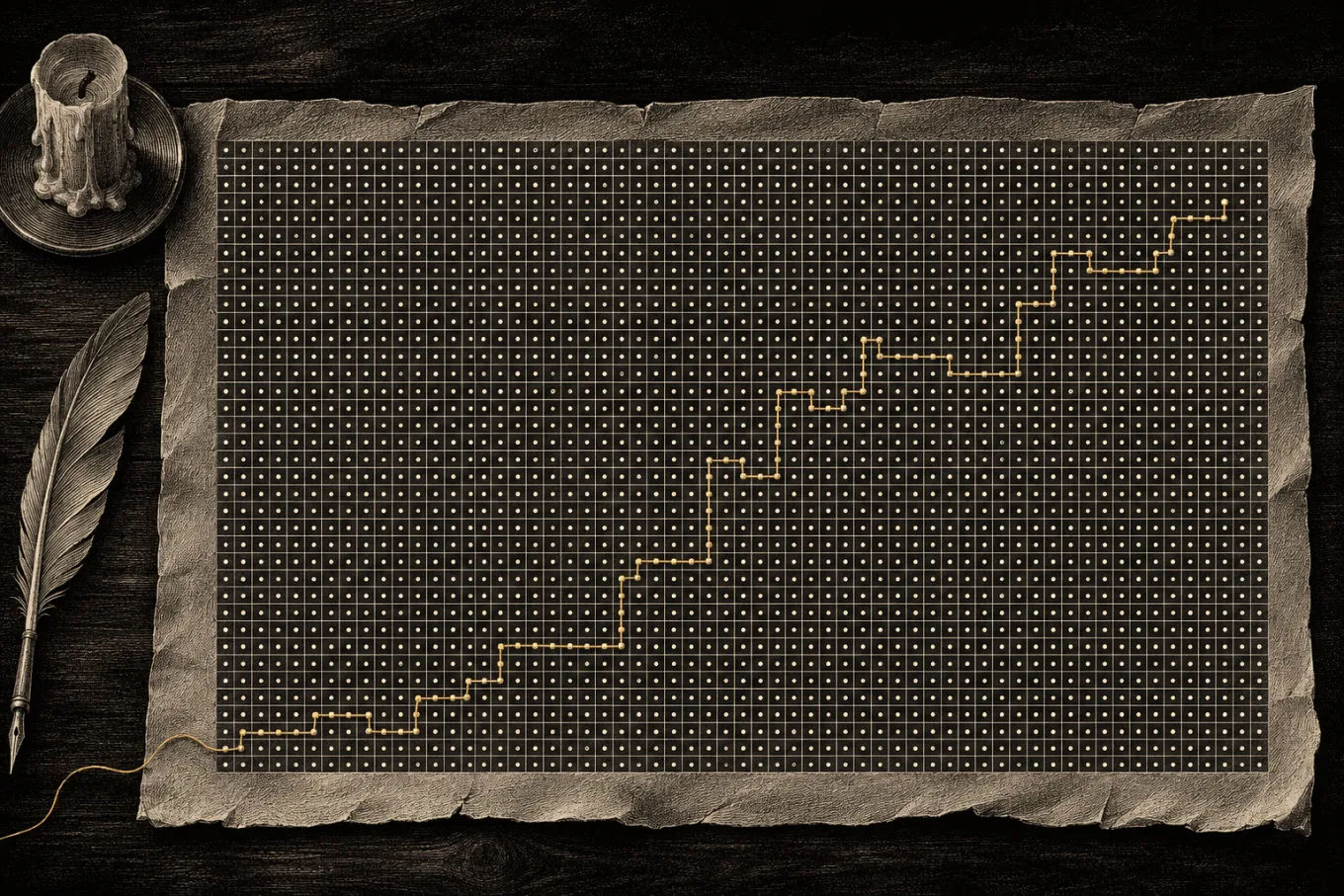
Of the twenty thousand letters, 8,638 were vowels, or 43.2%. If letters had nothing to do with one another, then whatever the previous letter was, the chance of the next one being a vowel should be about 43.2%. What he counted was this: after a vowel, the next letter was a vowel only 12.8% of the time; after a consonant, 66.3%.
Tomorrow looks only at today
Motif IV: The serpent — A serpent winds down from beneath the angel’s cloud, head first, keeping close to the left side of the wheel as it goes.The rule of a Markov chain fits in one sentence: where you go next depends only on the square you’re on now, not on how you got there.
And it doesn’t tell you where you must go next. It only gives you a table: from this square, here is the chance of going to that one.
Put the three views side by side:
- Laplace: the future has only one road; you just can’t calculate it.
- The Idle Argument: the future has only one road, and it has nothing to do with you.
- The Markov chain, as a model: the future has many roads, each with a probability, and those probabilities depend only on where you stand now.
Markov himself had no plans to use it to talk about human lives. That way of asking is ours, and it’s borrowed.
“Only the present counts” is easy to hear as “the past doesn’t matter.” It’s just the opposite. You reached this square by way of every step before it. The past hasn’t gone anywhere; all of it is pressed into today’s square. It just can’t go around today and reach out to touch tomorrow.
Of course, a person isn’t so simple a chain. Neither is real writing: a letter’s influence reaches more than one square ahead. It’s only a model. But what a good model is for is turning a question nobody can quite state into one that can be answered.
“Is it all settled the day we’re born?” can now be asked another way: after walking long enough, does the chain still remember where it started?
Eight times
Motif V: The letters — The rim of the wheel carries four letters: T, A, R, O. Starting from T they read TARO; starting from R, ROTA, Latin for “wheel.”There is one chain every card reader has walked by hand: the shuffle.
The order of a deck at this moment is the square it’s on. One shuffle moves it to the next square, and where it lands depends only on the current order and on how this shuffle goes, not on the order before last. A freshly unsealed deck starts from its factory order. To say a deck is well shuffled is to say the chain has forgotten that start.
So how many shuffles does it take?
In 1992 Dave Bayer and Persi Diaconis gave an answer that could be calculated exactly. They studied the riffle shuffle, where you split the deck in two and let the halves fall interleaved like a zipper. For a 52-card deck of playing cards, the conclusion became a famous number: seven.
What’s most unusual about this result is that things don’t improve gradually. By the yardstick they used, after the first four shuffles the deck is almost as far from truly random as ever; then, within just a few shuffles, the distance collapses.
The formula doesn’t require 52 cards, so I ran it for the 78 of a tarot deck.
After five shuffles the distance is still 0.9996: by this yardstick, barely different from not shuffling at all. By the eighth it has dropped to 0.31. So twenty-six more cards take only one more shuffle.
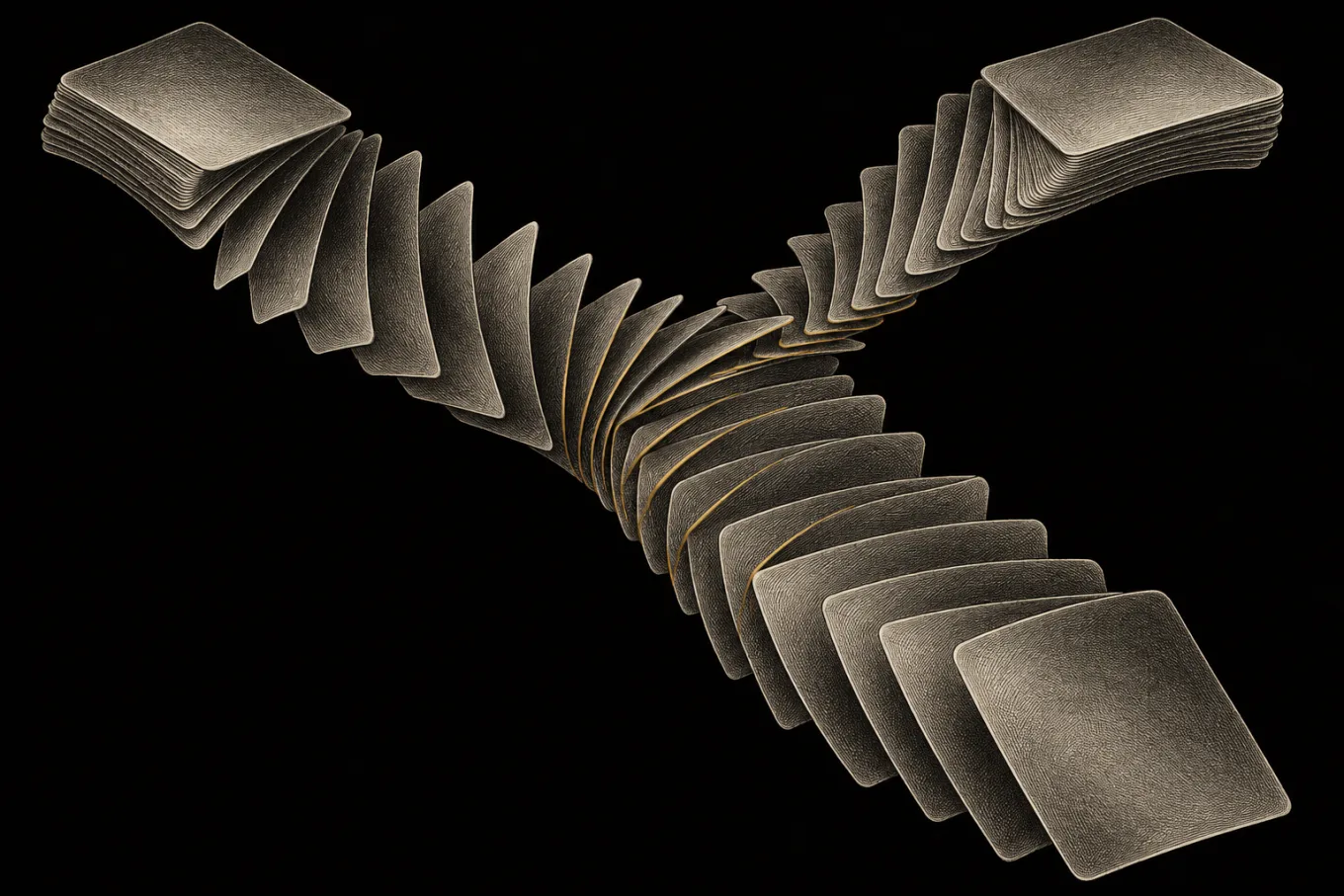
But tarot cards are long and large, and many people don’t riffle them. They use the overhand shuffle, moving a small packet at a time. This way is far slower: it has been proved mathematically that the number of shuffles needed grows roughly with the square of the number of cards, times a logarithm. For 52 cards, the estimates passed around run from a little over two thousand to more than ten thousand, and no one has pinned down an exact figure.3
So if you only give the cards a few casual cuts like this, much of the order from your last reading is still in the deck.
The deck still remembers.
How the cards get shuffled here
Motif VI: The signs — The four spokes carry four small signs, usually identified as mercury, sulfur, water and salt. Together they read like a recipe.Having come this far, I owe you an account of how this site deals its own cards. It does so in more than one way.
The ordinary draw, once you’re signed in, uses an algorithm called Fisher–Yates: starting from the last card, each card swaps once with any card before it (or with itself). It doesn’t need seven or eight passes. After one pass, as long as the random numbers are truly random, every order of the 78 cards is equally likely. The start is completely forgotten in that first pass.
The trouble lies in that “as long as.”
The random numbers in this code come from the browser’s Math.random, which is pseudorandom: a fixed formula working out, step by step, numbers that look chaotic. In Chrome, for example, its internal state is only 128 bits. This has two consequences.
First, from any given state, every number that follows is already settled. If Laplace’s demon lived in your browser, it would know the entire order of this deck.
Second, a 128-bit state allows at most about 3.4 × 10³⁸ possibilities, while 78 cards can be ordered in about 1.1 × 10¹¹⁵ ways. So the orders this site can produce are a sliver of all the possible ones, almost too small to name. (The ten-odd cards you draw at one time have fewer combinations than that, so they don’t run into this limit.)
Still, you tap the card yourself. The cards lie spread face down, in an order the algorithm set, and the algorithm doesn’t know in advance where your finger lands. If you tap “Skip ahead to the reading,” the algorithm stands in for that finger too.
The draw on your first visit, before you’ve signed up, is different. The server draws the cards in advance, using cryptographic-grade random numbers. Whichever card your finger touches, it swaps places with the one already drawn. Here your finger decides when, not which.
The Daily Card isn’t shuffled at all. It puts your account (or, when you’re not signed in, an anonymous ID in your browser) and the day’s date into a hash function, works out a number, and that number maps to a card. Same person, same day: open it as many times as you like and it’s the same card. This card was settled when the day began.
I’m writing all this out because I don’t want you thinking something is choosing this card. It reaches you by way of an algorithm, sometimes with a finger added. No one arranged it.
Further on, I’ll say why I think it’s still worth reading.
When the start counts
Motif VII: The jackal-headed figure — A figure with a jackal’s head clings to the right side of the wheel, both hands gripping the rim.The shuffling chain forgets everything in the end. Not every chain does.
Below are three chains I calculated, eight squares each. Each column is one step, and the brighter the square, the more walkers have ended up there.
The first is determinism with only one road, and it sounds the most like fate. Yet it’s surprisingly fragile: put just a little chance into each step and it begins to forget.
The third is the one to really worry about when people say “settled at birth.” There’s no destiny here. It’s just that some squares can’t be left once you’re in, and which one you’re closer to depends on where you started.
This isn’t only a metaphor. Starting with a 1955 paper by Prais, economists have used transition tables like these to study mobility from one generation to the next.
In 2014, Raj Chetty and colleagues used the tax records of nearly ten million American children born in 1980–82 to work out the table below. Income is divided into five groups of equal size. If parents’ income had no effect on their children, every cell should read 20%.
That’s a long way from 20%. So if you ask me whether a life is settled at birth, the honest answer is: not settled, but not the same for everyone either. And that difference isn’t on a natal chart. It’s on a tax return.
But the table tells us two other things.
First, it isn’t a constant of nature. For the same climb from the lowest group to the highest, the figures this paper calculates or cites are 11.7% for Denmark, 13.4% for Canada, 4.4% for Charlotte and 12.9% for San Jose, both in the US (not all measured in quite the same way). The paper doesn’t make clear what causes these differences, but a table that changes from place to place isn’t carved in the sky.
Second, it’s about groups, not you. 7.5% is not a verdict on any one child.
If you run this table forward generation after generation, the descendants of the poorest and richest families are, three generations on, only about 4% apart by the earlier yardstick. It’s a lovely result, but I don’t quite dare believe it: it assumes the table never changes, and that each generation is affected only by the one before. Gregory Clark, tracing social status through surnames over several centuries, found far slower mobility, though his conclusions are themselves disputed. Real people remember more than a chain that looks back only one square.
The wheel that never stops
Motif VIII: The hub — Eight spokes meet at one point. When the wheel turns, this point alone barely moves.Now we can come back to this card.
The Wheel of Fortune is often read as a saying about luck turning: what goes up comes down, and what’s down comes up. But if it really were a wheel turning strictly, it would be the first chain in that chart: which square you’re on at which moment is written from the first step. That’s the one-road determinism again.
Luckily, there’s no wheel in human life built that tight. There’s always some looseness: someone pauses, someone slips back a square. Each bit of looseness fades the start a little.
In the notes Waite wrote for his own 1909 deck, there’s a line I love. He says the card’s symbolism stands for “the perpetual motion of a fluidic universe and for the flux of human life. The Sphinx is the equilibrium therein.”
He wrote this around 1910. By then Markov had already built his chain, and a few years later he would go on to count letters. The two things have nothing to do with each other. But reading the line today, I think of a concept from Markov chains: the stationary distribution. Once a chain that forgets has walked long enough, each individual keeps moving, yet the overall proportions stop changing. The wheel keeps turning, and something doesn’t move.
This is my own association, of course, not what Waite meant.
This card: the Wheel of Fortune
Motif IX: The ox and the lion — Below, the ox and the lion each lie on a cloud, an open book spread in front of them.Everything you’ve read is on this card
- The wheelChapter 1
- The sphinxChapter 2
- The booksChapter 3
- The serpentChapter 4
- The lettersChapter 5
- The signsChapter 6
- The jackal-headed figureChapter 7
- The hubChapter 8
- The ox and the lionChapter 9
If I had to pair this essay with a card, it could only be the Wheel of Fortune. Its number in the Major Arcana is ten.
Almost everything on this card can be found in this essay. The wheel is a chain’s state diagram. The serpent going down and the jackal-headed figure going up are both just moving from one square to the next. The letters on the rim, read from a different place, become a different word, much like the order of a deck. The sphinx lies on top, watching it all turn and not moving at all, like the intellect that knows everything, and like the proportions that no longer change. The four creatures each keep watch over an open book.
Some read this card as luck, some as fate. I’d rather read it as a map: it doesn’t tell you which square comes next. As you read it, you can think about which square you’re standing on right now.
If you’d like to see the card’s other meanings, open the Wheel of Fortune page.
Mysticism or science
So is this mysticism or science?
My answer: shuffling is science, reading is mysticism.
I don’t want to be vague about this. So far there is no reliable evidence that a card or a chart can tell you what will happen in the future. Lunarcana is a manuscript for reading and for thinking; it’s for entertainment and self-reflection, not for telling you your fate.
Then why draw a card at all?
I think it’s because randomness has a benefit that rarely gets mentioned: it doesn’t flatter you. Left to choose for yourself, you’ll always pick the things you’ve already thought about. A card that lands in front of you at random makes you look at where you are from an angle you hadn’t prepared for. Whether it “hit” doesn’t matter. What matters is what came to mind as you read it.
As for whether a life is settled at birth: for the “settled” of the natal chart, I found no evidence. The “not the same” of the tax return is real, and it isn’t the same everywhere. And the hardest determinism, even if it’s true, still has to run its road through you.
The past doesn’t disappear. It can only go on acting through today.
Shuffling is science, reading is mysticism, and what stands between them is you.
The next time you shuffle, maybe give it a few more, so it can forget the last reading.
You aren’t a deck of cards; you can’t shuffle eight times and start over. But you aren’t only a deck of cards, either. Before the next step, you can always first take a look at which square you’re standing on.
The engraved illustrations in this essay were drawn with AI assistance and are not historical images. The charts were calculated or compiled from the formulas and public data cited in the text.