
The book already written
Is it all settled the day we’re born? How the people who believed it have lived, for more than two thousand years
Nearly every civilization has imagined a book already written. What I’m more curious about is how the people who believed in it got out of bed the next morning.
In Ming China there was a scholar named Yuan Huang. As a young man, at his mother’s wish, he gave up his studies to learn medicine, and at a temple he met an old man named Kong. The old man urged him back to his books, said he had received the authentic method of Shao Yong’s Huangji calculations, and worked out Yuan Huang’s whole life for him.
It came as a list, and a very specific one. The old man began with three examinations: fourteenth place in the county exam, seventy-first in the prefectural, ninth in the provincial. By Yuan Huang’s own account, when he sat them the following year, all three placings were right. Then the old man went on to the rest of his life: the year he would receive a student’s stipend, the year he would become a tribute student; then a post as a county magistrate in Sichuan, where after three and a half years he should go home; death at home at fifty-three, in the small hours of the fourteenth day of the eighth month; no son.
All of this he wrote down himself, in Liaofan’s Four Lessons. I want to start from that story, walk through what people have said about being fated over more than two thousand years, and come back around to him. Last issue, How many shuffles until a deck forgets its past, was about math. This one is about people.
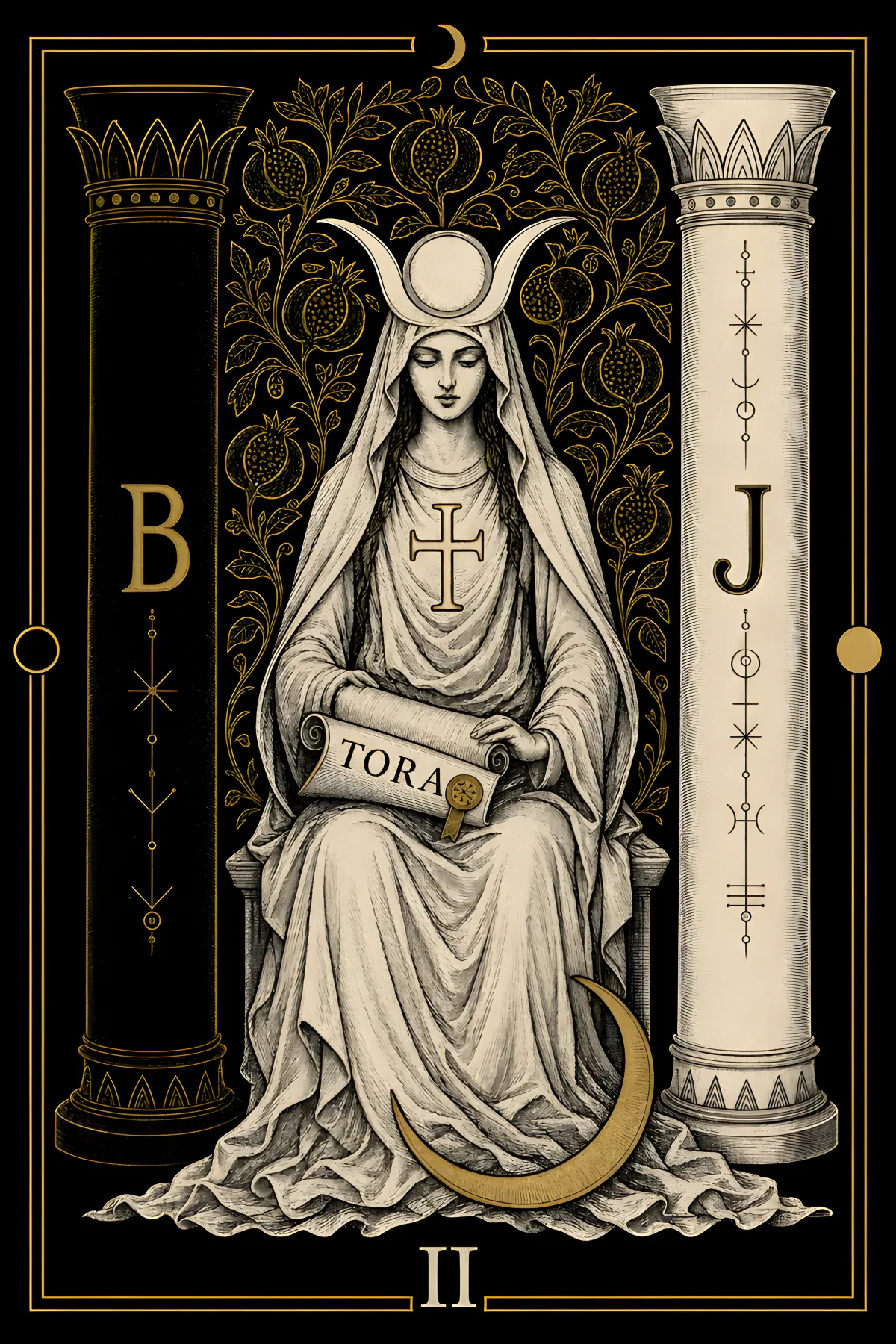
Nine images from the High Priestess are hidden across the ten sections of this essay. When you come across one, glance back at the card above.
A man who had already read it
Motif I: The scroll — A scroll lies in her lap, half rolled, with both hands pressed on it.He says that from then on, at every examination, his place never fell outside the range the old man had named. Even the amount of stipend grain he had to draw before he could become a tribute student came out exactly as calculated. Yuan Huang wrote:
Because of this I believed all the more that advancement and retreat are decreed and that early and late have their set times, and I grew serene and sought nothing.
Later he went to the capital and stayed for a year, and there, he writes, he “sat in stillness all day and did not read a word.”
This scene deserves a longer look. A scholar in his thirties, holding a list of his own life: which post in which year, on which day he stops breathing. For that whole year he doesn’t read, and he isn’t in any hurry. To anyone watching, it probably looked a lot like self-cultivation.
Let me set him aside for now. His story has another half.
Settled the day you’re born
Motif II: The two pillars — She sits between two pillars, black on the left and white on the right, marked B and J.“Is it all settled the day we’re born?” In China, people answered that outright very early on, and their answers flatly opposed each other.
Wang Chong, of the Eastern Han, said yes. In the Lunheng he wrote that each person is born by receiving a portion of qi: “receive nobility and you are noble, receive lowliness and you are lowly.” Rank and wealth, he says, “are all set at the moment of first receiving, and do not arrive later on, after you are grown, according to your conduct.”
This is the closest I’ve found in an old text to “settled the day you’re born.” Wang Chong was no credulous man. He said the whole Lunheng comes down to one phrase, “hatred of falsehood,” and many of its chapters argue against the ghosts and portents popular in his day. Yet close on the heels of “receive lowliness and you are lowly,” he also says that high and low rank “are all bestowed by the high and low, great and small places of the stars.” My guess is he felt that good people so often going unrewarded needed some explanation.
More than four hundred years before him, Mozi was already standing under the other pillar. The “Against Fate” chapters of the Mozi report what the believers in fate said: “Fated to be rich, you are rich; fated to be poor, you are poor,” and “Against fate, what good is strength, however great?”
Mozi did argue about whether fate exists at all: from ancient times to now, who has seen what it looks like, who has heard its voice? But he put more of his effort into a different question: if people believe this, what happens?
His answer: “Those above will not govern, and those below will not work.” So this kind of talk, he says, is “a great harm to the whole world.”
It’s nearly the same worry as the Idle Argument from last issue. If you’re fated to recover, why call a doctor? One in ancient Greece, one in ancient China, and both hit on the same thing.
Mozi’s second question is really the one this essay wants to ask.
Blossoms falling from a tree
Motif III: The pomegranates — Behind her is a spread of vines and pomegranates. Some have split open, showing the seeds inside.Some people stood at neither pillar.
Under the Southern Qi, Xiao Ziliang, the Prince of Jingling, was a devout Buddhist. He put a question to Fan Zhen, one of the guests of his household: you don’t believe in karmic cause and effect, so why are some people in this world rich and honored and others poor and lowly?
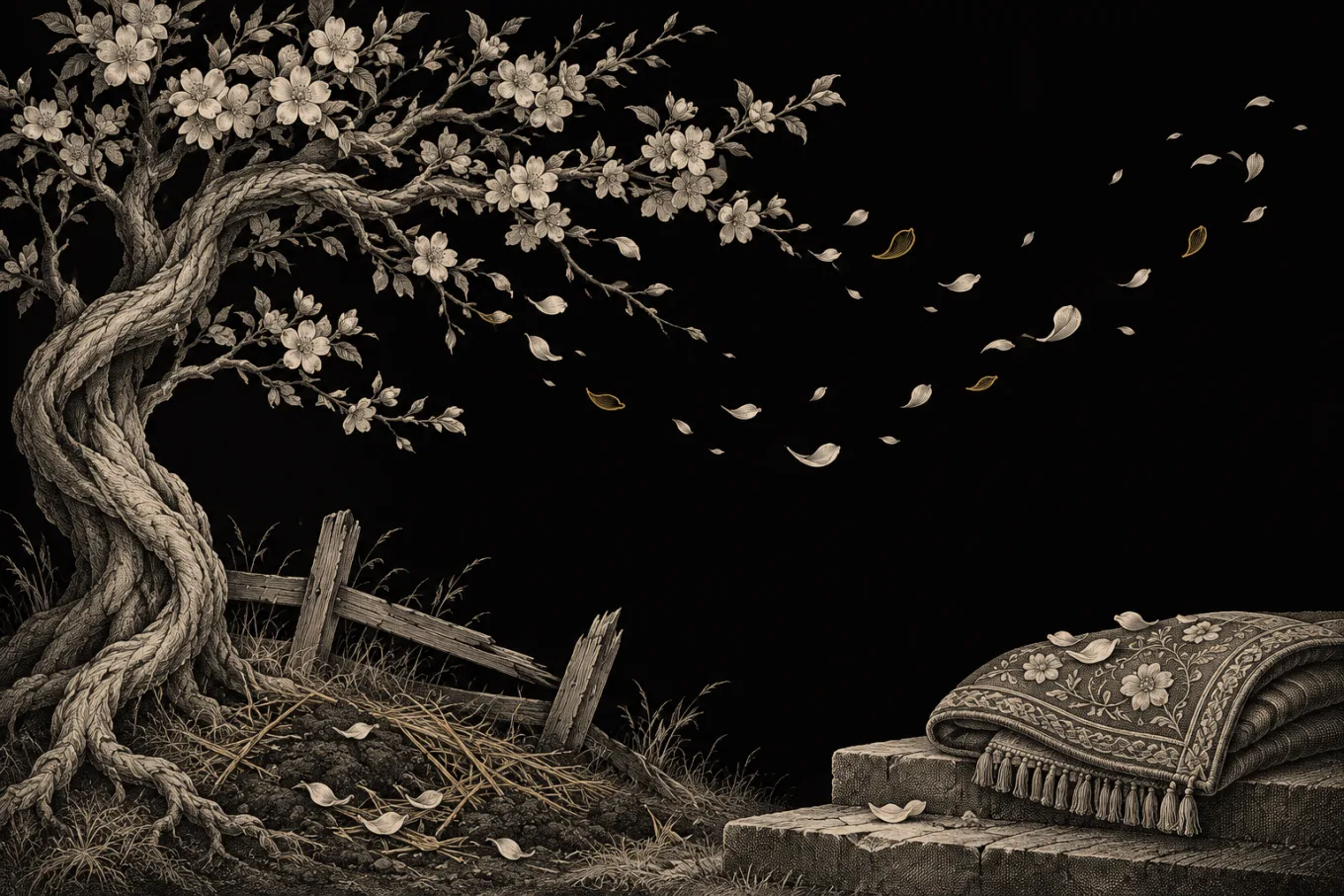
As the History of the Southern Dynasties tells it, Fan Zhen replied that human lives are like blossoms on one tree, opening together and scattered by the wind. Some brush past the curtains and land on a mat. Others clear the fence and drop into a cesspit.
The one that falls on the cushioned mat is Your Highness; the one that lands in the cesspit is your humble servant. High and low have gone their different ways, but where in this is cause and effect?
A guest of the household, saying this to a prince’s face: that took nerve. And his answer differs from both Wang Chong’s and Mozi’s. Not fate, and not the fruit of effort, but wind.
Fan Zhen’s view is actually harder to accept than fatalism. Fate at least has some arrangement behind it. The wind arranges nothing.
The ball of thread that runs out
Motif IV: The small marks — Both pillars carry a row of small marks, running from top to bottom in one line.India, too, had a thoroughgoing school of fatalists, the Ajivikas. Almost none of their writings survive. What we know comes mostly from the reports of rivals such as the Buddhists and the Jains, and I should say so up front.
The Samaññaphala Sutta, in the Dīgha Nikāya of the Theravada canon, records the teaching of their leader, Makkhali Gosala: the defilement and purification of beings have no cause; pleasure and pain have been measured out in advance, and the round of rebirth has a fixed length.
It is like throwing a ball of thread: it unwinds as it rolls, and when the thread is gone, it has reached its end.
Fools and the wise alike go this way. They walk the distance, and then their suffering ends.

Interestingly, according to their rivals’ accounts, the practitioners of this school did not lie down and give up. They were known for their austerities.
The Buddha criticized this teaching severely. Something often gets mixed up here: karma as Buddhism teaches it is not fate. In the sutras the Buddha argues against the claim that “everything is determined by deeds done in the past,” for nearly the same reason as Mozi: if everything has already been decided by the past, a person has no reason to want to do this or to refrain from that.
So when people today say “that’s my karma” and mean “it’s all settled anyway,” that is exactly the view the Buddha disagreed with.
Tomorrow’s sea battle
Motif V: The crescent moon — At her feet lies a crescent moon, not yet full.So far, fate has always needed something to work through: qi, the stars, the measured-out round of rebirth. The trouble Aristotle raised needs none of that. It needs only a sentence and whether that sentence is true or false.
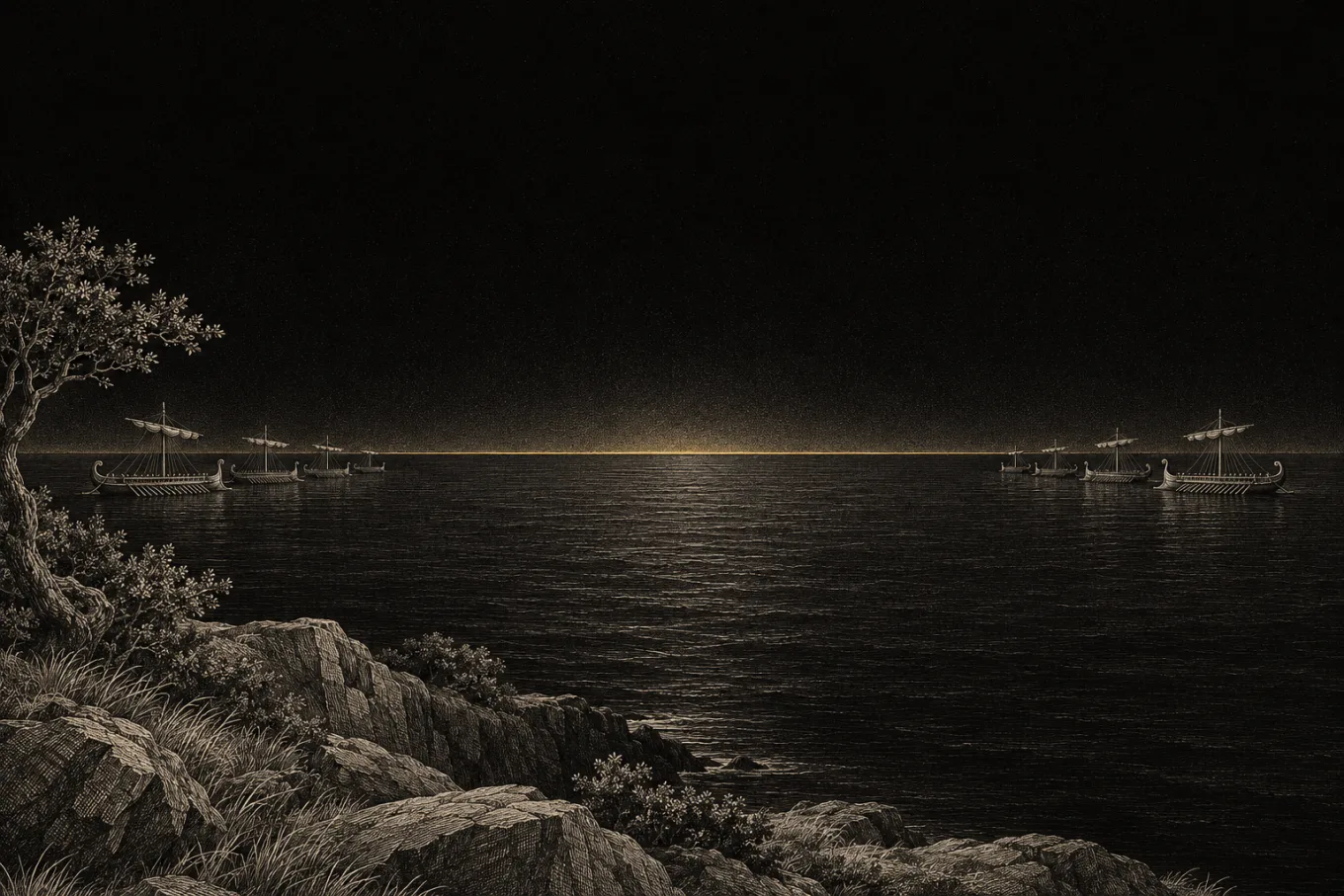
In chapter 9 of De Interpretatione he asks: is the sentence “There will be a sea battle tomorrow” true or false today?
If it’s true today, tomorrow’s battle has to happen. If it’s false today, the battle can’t happen. Either way, it seems, the people of tomorrow don’t get a say.
Aristotle himself didn’t accept this conclusion. If it held, he said, people would have no need to deliberate or to take trouble over anything. How he actually resolves the puzzle has been argued over for more than two thousand years. One common reading is that a sentence about the future doesn’t yet have a definite truth value today.
What’s so formidable about this argument is that it doesn’t even need a book. As long as the phrase “what’s going to happen” makes sense, the book already seems to be written.
Waiting on the verdict
Motif VI: The cross — On her chest is a gold cross.The doctrine that took this book most seriously was probably Christian predestination.
From Augustine on, some have held that whether a person is saved depends not on their own merit but on God’s election. In the sixteenth century Calvin put it more severely still: who is saved and who is not comes from God’s eternal decree, and nothing a person does can change it.
By the Idle Argument, this should be the most disheartening doctrine in the world. If nothing you do makes a difference, why not lie down and give up?
But in 1904–05 the German sociologist Max Weber put forward a famous idea: things went just the other way. In his account, Calvin’s followers could not be saved by their deeds, yet they badly wanted to know whether they were among the chosen. And no one could tell them. So they took diligence, restraint and tireless work as signs of their own election. They weren’t working to be saved. They were working to be sure. Weber saw an elective affinity between this cast of mind and the spirit of modern capitalism.
The idea is heavily disputed. Some scholars argue that believers at the time weren’t that anxious, and that too is still debated. In 2015 Davide Cantoni tested it against long-run population data for 272 cities in German-speaking lands and found no effect of Protestantism on economic growth. (Most of those cities were Lutheran; only 21 were Calvinist, and looking at those alone turned up nothing either.) In German-speaking lands at least, Weber’s grand causal story probably did go too far.
But the possibility he raised still seems to me worth thinking about: believing it’s all settled doesn’t necessarily make a person lie down.
The Islamic tradition has had the same debate. In the early disputes, some held that people determine their own actions, and some were accused of holding that human acts are wholly determined by God. Later the Ash’arites used the idea of “acquisition” (kasb), often regarded as a compromise. A widely known hadith, in Tirmidhi’s collection, has someone ask the Prophet: should I tie my camel and then trust in God, or leave it untied and trust? The answer: tie it, then trust.
It may be the shortest reply to the Idle Argument I’ve read.
The book in physics
Motif VII: The lunar crown — On her head is a disk held between a pair of curved horns, as if the moon’s waxing and waning had been set side by side.Today this book has one more edition, and it comes from physics rather than theology.
Special relativity tells us that “at the same time” isn’t absolute: two people moving relative to each other disagree about which events are happening “now.” In 1966 and 1967, Rietdijk and then Putnam argued from this that if everything happening “now” for some observer is real, then someone else’s future may already be there too. Past, present and future may all exist equally. This picture is often called the “block universe.”
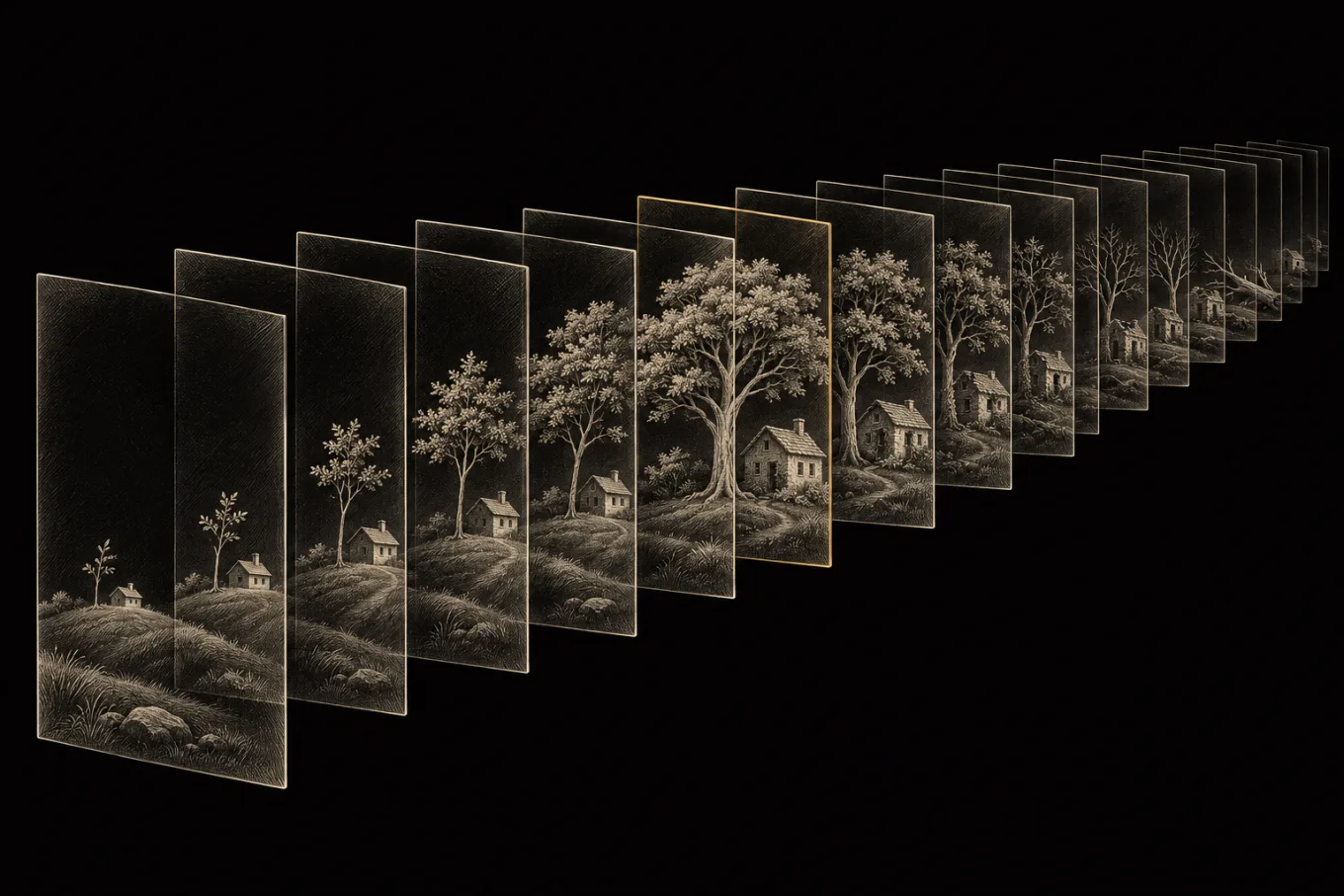
After his old friend Besso died, Einstein wrote to Besso’s family, and the letter has an often-quoted line: the distinction between past, present and future is only a stubbornly persistent illusion.
This picture isn’t settled either. Its premises have been questioned all along, and it speaks only to the structure of spacetime. It doesn’t say that nothing you do matters. Your hesitation at this moment is in the block too, and so is the decision you make next, just as the outcome is. That is exactly the answer Chrysippus gave in the last issue: calling the doctor is part of the book as well.
As for whether quantum mechanics leaves real randomness in the future, physicists still don’t agree. It depends on which interpretation you accept.
So whether this book exists, I don’t know. No one does. I’ve gradually come to think this may not be the most pressing question.
After he’d read it
Motif VIII: The lowered eyes — Her eyes are lowered. She isn’t looking at you.Now back to Yuan Huang.
After his year of sitting in the capital he came back south. Before entering the Imperial Academy at Nanjing, he first went up Qixia Mountain to visit the Chan master Yungu. The two sat facing each other for three days and three nights, and not one stray thought arose in him. Yungu asked him how he had done it.
Yuan Huang said: my whole life has already been worked out by Mr. Kong. Honor and disgrace, life and death, all have their fixed measure. Thinking would do no good, so there is nothing to think about.
Yungu laughed. “I took you for a hero. It turns out you are only an ordinary man.” He went on to tell him: “Fate is of my own making; blessings are mine to seek.” So Yuan Huang changed his literary name to Liaofan, roughly “done with the ordinary,” and began keeping a daily record of his good deeds and his faults.
Here’s how it ended. He later passed the highest examination and became a jinshi. He served as magistrate of Baodi County, not in Sichuan. He had a son and named him Tianqi. The year he was fifty-three passed without incident. By the time he wrote these lines he was sixty-nine.
I want to be clear: the degree, the post and the son can be found in other records; the list itself rests on his own account alone, and that account was written as family instruction to his son. We have no way of checking whether those placings were really so accurate. And whether doing good truly changed his fate isn’t something I can prove. I don’t believe this story proves that fate can be changed, and I don’t believe it proves that fate can be calculated.
But one thing holds without the list having to be true at all: the list changed him.
In 1948 the sociologist Robert Merton gave this kind of thing a name: the “self-fulfilling prophecy.” He invented a bank that was perfectly healthy. Once everyone believes it is failing and rushes to withdraw their money, it really does fail. A statement that wasn’t true becomes true because people believe it.
Tell a man he’ll never pass that examination and never have a son, and if he truly stops trying, that list really is more likely to come true.
Now set the two side by side. Both believed it was all settled. Liaofan sat down quietly; the Calvinists as Weber describes them worked themselves to the bone. I thought about this for a long time, and I think the difference comes down to something very small: Liaofan thought he had read the book, and they knew they never could.
This card: the High Priestess
Motif IX: One empty, one filled — On either side of the card is a small circle: the left one empty, the right one gold.Everything you’ve read is on this card
- The scrollChapter 1
- The two pillarsChapter 2
- The pomegranatesChapter 3
- The small marksChapter 4
- The crescent moonChapter 5
- The crossChapter 6
- The lunar crownChapter 7
- The lowered eyesChapter 8
- One empty, one filledChapter 9
If I had to pair this essay with a card, I’d choose the High Priestess. Her number in the Major Arcana is two.
The scroll in her lap is the very book this essay has been about. In the notes Waite wrote for his 1909 deck, he says of the scroll in her hands that it is “partly covered by her mantle, to show that some things are implied and some spoken.” On this card it lies half rolled, with both hands pressed on it.
She doesn’t unroll it for you, and her own eyes are lowered. The pomegranates behind her have split open; you can see the seeds, but not all of them. The two pillars, one black and one white, are like Wang Chong and Mozi. She sits between them and speaks for neither.
I used to think what she guarded was an answer. Now I’d rather read her as a reminder: the book may exist or it may not, but she isn’t going to read it to you.
If you’d like to see the card’s other meanings, open the High Priestess page.
Why this site won’t tell you
Having come this far, I want to say something about this site.
Lunarcana doesn’t tell you what’s going to happen. It won’t say who you’ll meet, or in what year, and it won’t answer your question with a “yes” or a “no.”
One reason is simple: so far there is no reliable evidence that a card or a chart can do this, as I wrote last issue. Lunarcana is for entertainment and self-reflection.
But after writing this essay, I found another reason. Even if someone really could read that book aloud, I wouldn’t want this site to do it. It’s easy to ask things like: Will this relationship go anywhere? Will I get this job? In the moment of asking, what you want is an answer. But an answer may well be the list in Yuan Huang’s hands.
All a card can do is set a question in a place you hadn’t thought to look.
“Written” is not the frightening part. The frightening part is believing you’ve “read” it.
The book may exist or it may not. Either way, no one has read it.
Is it all settled the day we’re born? After more than two thousand years the question still has no answer, and I’m not going to pretend it does.
But if you have to get up tomorrow anyway, then get up. Tie your camel, and open the book you meant to read today.
The engraved illustrations in this essay were drawn with AI assistance and are not historical images. The classical passages come from Liaofan’s Four Lessons, the Lunheng, the Mozi and the History of the Southern Dynasties.